What a Hydraulic Pressure Test Bench Does
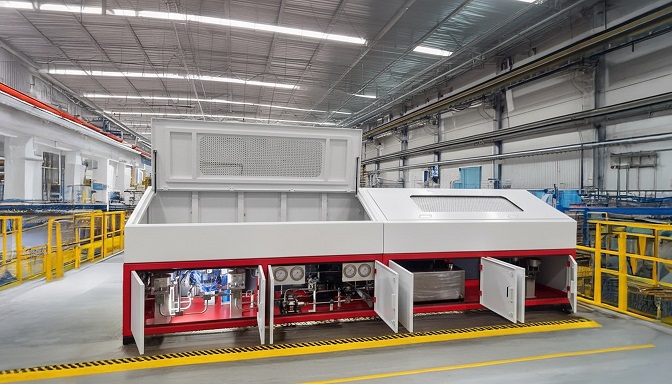
A hydraulic pressure test bench generates, controls, and measures hydraulic pressure to test components and assemblies. Core functions include:
- Proof pressure testing — applying a defined overload pressure (typically 1.5x working pressure) to verify structural integrity without permanent deformation
- Burst pressure testing — applying increasing pressure until failure to characterise maximum strength
- Leak testing — holding pressure for a defined period while monitoring for pressure decay
- Functional testing — operating the component (valve, actuator, pump) under controlled pressure and flow conditions while measuring performance parameters
- Impulse/fatigue testing — cycling pressure repeatedly to verify long-term durability
Key Components of a Modern Hydraulic Test Bench
Hydraulic power unit (HPU) — motor-driven pump providing the required flow rate and pressure. Servo-controlled variable displacement pumps allow precise pressure and flow control.
Pressure control system — proportional pressure relief valves or servo valves regulate test pressure. Closed-loop control maintains pressure to within 0.1% of setpoint.
Instrumentation — calibrated pressure transducers, flow meters, and temperature sensors. All must be traceable to national standards (NIST, NPL, PTB).
Safety systems — automatic pressure relief, burst disc protection, blast shields, and interlocked guards. Mandatory for compliance with EN 13849 (machinery safety, Europe) and OSHA 29 CFR 1910 (USA).
Data acquisition — PLC or PC-based DAQ captures all parameters at defined sampling rates. Test results are logged automatically with timestamps for traceability.
International Compliance Standards
| Standard | Region | Scope |
|---|---|---|
| ISO 10100 | International | Hydraulic cylinders, acceptance tests |
| ISO 4413 | International | Hydraulic fluid power, safety rules |
| EN 13849-1 | Europe | Safety of machinery, control systems |
| ASME B31.3 | USA | Process piping pressure testing |
| MIL-H-5440 | USA/NATO | Military hydraulic systems |
| NAS 1638 | USA/International | Hydraulic fluid cleanliness (aerospace) |
Applications by Industry
Aerospace and Defence: Landing gear actuators, flight control hydraulics, weapon system actuators, and airborne hydraulic pumps are all tested on certified hydraulic test benches. MIL-H-5440 and NAS 1638 cleanliness requirements are mandatory for military hydraulics.
Oil and Gas: Subsea valves, BOP components, and wellhead equipment are hydro-tested per ASME B31.3 and API 6A requirements before deployment.
Automotive: Brake system components, power steering assemblies, and transmission hydraulics are tested per SAE and OEM-specific standards.
Industrial Machinery: Hydraulic press cylinders, injection moulding machine hydraulics, and CNC machine tool actuators are proof-pressure tested per ISO 10100.
Railways: Hydraulic dampers and suspension components for rail vehicles are tested per EN 13480 and UIC standards.
Neometrix Hydraulic Pressure Test Bench
The Neometrix Hydraulic Pressure Test Bench is a computer-controlled test system for proof pressure, burst, leak, and functional testing of hydraulic components across aerospace, defence, oil and gas, and industrial applications. Features include closed-loop servo pressure control, PLC-based data acquisition, safety-interlocked test cell design, and automated test reports for ISO 4413, ASME, and MIL-STD compliance.
View Specifications | Request a Quote
FAQ
Q: What is the difference between proof pressure testing and burst pressure testing?
A: Proof pressure testing applies a defined overload pressure (typically 1.5x rated working pressure) and verifies no permanent deformation or leakage occurs. Burst pressure testing increases pressure until component failure, used for design validation.
Q: What standard applies to hydraulic cylinder acceptance testing?
A: ISO 10100 specifies acceptance tests for hydraulic cylinders including proof pressure test, load efficiency test, external leakage test, and cushion performance test.
Q: What is ISO 4413 and does it apply to test benches?
A: ISO 4413 is the international standard for safety rules for hydraulic fluid power systems. It applies to hydraulic test benches as well as production hydraulic systems.
Q: What safety standards apply to hydraulic test benches in Europe?
A: EN 13849-1 and EN ISO 4413 are the primary standards. The Machinery Directive 2006/42/EC requires hydraulic test equipment sold in the EU to comply with EN 13849 and bear CE marking.
Q: What fluid cleanliness level is required for aerospace hydraulic testing?
A: NAS 1638 Class 6 or cleaner is typically required. Test bench hydraulic circuits must be flushed and verified to the required cleanliness level before use, with particle count documentation.