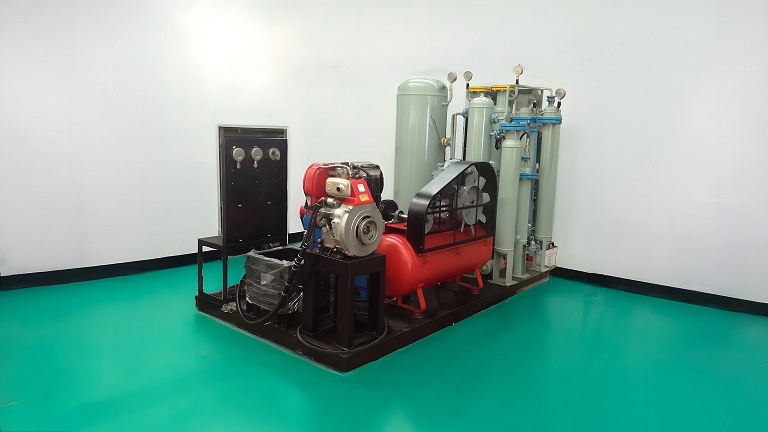

Industrial facilities in remote locations, forward military bases, offshore platforms, and industrial sites far from gas supplier infrastructure face a common challenge: they need nitrogen — for inert atmospheres, purging, charging, testing, and preservation — but cannot depend on delivered gas cylinders to be reliably available when needed. The logistics of cylinder management, the cost of delivered gas at remote locations, and the operational vulnerability of depending on external supply chains all point toward the same solution: on-site nitrogen generation.
A self-contained, diesel-driven nitrogen generation plant with integrated air compressor, PSA separation module, and hydraulic booster produces high-purity nitrogen (up to 99.9%) at pressures up to 200 bar — entirely independently of electrical grid infrastructure, gas supplier logistics, or existing compressed air systems.
How the System Works — From Air to High-Pressure Nitrogen
Stage 1 — Air compression: A diesel engine drives a two-stage air compressor that takes ambient air and compresses it to the pressure needed by the PSA (Pressure Swing Adsorption) separation module. Pre-filtration removes water, dust, and oil carryover from the compressed air before it enters the separation system.
Stage 2 — Moisture removal: A heatless regenerative desiccant dryer removes moisture from the compressed air to the dew point required by the PSA molecular sieves — typically -40°C or lower. Activated carbon filters remove residual oil vapour.
Stage 3 — PSA nitrogen separation: The twin-tower PSA module uses molecular sieve (zeolite) adsorbent that selectively adsorbs oxygen from compressed air when under pressure, allowing nitrogen to pass through. As one tower adsorbs oxygen (producing nitrogen), the other tower regenerates by venting — creating a continuous nitrogen flow. Output purity is controlled by adjusting adsorption/desorption cycle timing and pressure.
Stage 4 — Surge storage: Generated nitrogen at approximately 5.8 bar is stored briefly in a surge tank that buffers flow rate variation between the PSA cycle and the booster input, ensuring stable feed to the hydraulic booster.
Stage 5 — Hydraulic boosting: A hydraulically driven piston booster amplifies the 5.8 bar PSA output to 200 bar — suitable for direct cylinder filling or high-pressure system charging. The hydraulic power pack driving the booster is integrated into the same skid.
Stage 6 — PLC control: A Siemens PLC manages the complete automated sequencing — PSA cycle timing, booster operation, safety interlocks, pressure monitoring, and alarm management — allowing largely unattended operation once initiated.
Key Specifications
| Parameter | Specification |
|---|---|
| Nitrogen purity | Up to 99.9% |
| Output pressure | Up to 200 bar |
| PSA intermediate pressure | ~5.8 bar |
| Drive system | Diesel engine (Greaves Cotton or equivalent) |
| Air compressor | Two-stage |
| Moisture removal | Heatless regenerative desiccant dryer |
| Control | Siemens PLC with automated sequencing |
Applications
Remote and off-grid industrial operations: Mining, construction, and remote processing facilities requiring nitrogen for inert atmospheres, purging, and pneumatic testing without cylinder delivery infrastructure.
Forward military deployments: Military forward operating bases requiring nitrogen for aircraft systems (tyre inflation, strut charging, system purging), weapon system maintenance, and pneumatic testing — without supply chain vulnerability.
Laboratory and test facilities: R&D facilities, testing laboratories, and educational institutions requiring on-site nitrogen supply for controlled atmosphere applications, analytical instrumentation, and component testing without dependency on gas supplier delivery schedules.
Industrial gas replacement: Facilities currently purchasing nitrogen cylinders or bulk liquid nitrogen that wish to reduce recurring costs and supply dependency by generating nitrogen on-site from ambient air.
Maritime and offshore: Ships and offshore platforms requiring nitrogen for tank inerting, system charging, and maintenance — where delivered gas cylinders are impractical or prohibitively expensive.
International Standards Referenced
| Standard | Relevance |
|---|---|
| ISO 8573-1 | Compressed air quality classes — informs inlet air quality requirements |
| MIL-PRF-27401 | Nitrogen purity specification for aircraft applications |
| EIGA IGC Doc 121 | Safe handling of nitrogen (European Industrial Gases Association) |
| NFPA 55 | Compressed gases and cryogenic fluids (USA) |
Neometrix Manual Nitrogen Generation Plant
A self-contained, diesel-driven skid-mounted system integrating a two-stage air compressor, heatless desiccant dryer, twin-tower PSA module, surge tank, hydraulic power pack, and piston booster to produce up to 99.9% purity nitrogen at 200 bar. Siemens PLC-automated sequencing for reliable unattended operation. Designed for off-grid and remote deployment.
FAQ
Q: What is PSA nitrogen generation and how does it work?
A: PSA (Pressure Swing Adsorption) nitrogen generation uses molecular sieve adsorbent — typically zeolite — that preferentially adsorbs oxygen from compressed air when under pressure. In a twin-tower system, one tower adsorbs oxygen while the other regenerates by pressure release, creating a continuous nitrogen output. Purity is controlled by cycle timing and pressure: longer cycles at higher pressure produce higher purity but lower flow rate. PSA can achieve up to 99.9% nitrogen purity, suitable for most industrial and laboratory applications.
Q: Why is a hydraulic booster used rather than a mechanical piston compressor to reach 200 bar?
A: A hydraulically driven piston booster amplifies the PSA output pressure (approximately 5.8 bar) to 200 bar using a differential piston area principle — hydraulic pressure acting on a large-area piston drives a small-area gas piston to generate much higher gas pressure. This approach is simpler, more reliable, and more compact than a dedicated gas compressor stage for the boost function, and integrates naturally with the hydraulic power pack already included for other system functions. It also produces no additional heat in the nitrogen circuit since it is a mechanical compression rather than a rotary process.
Q: What nitrogen purity is required for aircraft system applications?
A: MIL-PRF-27401 specifies nitrogen purity of at least 99.5% for aircraft system use, with maximum moisture content (dew point ≤ -40°C) and maximum oxygen content. A PSA plant producing 99.9% purity comfortably exceeds this requirement. The moisture removal stages (heatless desiccant dryer and molecular sieve filters) are essential to meeting the dew point specification — raw PSA output without drying would not meet aircraft-grade nitrogen purity.
Q: How does a self-contained diesel-driven plant eliminate supply chain dependency?
A: The plant takes ambient air as its feedstock — available anywhere — and uses diesel fuel (universally available even in remote locations) as its energy source, requiring no electrical grid connection. This means nitrogen production is completely independent of gas supplier delivery schedules, compressed air infrastructure, or electrical supply. For forward military deployments, offshore operations, or remote industrial sites, this eliminates the logistics vulnerability of depending on cylinder deliveries.
Neometrix Defence Ltd. designs and manufactures manual nitrogen generation plants for remote, military, and industrial on-site nitrogen requirements. [email protected] | +91-7777-876-876