
High-power rotating test facilities — used for cyclic fatigue testing of gearboxes, transmission components, shaft assemblies, and rotating machinery — place extreme demands on their lubrication systems. At 1000 HP (approximately 746 kW) and high rotational speeds, bearing and gear mesh temperatures, oil flow requirements, and the criticality of uninterrupted lubrication are all substantially greater than in standard industrial machinery. A lubrication system failure on a high-speed, high-power test facility doesn’t just halt the test — it can cause catastrophic bearing or gear failure, destroying expensive test articles and the test facility itself.
A suction lubrication system for a high-power cyclic spin test facility is the dedicated oil supply, filtering, cooling, and monitoring subsystem that maintains continuous, clean, temperature-controlled oil delivery to the test rig’s critical tribological interfaces throughout the demanding cyclic test profiles these facilities run.
What Makes High-Power Cyclic Spin Testing Demanding for Lubrication
High rotational speeds: High-speed spindles, gear meshes, and bearings at 1000+ HP generate heat rapidly. Oil must flow at sufficient rates to carry this heat away before bearing temperatures reach damaging levels.
Cyclic loading profiles: Unlike steady-state industrial machinery, a cyclic spin test facility repeatedly accelerates and decelerates, applies and releases torque loads, and cycles between operating conditions. These transients create varying oil demand, varying heat generation, and dynamic pressure changes in the oil circuit that a static lubrication system cannot adequately handle.
Critical test articles: The components under test in a high-power facility are typically expensive — gearboxes from aircraft transmissions, vehicle drivetrains, or industrial machinery — and any lubrication-related failure damages irreplaceable test specimens.
Continuous operation duration: Cyclic fatigue tests run for millions of cycles, which can mean weeks or months of continuous operation. Lubrication reliability must be extremely high throughout.
Core Functions of a Suction Lubrication System
Oil supply at controlled pressure and flow: A precision pump delivers oil to the bearing housings, gear meshes, and shaft seals at the flow rates and pressures specified for the test rig. Flow is typically controlled by the PLC to match the test profile — higher flow at higher speeds and loads.
Filtration: Multi-stage filtration (typically 10μm nominal for bulk removal, 3μm absolute for servo-grade cleanliness) removes wear debris and contaminants that would accelerate component failure and contaminate particle count data.
Temperature control: An oil cooler (water or air-cooled) maintains oil inlet temperature to the test rig within a defined band — typically 40–60°C for most gear and bearing oils — with a heater for cold-start warm-up. Temperature stability is critical because viscosity varies significantly with temperature, and viscosity changes affect film thickness and test conditions.
Condition monitoring: Oil temperature, pressure, and flow are monitored continuously. Particle count via online or offline particle counters tracks wear progression. Low flow, high temperature, or high pressure alarms trigger before damage occurs.
Safety interlocks: Automatic test shutdown on loss of oil pressure (preventing continued operation without lubrication), over-temperature (preventing thermal damage), low oil level (preventing cavitation and pump damage), and filter bypass indication (warning of filtration failure).
Instrumentation and Standards
| Parameter | Instrumentation | Standard Reference |
|---|---|---|
| Oil cleanliness | Online particle counter or ISO 4406 sampling | ISO 4406, NAS 1638 |
| Oil temperature | PT100 RTD at inlet and outlet | — |
| Oil pressure | Pressure transducer at supply manifold | — |
| Oil flow | Turbine or Coriolis flowmeter | — |
| Filter differential pressure | DP switch for bypass indication | ISO 16889 (filter test) |
Applications
Aerospace transmission testing: Aircraft gearboxes and transmission systems are fatigue-tested on high-power cyclic spin facilities, requiring precision lubrication systems that maintain the MIL-L-23699 or OEM-specified oil conditions throughout the test.
Automotive and commercial vehicle transmission development: Gearbox and driveline fatigue testing requires lubrication systems that replicate actual transmission oil circuits under controlled, repeatable conditions.
Wind turbine gearbox testing: Multi-MW wind turbine main gearboxes are tested on high-power cyclic facilities requiring large-capacity lubrication systems.
Industrial gearbox qualification: Large industrial gearboxes for mining, process, and power generation are endurance-tested with dedicated lubrication system monitoring.
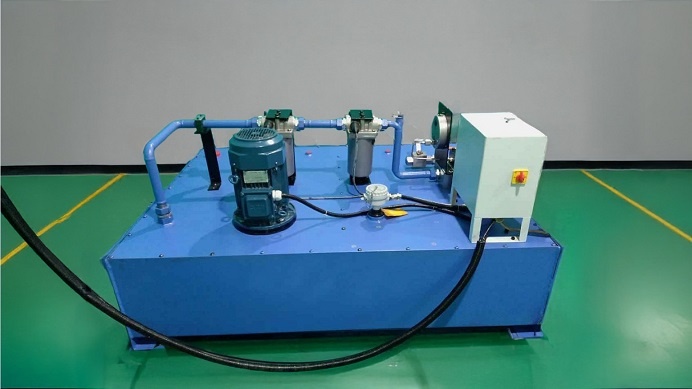
Neometrix Suction Lubrication System for 1000HP Cyclic Spin Test Facility
A precision oil supply, filtration, cooling, and monitoring system designed for the demanding lubrication requirements of a 1000HP (746 kW) cyclic spin test facility — providing controlled-pressure, temperature-stable, filtered oil supply with comprehensive condition monitoring and automatic safety interlocks.
FAQ
Q: Why does a cyclic spin test facility need a dedicated lubrication system rather than using the test article’s own internal lubrication?
A: Many test articles (gearboxes, transmissions) have their own internal lubrication circuits, but these are designed for the final installed application conditions — not for the demanding cyclic loading, instrumentation access, and monitoring requirements of a test facility. A dedicated external lubrication system allows precise control and monitoring of oil inlet conditions (temperature, pressure, flow, cleanliness) as independent test variables, provides full instrumentation access that the installed application would not permit, and ensures lubrication supply to test rig spindles, bearings, and drive components that are external to the test article itself.
Q: What oil cleanliness level is typically required for high-power gearbox test facilities?
A: Cleanliness requirements depend on the application, but aerospace gearbox test facilities typically specify NAS 1638 Class 6 to 8 (approximately ISO 4406 14/12/9 to 16/14/11). Industrial gearbox testing may accept slightly less stringent levels. The lubrication system’s filtration must maintain this cleanliness throughout the test, and cleanliness is typically verified by regular oil sampling and particle count analysis to ensure contamination-driven wear doesn’t confound fatigue test results.
Q: Why is oil temperature stability critical in cyclic spin test facility lubrication?
A: Lubricating oil viscosity changes significantly with temperature — a 10°C rise can reduce viscosity by 15–25% depending on the oil grade. Since film thickness in bearings and gear meshes depends on viscosity, temperature variation changes the actual lubrication regime during the test. For a fatigue test to produce reproducible, comparable results, the lubrication conditions must be stable throughout and consistent between repeat tests. This requires closed-loop temperature control, not just passive cooling.
Neometrix Defence Ltd. designs and manufactures precision lubrication systems for high-power test facilities. [email protected] | +91-7777-876-876