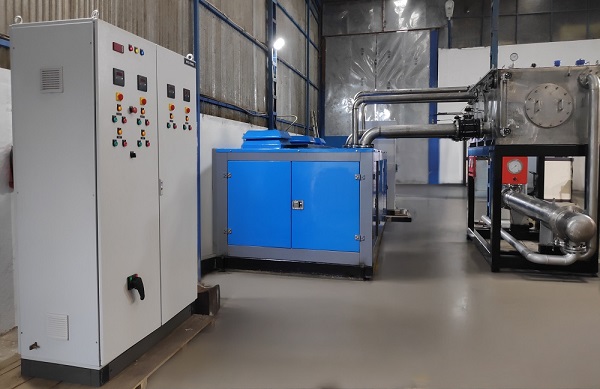

A hydraulic power pack and actuator system is the core infrastructure of any hydraulic test facility, simulation system, or high-force actuation application. Where simple fixed-displacement power units suffice for many industrial applications, precision test and simulation applications — structural testing, hardware-in-the-loop simulation, flight control system test benches, and high-force industrial presses — require modular, skid-mounted hydraulic power packs with variable displacement, high filtration, precise pressure control, and the thermal management needed for continuous duty operation.
This guide covers the engineering requirements for high-performance hydraulic power packs and actuator systems at the 300 kW/250 bar level — the scale needed for serious structural testing and industrial actuation applications.
Core Architecture of a High-Performance Hydraulic Power Pack
Variable displacement pump: Stepless variable displacement reduces energy waste when actuator demand is low. Unlike fixed displacement systems where excess flow dumps across a relief valve (converting energy to heat), a variable displacement pump reduces its output to match demand — saving energy and reducing thermal load on the cooling system.
2000L stainless steel reservoir: The large reservoir provides thermal mass (temperature stability), air bubble separation time, particle settling, and adequate fluid volume for actuator stroke cycling without reservoir level fluctuation. Internal baffling prevents short-circuiting between return and suction. SS304 construction eliminates rust contamination.
Multi-stage filtration: 10μm nominal on the pressure line removes large wear particles; 3μm absolute on the return line provides servo-grade cleanliness protection. Coalescers remove water contamination; electrostatic cleaners can remove sub-micron particles for ultra-clean applications.
CNC-machined aluminium manifold: The core manifold block is CNC-machined from high-grade aluminium alloy — precision-machined galleries minimise internal leakage paths, ensure consistent flow distribution, and reduce the external piping connections that each represent a potential leak point.
Vibration isolation: Vibration-isolated mounts decouple pump and motor vibration from the system being powered — critical for precision test applications where vibration contamination of load and position measurements must be minimised.
Actuator System Integration
The hydraulic power pack is only the power source — the actuator system converts hydraulic power into useful mechanical work. For precision test and simulation applications, this typically involves servo-hydraulic actuators with:
- Electro-hydraulic servo valves (EHSV) or proportional valves for closed-loop position, force, or pressure control
- Linear variable differential transformers (LVDT) or optical encoders for position feedback
- Load cells for force measurement and closed-loop force control
- Servo controllers (typically digital, MTS, Moog, or custom PLC-based) implementing PID or more sophisticated control algorithms
The hydraulic power pack specification — particularly flow rate and pressure stability — directly determines the maximum actuator velocity, force capacity, and bandwidth achievable in the actuator system.
Key Applications
Railway fuelling and testing (±0.1% mass accuracy): Precision hydraulic actuation for railway component testing where mass measurement accuracy drives force control requirements.
1 MN industrial actuation: Large-force hydraulic actuation for structural testing, press operations, and material testing at forces in the megaNewton range.
Marine deck machinery: Deck winches, cranes, and anchor handling on ships and offshore platforms — high-power hydraulic drives requiring reliability in harsh environments.
Aerospace testing: Hydraulic power supply for servo-hydraulic structural test actuators, flight control system simulation rigs, and landing gear fatigue test facilities.
International Standards
| Standard | Relevance |
|---|---|
| ISO 4413 | Hydraulic fluid power — safety rules |
| ISO 4406 | Fluid cleanliness coding |
| NAS 1638 | Aerospace hydraulic cleanliness |
| EN 13849-1 | Safety of machinery — Europe |
| ISO 12100 | Safety of machinery — risk assessment |
Neometrix Hydraulic Power Pack and Actuator System
A fully modular, skid-mounted electro-hydraulic solution delivering up to 300 kW continuous at 250 bar. Variable displacement pump with auxiliary fixed-displacement stages and optional redundancy. 2,000L stainless-steel reservoir with internal baffling, multi-stage filtration (10μm + 3μm absolute, coalescers, electrostatic cleaning), CNC-machined aluminium manifold, vibration-isolated mounts, and removable access panels. Applications include railway testing, 1 MN industrial actuation, marine deck machinery, and aerospace test facilities.
→ View Full Specifications
→ Request a Quote
FAQ
Q: What is the advantage of a variable displacement pump over a fixed displacement pump in a hydraulic power pack?
A: A fixed displacement pump delivers constant flow regardless of system demand — when actuators are stationary or moving slowly, excess flow must dump across a pressure relief valve, converting pump energy entirely to heat. A variable displacement pump reduces its output to match demand, so at low-demand conditions (stationary or slow actuators) the pump uses far less energy and generates far less heat. For test facilities with intermittent high-demand test cycles and long idle periods, variable displacement can reduce energy consumption by 40–60% and substantially reduce cooling system requirements compared to a fixed displacement system of equivalent peak capability.
Q: Why is a 2000L reservoir specified for high-power hydraulic systems?
A: Large reservoir volume serves multiple functions: thermal mass to absorb heat between test cycles, stabilising fluid temperature; air bubble separation — bubbles entrained during system operation need residence time to rise to the oil surface before recirculating (approximately 1 minute at low velocity, requiring reservoir volume proportional to flow rate); particle settling — heavy contamination settles rather than recirculating; and adequate oil volume to accommodate actuator piston rod extension and retraction without level changes that affect pump priming. At 300 kW/250 bar with significant actuator volumes, 2000L provides comfortable margins for all of these functions.
Q: What is an electrostatic oil cleaner and when is it needed?
A: An electrostatic oil cleaner uses a high-voltage electric field to attract and capture sub-micron particles (below 1μm) that conventional filter elements cannot efficiently remove. These ultra-fine particles — including products of oxidation, varnish precursors, and sub-micron wear debris — pass through even 3μm absolute filters. For the most demanding servo valve applications and long-life systems where varnish deposits on valve spools are a concern, electrostatic cleaning provides an additional layer of fluid cleanliness beyond what mechanical filtration alone can achieve.
Neometrix Defence Ltd. designs and manufactures hydraulic power packs and actuator systems for aerospace, industrial, and defence applications. [email protected] | +91-7777-876-876