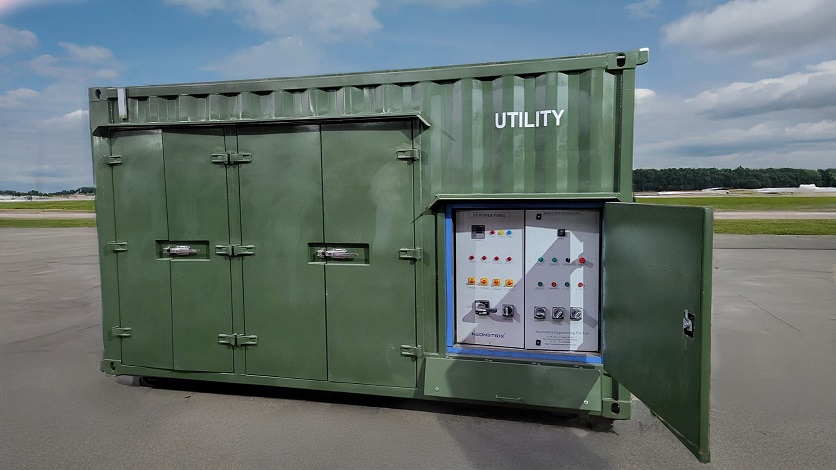

Aircraft engine testing has traditionally been confined to fixed test cells — large, permanent structures with fire suppression, noise attenuation, instrument rooms, and utility infrastructure that can only be built in a few locations and require engines to be transported to them. For military operations, remote maintenance facilities, aircraft operating from dispersed locations, and test programmes that need to validate engines in their actual environmental context, this fixed-cell model creates significant operational constraints.
A mobile test facility (MTF) brings the test cell to the engine — a self-contained, trailer-mounted propulsion test system that deploys to any operational location and provides performance mapping, endurance testing, and environmental qualification capability without requiring permanent infrastructure.
What a Mobile Test Facility Must Provide
A mobile test facility that genuinely replaces a fixed test cell must provide all the capabilities engineers rely on in permanent installations:
Complete self-sufficiency: The MTF cannot depend on external utilities (power, compressed air, fuel, data links) being available at the deployment site. It must carry its own power generation, compressed air supply, climate control, and communications.
Harsh environment operability: Military and remote deployment means temperatures from -20°C to +50°C, altitude up to 4,522m AMSL, dust, humidity, and vibration during transport. The MTF must operate reliably throughout this range.
Full instrumentation: Performance mapping, endurance testing, and fault diagnostics require the same sensor suite as a fixed test cell — thrust measurement, fuel flow metering, air mass flow, exhaust gas temperature (EGT), shaft speed, oil temperature and pressure, vibration, and acoustics.
Safety equivalent to a fixed cell: Fire suppression systems, acoustic enclosures, explosion-protected lighting, emergency stop interlocks, blast-rated test sections, and emergency egress — the consequences of an engine fire or failure in a mobile facility are the same as in a fixed cell.
Rapid engine change capability: Field deployment means testing multiple engines in sequence at the same location. Quick-change engine mounts that allow engine removal and installation in hours, not days, are essential for operational tempo.
Module Architecture — Four Complementary Modules
The Neometrix MTF uses a four-module architecture that can be transported separately and connected at the deployment site:
Utility Support Module: Onboard diesel power generation, fuel storage and distribution, hydraulic utilities, and compressed air supply. The self-contained energy and utility source for the entire facility.
Control Cabin Module: Climate-controlled operator workspace with PLC/SCADA control stations, data storage (4 TB RAID-5), remote telemetry, and safety monitoring displays. Operators work at a safe distance from the engine during testing.
Engine Test Section Module: The test article housing — acoustic enclosure, engine mount structure with rapid-change fittings, fire suppression system, exhaust ducting, and thrust measurement system. Blast-rated design for contained failure scenarios.
High-Pressure Compressor Module: Provides high-pressure air for engine starting and any bleed air simulation requirements.
Technical Capabilities
| Parameter | Specification |
|---|---|
| Thrust capacity | Up to 450 kgf |
| Operating temperature | -20°C to +50°C ambient |
| Altitude capability | Sea level to 4,522m AMSL (with optional altitude simulation) |
| Data storage | 4 TB RAID-5 |
| Control system | PLC/SCADA with remote telemetry |
| Optional modules | Altitude simulation, emissions analysis |
International Standards References
| Standard | Relevance |
|---|---|
| MIL-E-5007 | Aircraft turbine engine specification |
| DO-160 | Environmental conditions for airborne equipment |
| MIL-STD-810 | Environmental testing (transport, vibration, temperature) |
| SAE ARP 1137 | Aircraft engine test facilities |
| RTCA DO-160 | Avionics environmental qualification |
Applications
Military field engine testing: Evaluating engine performance at forward operating bases without returning engines to depot facilities, reducing logistics chain length and aircraft downtime. Supporting rapid engine diagnostics in the field.
Remote and dispersed operations: Fixed test cell access may be hundreds or thousands of kilometres from operational locations. Mobile facilities eliminate transit time and cost for engines requiring performance verification.
Post-overhaul acceptance testing: Performing final performance acceptance tests on overhauled engines before returning them to operational aircraft, at the maintenance facility rather than at a separate test cell.
Development and qualification programmes: Testing engine performance in the actual environmental conditions (altitude, temperature, humidity) of the intended operational environment, rather than in a fixed cell approximating these conditions.
Neometrix Mobile Test Facility for Aircraft Engines
A fully self-contained, trailer-mounted propulsion test system for turbo-propulsion units up to 450 kgf thrust. Four DOT/ADR-compliant transport modules integrate onboard power, climate-controlled control cabin, rapid-change engine test section, and high-pressure compressor. PLC/SCADA control with 4 TB data storage and remote telemetry. Operates from -20°C to +50°C and sea level to 4,522m AMSL.
→ View Full Specifications
→ Request a Quote
FAQ
Q: What is DOT/ADR compliance for transport modules and why does it matter?
A: DOT (US Department of Transportation) and ADR (European Agreement for International Carriage of Dangerous Goods by Road) are regulations governing the road transport of vehicles and loads that carry hazardous materials, including diesel fuel, compressed gases, and high-pressure hydraulic systems. DOT/ADR compliance for MTF transport modules means the modules are designed, marked, and documented to be legally transported on public roads in the US and Europe — including any hazardous material placarding, container ratings, and transport safety requirements. This is essential for a deployable system that will be moved between locations by road transport.
Q: What is RAID-5 data storage and why is it used in the control cabin?
A: RAID-5 (Redundant Array of Independent Disks, level 5) distributes data and parity information across multiple disk drives so that if any single drive fails, the data can be recovered from the remaining drives without data loss. For an engine test facility logging continuous high-rate sensor data across all test channels, the consequences of storage system failure — losing weeks of irreplaceable test data — are severe. RAID-5 provides fault tolerance against single-drive failure without the 100% storage overhead of RAID-1 mirroring, making it the standard choice for mission-critical test data storage systems.
Q: What is the difference between performance mapping and endurance testing for aircraft engines?
A: Performance mapping systematically evaluates engine thrust, fuel consumption, EGT, shaft speeds, and efficiency at all combinations of throttle setting, altitude, and temperature across the operating envelope — typically completed in hours to days. Endurance testing runs the engine for extended periods (hundreds of hours) at representative operating conditions to verify durability, identify wear modes, and confirm compliance with service life requirements. The Mobile Test Facility supports both: rapid performance mapping in field conditions, and multi-day endurance runs at locations chosen for their environmental representativeness.
Q: Can altitude simulation be added to a mobile test facility?
A: Yes — the MTF architecture supports an optional altitude simulation module that reduces the inlet air pressure and temperature to replicate the conditions the engine would experience at altitude. This is important for validating engine performance at altitude rather than extrapolating from sea-level test data, particularly for turbine engines where performance is altitude-sensitive. The optional altitude simulation module extends the MTF’s capability from sea-level performance measurement to full-envelope qualification at the deployment location.
Neometrix Defence Ltd. designs and manufactures mobile test facilities for military and commercial aircraft engine testing. [email protected] | +91-7777-876-876