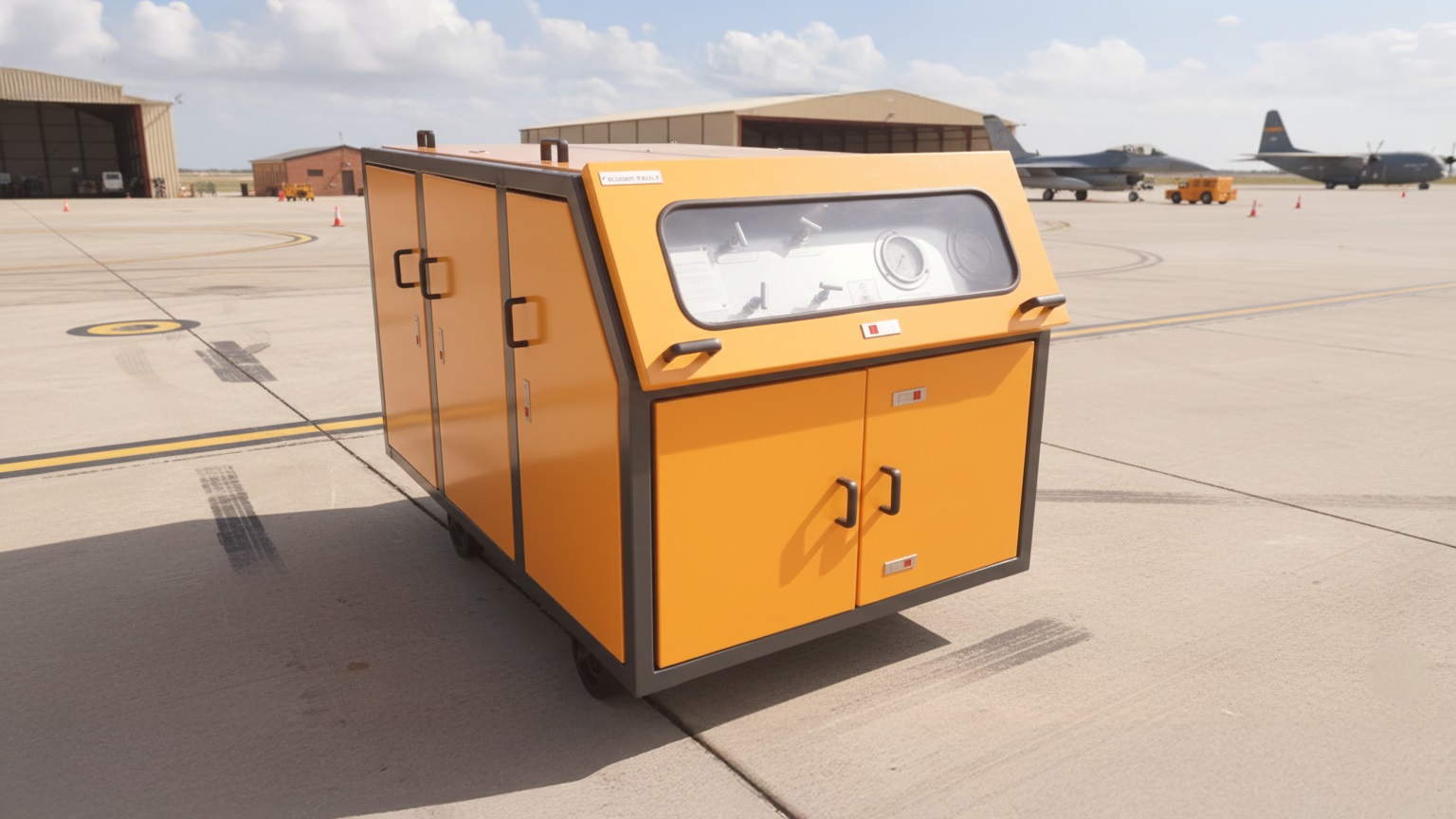

HST 300U Hydraulic Refilling Trolley: A Mobile Unit for Pressurizing, De-Aerating and Filtering Hydraulic Fluid
Topping off a fighter jet’s hydraulic system on the flight line isn’t the same job as topping off a car — the fluid has to arrive free of both particulate contamination and entrained air, because either one can compromise an actuator that’s expected to work exactly right the first time, every time. Neometrix’s HST 300U Hydraulic Refilling Trolley is a compact, towable ground support unit that pressurizes, de-aerates, filters, and transfers hydraulic fluid at up to 300 bar and 100 L/min per circuit — in a single mobile pass.
Nitrogen Does the Pumping, Not an Electric Motor
Twin 50-litre nitrogen bottles at 220 bar service pressure pressurize the dual-chamber reservoir to drive fluid transfer, rather than relying on an electric pump. On an airfield apron — where fuel vapor, dust, and unpredictable power access are all realistic conditions — a nitrogen-driven system removes the ignition risk and power-dependency that come with an electrically driven pump, while still delivering up to 100 L/min per circuit.
The Air You Can’t See Is the Air That Causes Cavitation
An engine-driven vacuum pump extracts dissolved air and moisture from the hydraulic oil down to under 200 mbar absolute before it ever reaches the aircraft. Entrained air that isn’t removed before transfer doesn’t just sit inertly in the fluid — it compresses under pressure and can cause cavitation or hydraulic lock once the system is back in operation, a failure mode that filtration alone does nothing to prevent.
Two Circuits, Serviced at Once
Two independent hydraulic circuits can be serviced simultaneously from the trolley’s twin 70-litre SS304L chambers, reducing aircraft downtime during depot-level maintenance where multiple hydraulic systems — primary flight controls and utility hydraulics, for instance — often need attention in the same maintenance window.
Filtration That Actually Holds ISO 4406 Class 18/16/13
Bypass and mainline 3 µm absolute filter stages strip particulates and varnish from the fluid before it reaches the aircraft, holding a cleanliness level — ISO 4406 Class 18/16/13 — that matters directly to actuator and servo-valve life downstream. Redundant relief valves and burst discs on both the nitrogen and hydraulic circuits, plus over-temperature shutdown and an emergency-stop circuit, protect both the equipment and the operator throughout.
Frequently Asked Questions
Why does the HST 300U use pressurized nitrogen to drive fluid transfer instead of an electric pump?
Because the environments this trolley operates in — airfield aprons, hangars, and forward operating bases — often involve fuel vapor, dust, and inconsistent power access, all of which make an electrically driven pump a less attractive choice than it would be in a controlled industrial setting. Twin 50-litre nitrogen bottles at 220 bar service pressure pressurize the dual-chamber reservoir directly, pushing fluid through the circuit without an electric motor or the ignition risk and power dependency that comes with one. This nitrogen-driven approach still delivers up to 100 L/min per circuit at up to 300 bar, so there’s no meaningful performance trade-off for choosing the safer, field-ready drive method over an electric pump.
Why does hydraulic fluid need to be de-aerated with a vacuum pump if it’s already being filtered?
Because filtration and de-aeration solve two completely different contamination problems. Filtration removes solid particulate contamination and varnish — physical material suspended in the fluid. But dissolved and entrained air is a gas mixed into the liquid itself, which filtration doesn’t touch at all. If that air isn’t removed before the fluid is transferred into an aircraft’s hydraulic system, it doesn’t just sit there harmlessly — it compresses and expands as system pressure changes during operation, which can cause cavitation in pumps and valves or hydraulic lock in actuators, both of which are serious functional failures rather than gradual wear issues. An engine-driven vacuum pump extracts dissolved air and moisture down to under 200 mbar absolute specifically to prevent this failure mode, which is a separate and necessary step alongside filtration, not a substitute for it.
Get In Touch
For full specifications, RFQs, or a technical discussion about the HST 300U Hydraulic Refilling Trolley:
– Product page: HST 300U Hydraulic Refilling Trolley
– Email: [email protected]
– Phone: +91-7777-876-876