
Secure the Helicopter, Walk It Home: Shipboard Traversing and Handling Systems
A naval helicopter’s hardest ordinary moment is on the deck: rolling, pitching, wet, with wind curling over the hangar face. After touchdown, a multi-ton aircraft on wheels stands on a moving steel floor, and a single uncontrolled metre can be a disaster. This guide explains how traversing and handling systems enforce one rule, the aircraft is never free, for naval aviation engineers, ship-integration teams and procurement officers in the USA, the UK and Europe.
Key Takeaways
– The system enforces a single rule: the aircraft is never free, from touchdown to lashing.
– At touchdown, the helicopter’s deck-lock probe engages a securing grid set flush in the deck and clamps the aircraft to the ship within seconds.
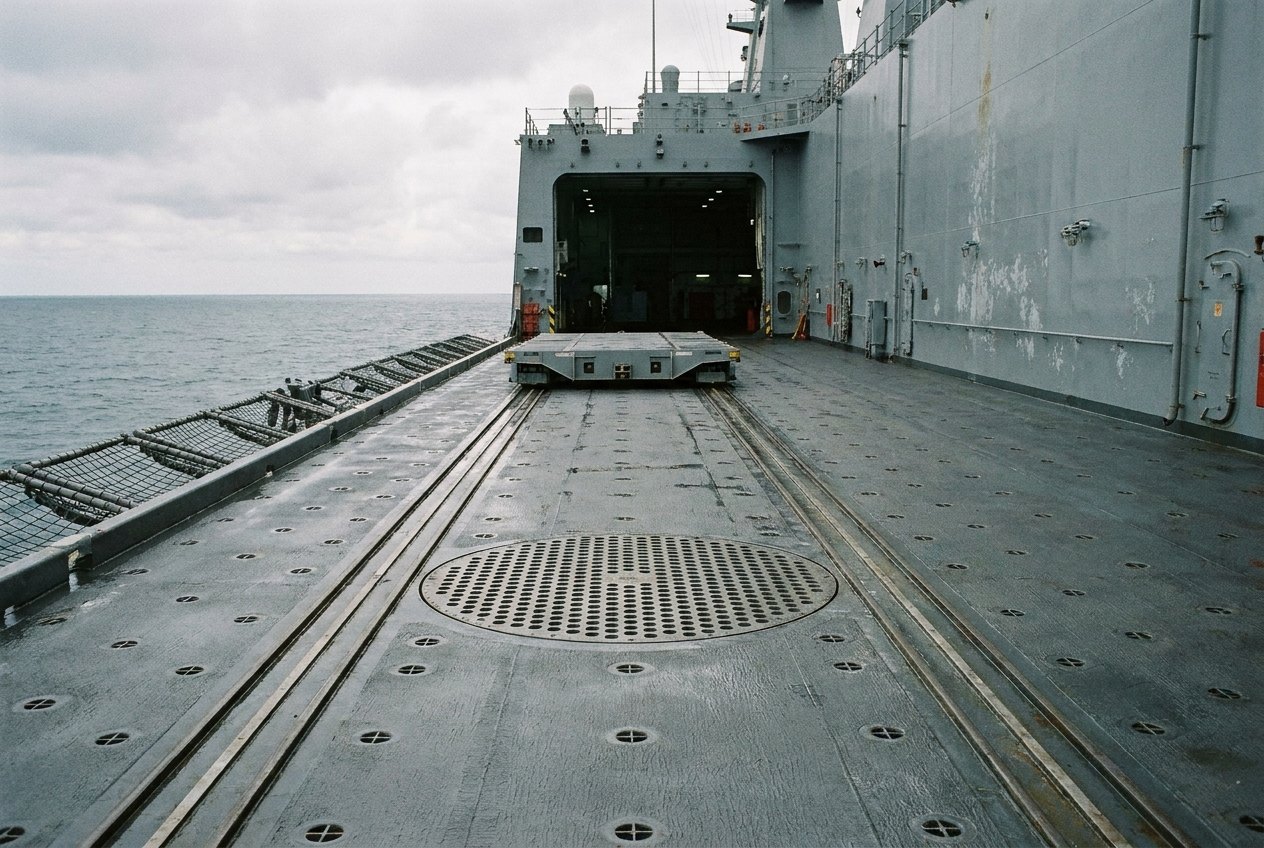
– A shuttle in flush deck rails then captures the aircraft’s deck fitting, and a winch or hydraulic drive walks it to the hangar at walking pace, restrained, centered through tight door clearances.
– NVG-compatible deck lighting supports night operations as part of the same outfit.
– Neometrix builds the rails, shuttle, drive, grid and lighting, installs on board, proves the system in trials and overhauls in-service systems. Engineered to order.
The Deck Never Stops
Everything about shipboard helicopter operation is decided by one fact: the landing spot moves. The ship rolls and pitches, heaves with the swell and is often wet with spray. A helicopter is superb in the air and helpless on wheels: shut down on a moving deck, it can neither fly away from trouble nor hold itself still against it. An aircraft that rolls one free metre on a moving deck is a casualty: aircrew, deck crew and a machine the ship cannot replace at sea.
A Recovery in Four Steps
1. Touchdown and secure. As the aircraft settles, its deck-lock probe drives into a heavy perforated securing grid and clamps. Within seconds the helicopter is structurally part of the ship. Deck crew add tie-down lashings to the surrounding pattern.
2. Shuttle captures. A low traversing trolley in flush deck rails comes to the aircraft and captures its deck fitting. From then on the aircraft’s own wheels and brakes are passengers.
3. Traverse restrained. A winch or hydraulic drive moves the shuttle at a controlled walking pace, holding the aircraft against roll and pitch, while rail and guide geometry keep it centered through the hangar door.
4. Hangared and lashed. The aircraft is positioned over its stowage, chocked and lashed. For launch, the sequence runs in reverse, ending with the grid releasing the probe as the rotors take the weight.
Four Outfit Variants
| Variant | Scope |
|---|---|
| Rail traversing system | The full deck-to-hangar outfit (flush rails, shuttle, drive, controls) for frigate and destroyer-class flight decks |
| Portable or wheel-guided handlers | Captive movement of the aircraft on small decks and for retrofit, without a full rail installation |
| Securing grid and lashing outfit | The grid plate, tie-down points, chocks and lashings, supplied and installed as their own package |
| NVG-compatible deck lighting and aids | Deck and landing lighting and hangar-face visual aids for night operations |
Why the Lighting Belongs to the Same Outfit
Recoveries do not wait for daylight. The deck’s visual aids are engineered as part of the same outfit, matched to the procedures the crews fly. Neometrix notes this as a quoted deck-lighting capability.
New-Build and Aftermarket
Traversing systems live hard lives at sea. The page points to repair rate contracts for helicopter traversing systems, work it has quoted, as the recurring aftermarket beside new-build work.
Applications
Frigate and destroyer-class flight decks; small-deck and retrofit handling; hangar traverse and stowage; securing grids and lashing outfits; deck lighting and night operations; and overhaul and refit of in-service systems.
Standards and Procurement Context for US, UK and European Buyers
Shipboard helicopter equipment is specified through naval requirements and class rules. Commonly referenced frameworks include:
– United States: NAVAIR helicopter operating procedures for air-capable ships, MIL-STD-3009 for night-vision-imaging-system compatible lighting and MIL-STD-810 for environmental conditions.
– United Kingdom: DEF STAN requirements and MOD shipboard-helicopter operating limits.
– NATO and Europe: NATO STANAG and AEP documents on helicopter operations from ships, naval class rules from bodies such as Lloyd’s Register, Bureau Veritas and DNV, and the Machinery Directive 2006/42/EC for non-military installations.
– Quality: ISO 9001 and ISO 14001 (listed on the Neometrix page).
Neometrix does not claim certification to these on the page. Send the ship class, aircraft and deck arrangement and Neometrix replies with a clause-by-clause compliance matrix within two working days.
Buyer’s Checklist: 8 Questions for a Traversing System Supplier
1. What aircraft weight, wheel or fitting interface and deck-lock probe design does it handle?
2. What ship motions (roll, pitch, heave) and wind limits is the system rated for?
3. How fast is securing at touchdown, and how is the grid designed and maintained?
4. How does the shuttle capture the aircraft, and how is it held during traverse?
5. What clearances does the hangar door allow, and how does the guide geometry keep the aircraft centered?
6. What NVG-compatible lighting and visual aids are included?
7. How is it installed, tested and proved in sea trials?
8. What overhaul and spares support is offered for in-service systems?
Frequently Asked Questions
Why is moving a helicopter on a ship a machine problem?
Because the deck moves, and a shut-down helicopter on wheels cannot hold itself still. Restraint has to come from the ship.
How does securing at touchdown work?
The helicopter’s deck-lock probe drives into a securing grid in the deck and clamps within seconds, with lashings added around it.
How does the traverse to the hangar happen?
A shuttle in flush rails captures the aircraft’s deck fitting, and a winch or hydraulic drive moves it at walking pace, restrained throughout.
What about ships without a full rail system?
Portable and wheel-guided handlers offer captive movement of the aircraft on small decks and for retrofit.
Get in Touch
Send the ship class, the aircraft and the deck arrangement for a clause-by-clause compliance matrix and a budgetary quotation within two working days:
– Product page: Shipboard Helicopter Traversing & Handling System
– Tenders and quotations: [email protected]
– Phone: +91-7777-876-876 (India; dial +91 from the USA, UK and Europe)