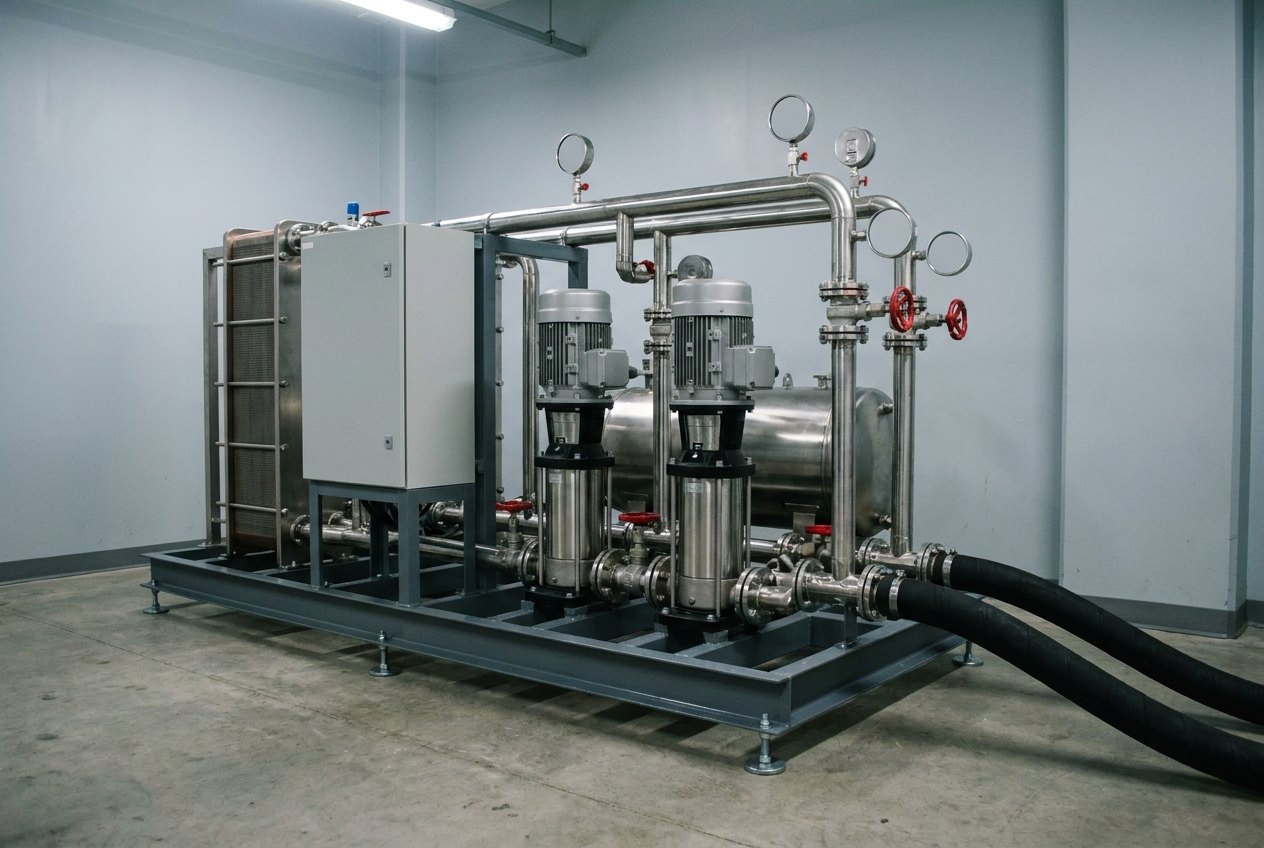

Take the Heat Out: Liquid Cooling Systems and Coolant Distribution Units
Modern electronics rarely fail because they run out of power. They fail, or quietly derate, because they run out of cooling. Every generation packs more power into less volume, and all of that power ends up as heat that must leave. Fans and finned heatsinks were enough for a long time, but past a certain heat flux air simply cannot carry the heat away. This guide explains how closed-loop liquid cooling solves that, for thermal engineers, systems integrators and procurement teams in the USA, the UK and Europe.
Key Takeaways
– Liquid carries far more heat per unit volume than air, and it can be taken right to the hot component.
– A liquid cooling system has four moves: pick the heat up (cold plates), move it (pumps), reject it (exchanger or chiller) and return it cold.
– A coolant distribution unit (CDU) isolates a clean secondary loop from the primary or facility loop and feeds many loads.
– Because the cooling is as critical as the load, it is built with dual redundant pumps, sensing, leak detection, alarms and interlocks.
– Neometrix does the thermal and hydraulic design, the skid, controls and qualification, and indigenizes existing units. The chiller, pumps, exchanger cores and cold plates are bought in; the equipment being cooled is the customer’s.
When Air Runs Out
Cooling with air is limited by how much heat a given volume of air can carry. Past a certain heat flux you cannot move enough of it: junction temperatures climb, the equipment throttles back to protect itself, and the capability you paid for is not available. Liquid changes the arithmetic. The choice becomes simple: cool with liquid or derate the equipment.
The Loop in Four Moves
1. Pick the heat up: cold plates or compact exchangers sit against the hot components, so the liquid collects heat at the source.
2. Move it: a pump and reservoir set circulates the coolant at a controlled flow, with filtration, de-aeration and expansion volume.
3. Reject it: a liquid-to-air or liquid-to-liquid exchanger dumps the heat, or a refrigerant chiller stage does when the coolant must be held below ambient.
4. Return cold: the coolant goes back to the load and does it again.
The CDU: Distribute and Isolate
Where there are many loads, or where the fluid touching the electronics must be held to a different standard than the building’s water, the machine becomes a coolant distribution unit. A manifolded system isolates a clean, filtered, controlled secondary loop from the primary or facility loop through a heat exchanger, and distributes flow to each load. It is the same engineering whether it feeds cabinets in a shelter or rear-door exchangers on a rack.
A Loop That Must Hold
Once equipment depends on liquid cooling, the cooling becomes as critical as the load. The loop therefore has:
– Dual pumps with changeover
– Continuous sensing of temperature, flow, pressure and level
– Leak detection throughout
– Alarms and interlocks that act to protect the equipment before damage occurs
– Looked-after coolant: flushed, filtered, de-aerated and corrosion-inhibited
Four Ways to Build It
| Variant | What it is |
|---|---|
| Airborne / onboard cooling system | Compact, light, packaged to an installation envelope and qualified for vibration, shock and altitude, the hardest version of the problem |
| Mobile and shelter cooling skid | A ruggedized skid or rack for a deployed cabin, with wide ambient range, dust and transport loads |
| Coolant distribution unit (CDU) | Secondary-loop isolation and manifolded distribution to many loads, including rack and rear-door applications |
| Indigenisation, repair and requalification | An existing unit re-engineered to its interface, built locally, rebuilt or repaired, then re-tested and requalified against the original duty |
Applications
Airborne and onboard electronics cooling; deployed shelter and cabin electronics; power-electronics and converter cooling; rack, server and facility coolant distribution; process and equipment liquid cooling; and indigenisation, repair and requalification.
How It Differs From Neighboring Neometrix Products
This is a closed liquid thermal loop for electronics. It is different from the aircraft ground air-conditioning cart (which cools an aircraft with conditioned air on the ground) and from the thermal test chambers (which test what heat does to equipment).
Standards and Procurement Context for US, UK and European Buyers
Liquid-cooling systems draw on environmental, electrical and thermal-management references. Commonly referenced frameworks include:
– United States: MIL-STD-810 (environmental) and MIL-STD-461 (EMI), MIL-PRF-87252 for dielectric coolant fluids, ASHRAE TC 9.9 liquid-cooling guidelines for data centers and electrical codes such as NFPA 70.
– United Kingdom: DEF STAN requirements, the Pressure Systems Safety Regulations (PSSR) where applicable and UK F-gas rules for any refrigerant stage.
– European Union: the Pressure Equipment Directive 2014/68/EU, the Machinery Directive 2006/42/EC (replaced by Regulation (EU) 2023/1230 from January 2027), the F-gas Regulation (EU) 2024/573 and EN 378 for refrigerating systems, and RoHS for materials.
– Quality: ISO 9001 and ISO 14001 (listed on the Neometrix page).
Neometrix does not claim certification to these on the page. Send the heat load, the platform and the environment and Neometrix replies with a clause-by-clause compliance matrix within two working days.
Buyer’s Checklist: 8 Questions for a Liquid Cooling Supplier
1. What is the heat load, the heat flux at the component and the allowable coolant temperature?
2. Is the system airborne, mobile, shelter-based or facility-based, and what is its environment?
3. How are redundancy and changeover handled for pumps and critical valves?
4. What leak detection, sensing, alarms and interlocks protect the equipment?
5. Which coolant is used, and how is it flushed, filtered, de-aerated and inhibited?
6. Do we need a CDU with secondary-loop isolation, and for how many loads?
7. How is the unit qualified for vibration, shock, altitude, temperature and dust?
8. Can an existing unit be indigenized, repaired or requalified, and what is bought in?
Frequently Asked Questions
Why not just use air?
Because past a certain heat flux air cannot carry the heat away, and equipment derates. A liquid carries far more heat per unit volume and can be taken right to the component.
What is a coolant distribution unit?
A manifolded system that isolates a clean secondary loop from the primary or facility loop through a heat exchanger and distributes flow to each load.
How are redundancy and leak safety handled?
Dual pumps with changeover, continuous sensing, leak detection throughout and alarms and interlocks that protect the equipment.
Can you indigenize an existing cooling unit?
Yes. The page describes re-engineering an existing unit to its interface, building it locally, repairing it and requalifying it against the original duty.
Get in Touch
Send the heat load, the platform and the environment for a clause-by-clause compliance matrix and a budgetary quotation within two working days:
– Product page: Liquid Cooling System & Coolant Distribution Unit
– Tenders and quotations: [email protected]
– Phone: +91-7777-876-876 (India; dial +91 from the USA, UK and Europe)