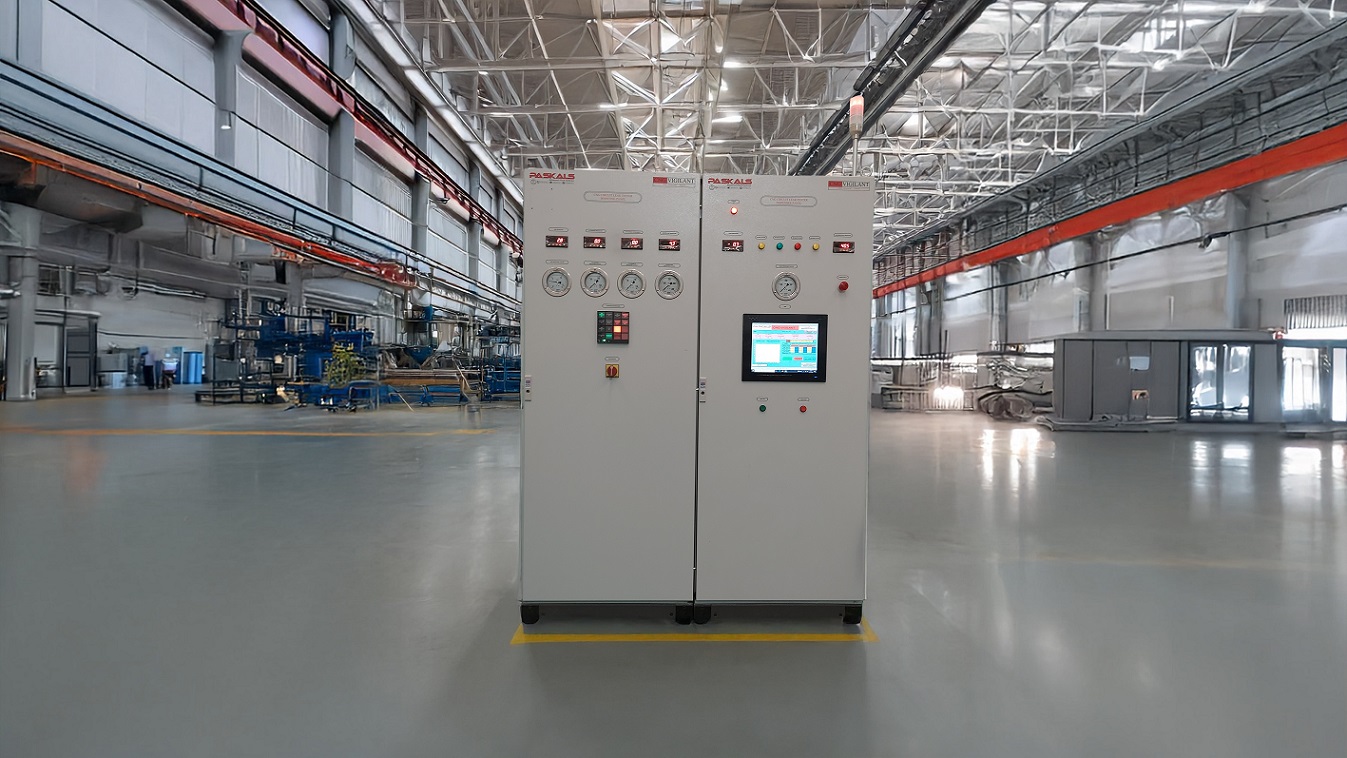

CNG Vigilant: Automated CNG Circuit Leak Testing System Up to 350 Bar
A CNG circuit that leaks a little today is a circuit that leaks more tomorrow — which is exactly why testing it once at end-of-line isn’t optional. CNG Vigilant is Neometrix’s flagship automated leak testing system for complete CNG vehicle circuits and critical components: regulators, cylinder valves, nozzles, and pressure lines, evaluated under high-pressure conditions up to 350 bar. It combines pressure decay and differential pressure sensing — or, in its higher-sensitivity configuration, Helium Mass Spectrometry — with a temperature compensation system and built-in nitrogen recycling, so a production line can test every vehicle rather than sampling a few and hoping.
Two Configurations, Two Jobs
Vigilant Ver. 0.30 pairs Pressure Decay with Differential Pressure sensing and a proprietary temperature compensation system, resolving leaks down to 1×10⁻⁹ atm cc/sec — fast and cost-effective for full-vehicle circuit testing and line-level verification. Vigilant Ver. 0.34 adds Helium Mass Spectrometry, pushing sensitivity down to 1×10⁻¹⁰ atm cc/sec, aimed at precision component testing (regulators, valves, injectors) where R&D and certification work demands the extra order of magnitude.
Why Temperature Gets Its Own Subsystem
High-pressure gas testing is quietly sensitive to heat. Even a 1°C shift can create a pressure error of nearly 1 bar in a 100 cc volume at 300 bar — large enough to trigger a false leak alarm or, worse, mask a real one. Neometrix addresses this with TTLIV (Temperature-Time-Logic-Integrated-Volume) technology: circuit-specific calibration across up to 5 different circuit volumes, with software-controlled fill rates that isolate genuine pressure drops from thermal drift.
Automation That Removes the Operator From the Loop
CNG Vigilant runs from a plug-and-play interface with remote control up to 10 meters, one-touch test initiation, and fully customizable pressure, hold-time, and leak-limit parameters. Stepwise pressurization and flow control logic catch loose fittings or open circuits early — before the circuit ever reaches full test pressure — while audio-visual alarms flag abnormal flow behaviour mid-test.
Nitrogen That Doesn’t Get Thrown Away
Every test cycle reclaims its nitrogen, compresses it, and stores it in a dedicated reservoir for reuse. The system supports up to 4 nitrogen cylinders simultaneously with automatic switching when one depletes, which is what keeps a high-throughput line from stopping for a cylinder change — and cuts nitrogen consumption meaningfully over a production run.
Frequently Asked Questions
Why does CNG leak testing need its own temperature compensation system instead of just testing at a fixed ambient temperature?
Because production floors and service bays don’t hold a fixed ambient temperature, and gas is extremely sensitive to thermal expansion under high pressure — a 1°C shift can create a pressure error of nearly 1 bar in a 100 cc volume at 300 bar. Without compensation, a circuit that’s perfectly sealed can appear to leak simply because it warmed up slightly during the hold period, or a genuine small leak can get masked by a cooling trend. CNG Vigilant’s TTLIV technology calibrates for up to 5 different circuit volumes and uses software-controlled fill rates to isolate real pressure drops caused by leaks from pressure changes caused by ambient or process temperature fluctuations.
Why does Neometrix offer two different leak detection methods instead of just using the most sensitive one for everything?
Because sensitivity and throughput trade off against each other, and different testing stages need different amounts of each. Pressure Decay plus Differential Pressure (Ver. 0.30) is fast and reliable enough for full-vehicle circuit testing and line-level production verification, where the goal is catching real leaks quickly across every unit. Helium Mass Spectrometry (Ver. 0.34) resolves leaks an order of magnitude smaller — down to 1×10⁻¹⁰ atm cc/sec — which matters for precision component validation, R&D, and certification work, but isn’t necessary or cost-effective to run on every full-circuit production test. Offering both lets a manufacturer match the test method to the actual risk at each stage rather than over- or under-testing.
Get In Touch
For full specifications, RFQs, or a technical discussion about CNG Vigilant:
– Product page: CNG Vigilant
– Email: [email protected]
– Phone: +91-7777-876-876