
One Blow, the Whole Truth: Impact Testing Machines for Metals, Plastics and Composites
Toughness is not strength. A material that stretches calmly under a slow pull can shatter under a blow, and steel that behaves at 20 degrees Celsius can fail cold. The impact machine finds that truth in milliseconds. This guide explains how pendulum testers, instrumented drop towers and conditioned-impact systems work, for materials laboratories, QA managers and procurement teams in the USA, the UK and Europe.
Key Takeaways
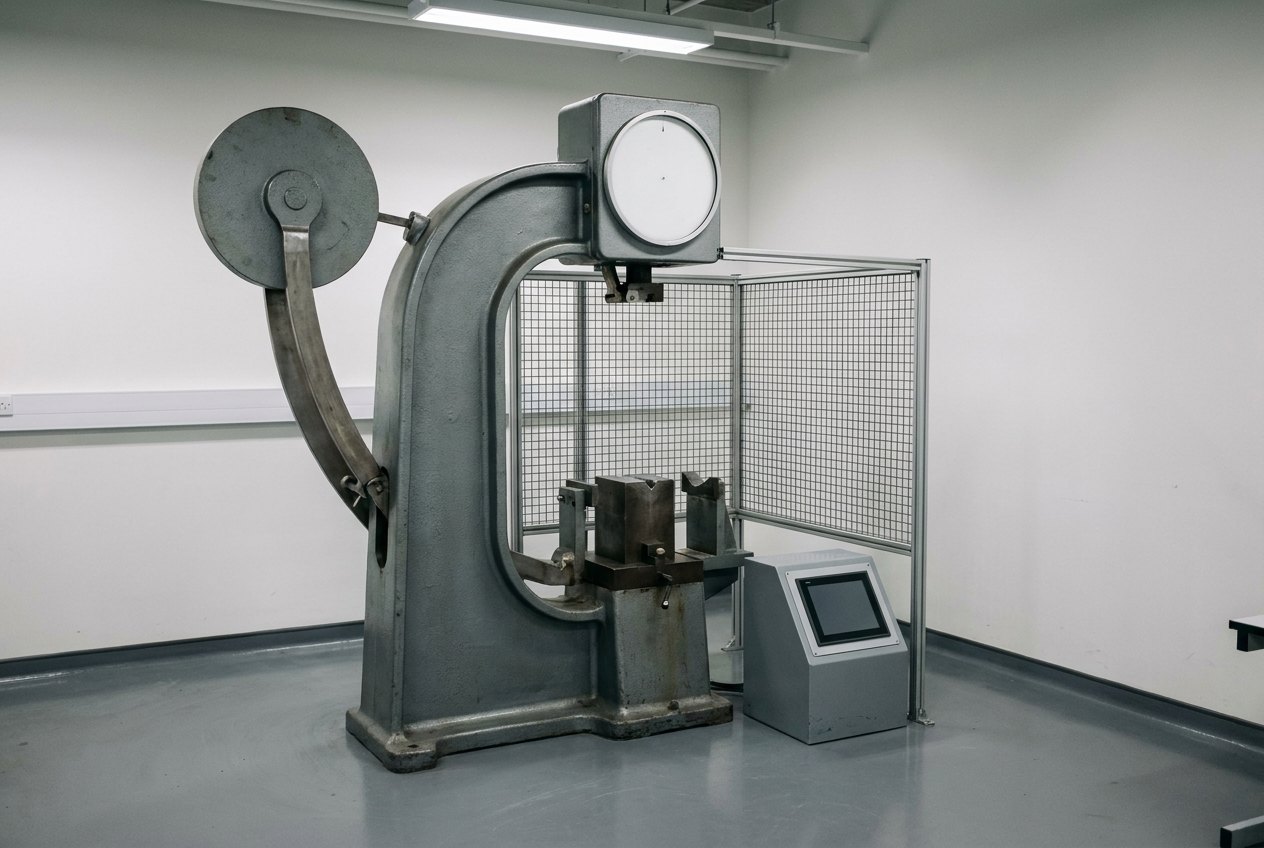
– A pendulum machine (Charpy and Izod, 150-750 J class, about 110-553 ft-lbf) swings a calibrated hammer through a notched specimen to ASTM E23 / ISO 148; the energy absorbed is read from the follow-through height.
– An instrumented drop tower records the force-time story of the hit, not just one number.
– Conditioned impact tests specimens at temperature, down to -196 degrees Celsius (-321 F) with liquid nitrogen, because the ductile-brittle transition must be found in the lab, never in service.
– Machines are verified by direct verification and by breaking certified reference specimens.
– Neometrix builds the frames, mechanisms, fixtures, conditioning, instrumentation and verification, engineered to order, drawing on its test-machine and climatic-chamber lines. No delivered machine is claimed.
Strong Is Not Tough, and Cold Changes the Answer
A tensile machine asks how a material behaves when pulled slowly. An impact machine asks what happens when it is hit. Energy arriving in milliseconds finds the brittle path a slow pull never takes, and a sharp notch concentrates it. Temperature moves the answer wholesale: the same steel that bends on a warm day can snap like glass on a cold one. Engineering learned this the hard way, in hulls and bridges that broke in winter, which is why the codes now demand impact numbers per heat of structural plate, pipe and forging, at stated temperatures.
How the Pendulum Produces Its Number
1. A hammer of calibrated mass and geometry is raised by motor to a latched height.
2. It is released through a notched specimen centered on precision-ground anvils.
3. What the specimen absorbs, the swing loses. The follow-through height, read by encoder, gives the energy in joules, the Charpy number quoted on the certificate.
4. The machine proves itself by direct verification and by breaking certified reference specimens whose answer is known in advance.
What the Drop Tower Adds
A guided mass falls on the specimen or product. Mass and drop height set the energy. An instrumented tup records force against time through the milliseconds of the event: not just how much energy was absorbed, but how (initiation, propagation and the shape of the failure). A velocity gate proves the impact speed and an anti-rebound catch ensures no specimen is struck twice. The same architecture serves plastics puncture, composite drop damage and the heavy drop-weight tear and nil-ductility patterns that qualify plate and pipeline steels.
Conditioned Impact: Finding the Transition
The transition lives on a curve, so specimens are tested along it. Low-temperature baths condition them to -196 degrees Celsius with liquid nitrogen, and they are broken within the codes’ transfer seconds. In the cleanest form, the machine is integrated with a climate chamber so the blow lands at temperature with no transfer at all. Plot energy against temperature and the curve shows where ductile turns brittle.
Four Variants
| Variant | What it is |
|---|---|
| Pendulum impact testers | Charpy and Izod machines to ASTM E23 / ISO 148: motorized, encoder-read, caged, from bench classes to the full 750 J metals frame |
| Instrumented drop towers | Guided-mass towers with force-time tups for plastics, composites and product impact, up to heavy tear and nil-ductility patterns |
| Conditioned-impact systems | Bath-conditioned testing to -196 C with transfer discipline, or chamber-integrated machines that strike at temperature |
| Verification, fixtures and AMC | Calibration programs, reference-specimen checks, anvil and striker wear parts, fixtures for new geometries |
Applications
Steel mills, forges and foundries (per-heat QC); pipeline and pressure-vessel qualification; aerospace and composite laboratories; defense QA and R&D establishments; polymer, packaging and product testing; and institutes, test houses and training labs.
Standards and Procurement Context for US, UK and European Buyers
Impact testing is among the most standardized tests in materials engineering. Commonly referenced frameworks include:
– United States: ASTM E23 (notched-bar impact testing of metallic materials), ASTM E2298 (instrumented impact testing), ASTM E208 (drop-weight nil-ductility testing) and ASTM D256 / D3763 for plastics.
– International and Europe: ISO 148-1 and ISO 148-2 (Charpy pendulum impact test and machine verification), ISO 14556 (instrumented Charpy), ISO 179 and ISO 180 for plastics, adopted as EN ISO standards.
– United Kingdom: BS EN ISO 148 and UKAS accreditation of testing laboratories.
– Quality and calibration: ISO/IEC 17025 for laboratory competence and traceable machine verification.
– Machine safety: the Machinery Directive 2006/42/EC (replaced by Regulation (EU) 2023/1230 from January 2027) for the guarded machine.
Neometrix names ASTM E23 and ISO 148 on its page as the codes the pendulum follows, and describes the machines as code-verified. It does not claim certification or accreditation of specific machines. Send your standards, energy range and temperatures and Neometrix replies with a clause-by-clause compliance matrix within two working days.
Buyer’s Checklist: 8 Questions for an Impact Machine Supplier
1. Which standards must the machine meet (ASTM E23, ISO 148, instrumented, plastics)?
2. What energy range do we need, and what specimen geometries and fixtures?
3. How is the machine verified, and how often (direct verification, reference specimens)?
4. What test temperatures are required, and how is transfer time controlled or eliminated?
5. Do we need instrumented force-time data, and what sampling rate?
6. How are the guards, interlocks and anti-rebound devices designed for operator safety?
7. What calibration, wear parts and AMC support are offered?
8. What is built in-house, what is bought in, and what documentation is provided?
Frequently Asked Questions
Why impact-test if tensile strength is already known?
Because strength and toughness are different. A material can be strong in a slow pull and brittle under a blow, especially when cold.
How does the pendulum produce its number?
The hammer is released through a notched specimen, and the energy absorbed is the difference between the starting height and the follow-through height, read by encoder.
Why test cold?
Because steels have a ductile-to-brittle transition temperature, and it must be found in the laboratory instead of in service.
What does an instrumented drop tower add?
The full force-time record, revealing initiation, propagation and failure mode, beyond a single absorbed-energy number.
Get in Touch
Send your standards, energy range and test temperatures for a clause-by-clause compliance matrix and a budgetary quotation within two working days:
– Product page: Materials Impact Testing Machine
– Tenders and quotations: [email protected]
– Phone: +91-7777-876-876 (India; dial +91 from the USA, UK and Europe)