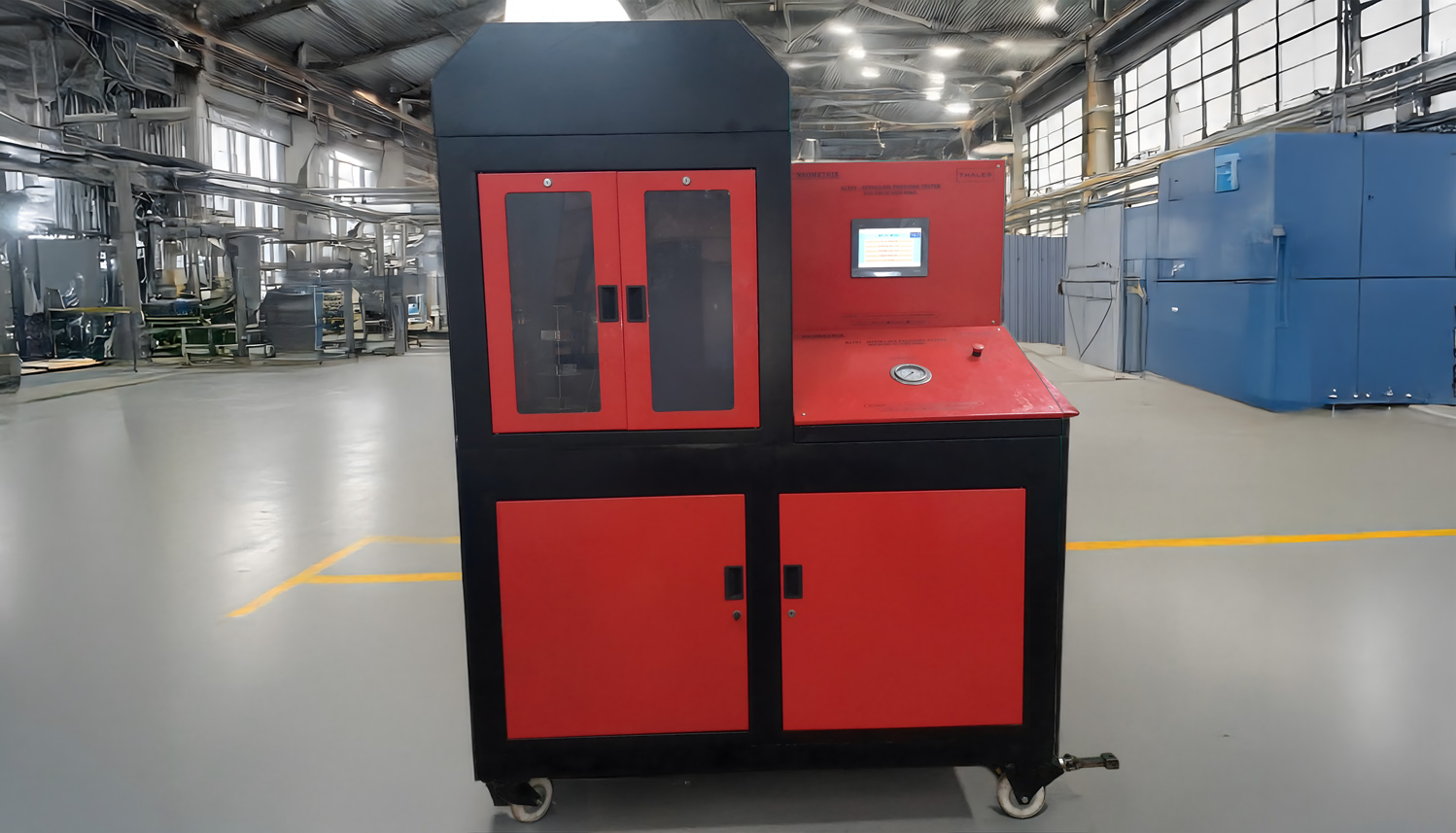

PLC Controlled Autoclave Pressure Tester: Batch Cyclic Testing to 9,000+ Cycles
A component that survives one pressure test tells you very little about what it does on cycle nine thousand. The PLC Controlled Autoclave Pressure Tester exists to answer the harder question: does this part still hold after it’s been pressurized, held, and released, over and over, the way it actually will be in service? Neometrix’s system runs a 13-liter SS304 pressure vessel — structurally rated to 200 bar, operated up to 150 bar — batch-testing up to 12 units at once, with every second of every cycle logged.
The Chamber Is Rated Well Above Where It Runs
The autoclave itself is mirror-polished SS304 (Ra ≤ 0.8 μm interior), pressure-rated to 200 bar, holding 12 UUTs on a perforated tray under a clamp-ring lid with both mechanical lockout and electrical interlock. Running the test envelope at 150 bar while the vessel is rated to 200 bar isn’t excess caution for its own sake — it’s the margin that keeps the chamber itself out of the failure mode being tested for.
Six Conditions, or the System Won’t Pressurize
Before a single bar of pressure builds, six interlock conditions all have to check out: lid fully clamped, fluid level adequate, air supply present and in range, filters unclogged, valves correctly configured, and temperature within limits. Only when every one of those reports green does the PLC allow pressurization to begin — which is what keeps operator error from becoming a pressure-vessel incident.
A Self-Test Before the Real Test
Before UUTs ever see full test conditions, the system runs a stepwise pressure verification pass specifically to catch gasket leaks, micro-fractures, or clamp misalignments — the kind of fault that, left undetected, would corrupt every subsequent cycle’s data without anyone noticing until the results stopped making sense.
Every Cycle, Captured at 10 Hz
Pressure and temperature are sampled ten times a second and plotted live throughout the test. Ramp time is programmable from 5 to 15 minutes, hold duration from one second to 24 hours, and cycle count from zero to nine-plus — parameters set once as a recipe on the touchscreen HMI and reused for every subsequent batch, with time-pressure graphs, cycle-completion logs, and CSV exports available for audit after the fact.
Frequently Asked Questions
Why is the autoclave chamber rated to 200 bar if the actual test pressure only goes up to 150 bar?
Because the chamber itself needs a safety margin above the highest pressure it will ever be asked to hold, so that the vessel is never the weak point in a test meant to find weak points in something else. Running the system’s programmable test envelope up to 150 bar while the vessel is structurally rated for 200 bar — conforming to standards like ASME Section VIII Division 1, ISO 11120, and PD5500 — means the chamber has meaningful headroom even during the highest-pressure cyclic tests, rather than operating right at its own rated limit. That margin is also what allows the system to run a stepwise self-test verification pass before exposing units under test to full pressure, without risking the chamber’s own structural integrity in the process.
Why does the system run a self-test before actually testing the components inside it?
Because a gasket leak, a micro-fracture, or a clamp misalignment in the chamber itself would silently corrupt every subsequent test cycle’s data, and that kind of fault often isn’t visible until results stop making sense — by which point a whole batch of cyclic testing may need to be repeated. Before exposing units under test to full pressure conditions, the system runs a stepwise pressure verification specifically designed to catch these chamber-level faults early. This kind of self-check is especially important in high-stakes applications like defense, aerospace, and nuclear instrumentation, where a false pass on the equipment itself could mean a false pass gets recorded for the components being validated.
Get In Touch
For full specifications, RFQs, or a technical discussion about the PLC Controlled Autoclave Pressure Tester:
– Product page: PLC Controlled Autoclave Pressure Tester
– Email: [email protected]
– Phone: +91-7777-876-876