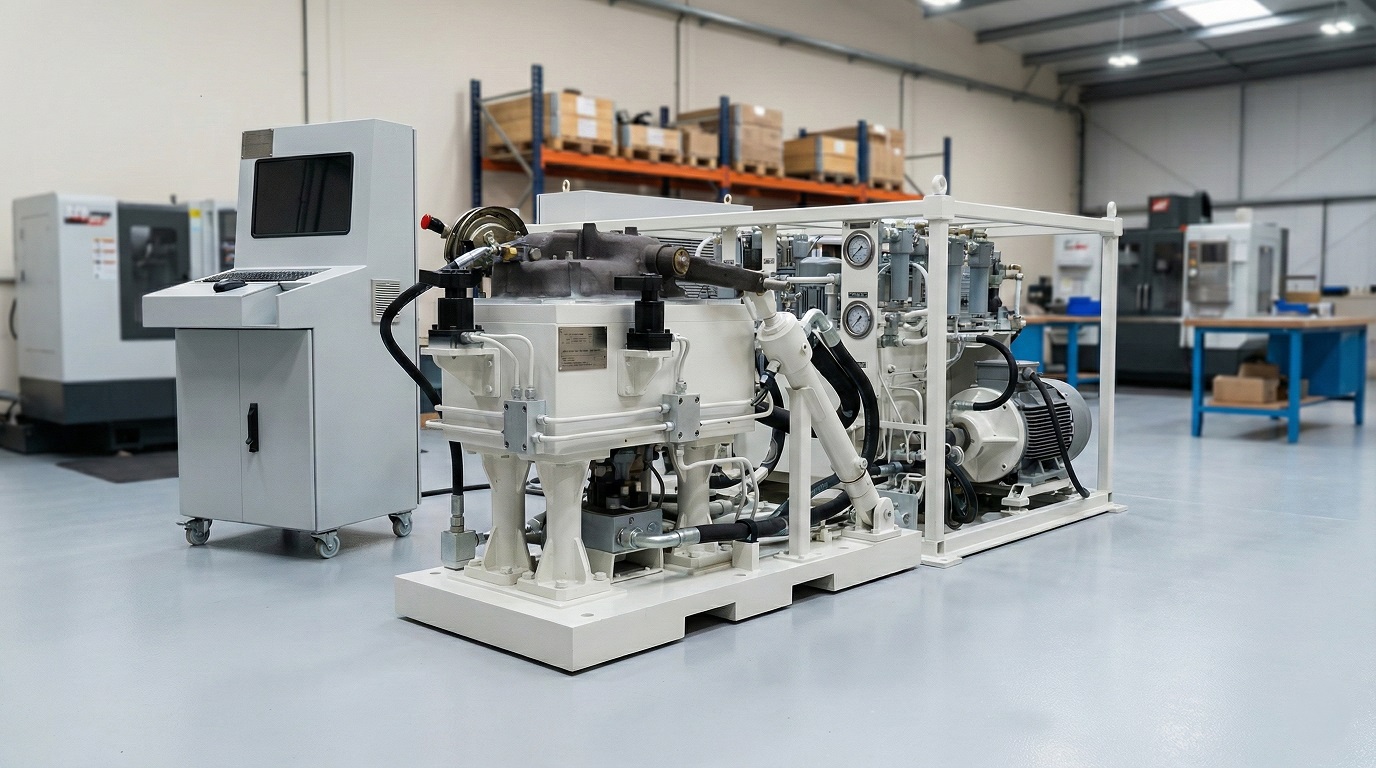

Rear Cover Hydraulic Test Rig: Functional Testing for Hydraulic Pump and Motor End Caps
Calling it a “rear cover” undersells what’s actually being tested. In many hydraulic pumps, motors, and hydrostatic transmissions, the rear cover isn’t just an end-cap sealing the housing — it’s a functional sub-assembly with precision oil galleries and integrated valve functions that directly govern pressure regulation, response behaviour, and stability. Neometrix’s Rear Cover Hydraulic Test Rig is a PLC- and DAQ-driven electro-hydraulic functional test bench built specifically to prove that governing behaviour, not just confirm the part looks right.
Why Dimensional Inspection Isn’t Enough
A few bar of pressure error, a sluggish response valve, an unnoticed free-play band, or inconsistent drop and hunting behaviour don’t show up on a dimensional check — but they turn into real field failures: unstable motion, slow or non-repeatable actuation, overheating, seal damage, premature wear, or unsafe machine behaviour under load. This rig forces the unit under test to demonstrate correct functional behaviour across low-flow and high-flow conditions, pressure thresholds, timing windows, and stability checks, while recording the evidence digitally.
Model-Wise Testing, Because Every Rear Cover Is Different
The rig supports four different models, each with its own parameter set — lift movement at defined flow rates, response valve pressure, free play, drop behaviour with the response valve open and closed, hunting/stability assessment, and lifting/lowering time. The operator selects the correct model before testing begins, because running the wrong model’s test recipe against a given rear cover wouldn’t just produce a useless result — it could produce a plausible-looking but wrong one.
Interlocked by Design, Not by Instruction
At each defined test step, the operator moves a lever to a defined position and presses acknowledge — and if acknowledge isn’t pressed, the test simply does not proceed further. This isn’t a documented procedure the operator is trusted to follow; it’s a hard interlock built into the test sequence itself, which is what actually prevents a rushed or skipped step from producing an incomplete but reported-as-complete test result.
Hunting Is a Stability Failure, Not a Performance Number
Alongside pressure checks, free-play measurement, and timing tests, the rig specifically checks for hunting — oscillation or instability in the rear cover’s control response rather than a simple pass/fail threshold on a single value. A rear cover that hits every individual pressure and timing spec but oscillates under a defined condition still has a control-stability problem that a pure numbers-based test would miss entirely.
Frequently Asked Questions
Why does a rear cover need functional testing instead of just dimensional inspection, if it’s essentially just an end-cap on the pump or motor housing?
Because in many hydraulic pump, motor, and hydrostatic transmission designs, the rear cover isn’t just a passive end-cap — it’s a functional sub-assembly that often integrates precision oil galleries and valve functions like pressure relief, response modulation, isolation, or anti-cavitation behaviour. Dimensional inspection can confirm that a part was machined to the correct measurements, but it cannot reveal whether the integrated valve functions actually behave correctly under real operating conditions — a pressure regulation error, a sluggish response valve, an unnoticed amount of free play, or an unstable “hunting” oscillation in the control response are all functional problems that dimensionally-correct parts can still have. Left undetected, these turn into real field failures: unstable motion, slow or non-repeatable actuation, overheating, premature seal wear, or in worst cases, unsafe machine behaviour under load. Functional testing forces the actual unit to demonstrate correct behaviour across defined flow conditions, pressure thresholds, timing windows, and stability checks — which is the only way to catch these failure modes before the part reaches the field.
Why does the test rig require the operator to press “acknowledge” at each defined step instead of just running the full test sequence automatically?
Because certain steps in the test procedure — particularly moving a control lever to a precise defined position before a measurement is taken — genuinely require operator judgment and positioning that can’t be fully automated away, and an interlock that blocks progress until that step is confirmed is what keeps the test rigorous rather than just fast. If the sequence could silently skip ahead past a step the operator hadn’t actually completed correctly, the resulting test report could show a completed pass/fail result that doesn’t actually reflect a properly executed test — which defeats the entire purpose of digital traceability. By making the test physically unable to proceed past a defined step until the operator has moved the lever into position and pressed acknowledge, the rig ensures that every recorded result corresponds to a step that was actually, correctly performed, rather than one that was assumed complete by the software.
Get In Touch
For full specifications, RFQs, or a technical discussion about the Rear Cover Hydraulic Test Rig:
– Product page: Rear Cover Hydraulic Test Rig (Electro-Hydraulic Functional Test Bench)
– Email: [email protected]
– Phone: +91-7777-876-876