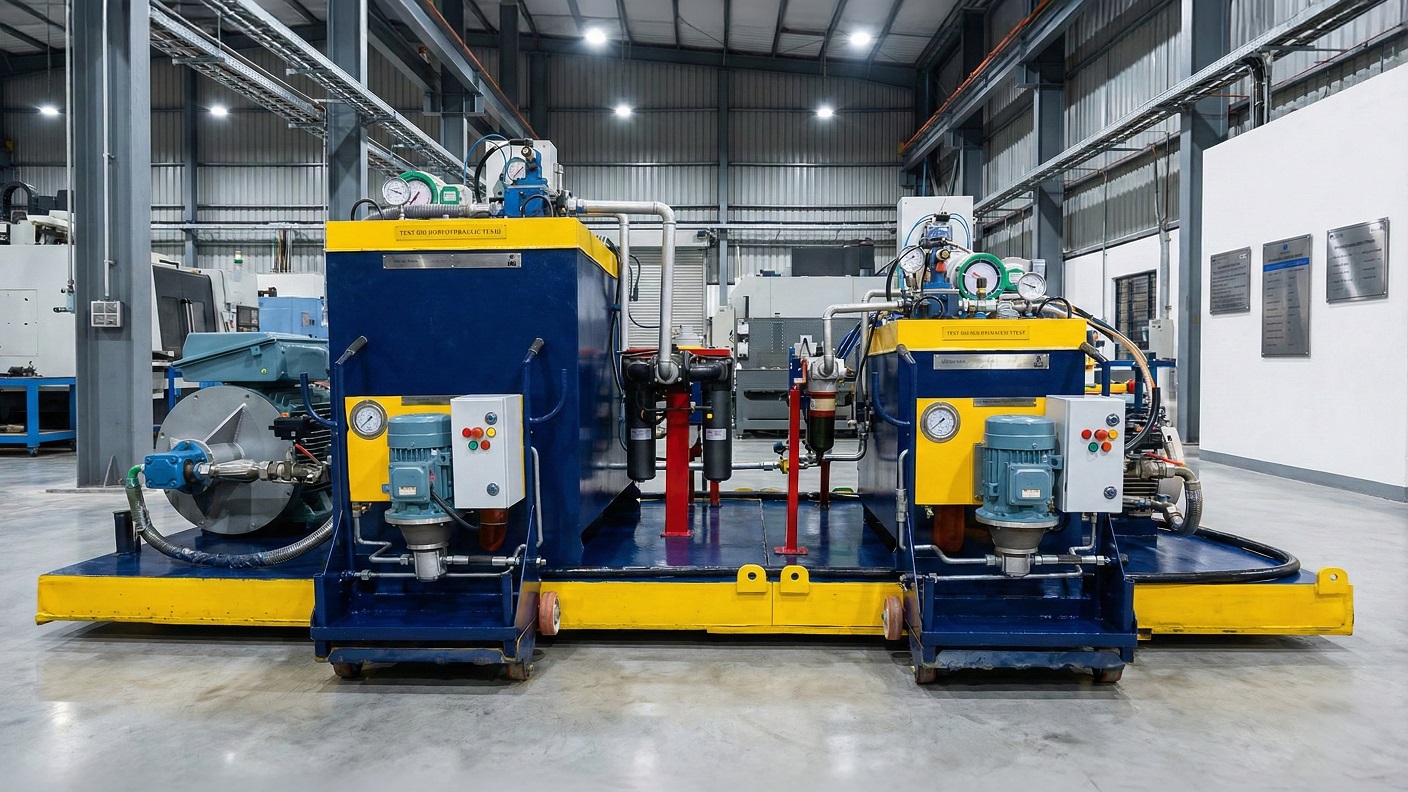

Test Rig for Hydraulic Fluid: Dual-Pump Wear and Oxidation Testing to ASTM D6973 / JCMAS P 045
A hydraulic fluid’s datasheet can promise excellent wear resistance and oxidation stability, but a datasheet isn’t a test — and the two failure modes it’s claiming to resist don’t happen the same way or under the same conditions. Neometrix’s Test Rig for Hydraulic Fluid is a fully automated, dual-pump bench that evaluates both, running a Vickers vane pump under ASTM D6973 and a bent-axis axial piston pump under JCMAS P 045, with automatic sampling and data logged every 0.1 seconds.
Why Wear Testing Needs a Vane Pump Specifically
The ASTM D6973 circuit uses a Vickers 35VQ25A-11*20 vane pump running at 2,400 RPM as the actual load element, cycling through outlet pressures of 6.9, 13.8, and 20.7 MPa and oil temperatures of 52°C, 79°C, and 95°C. A vane pump’s cam ring and vanes wear measurably under poor lubrication in a way that mirrors real vane-pump hydraulic systems — so the test doesn’t infer wear resistance indirectly, it measures actual mass loss from actual wear components running in real fluid.
Why Oxidation Testing Needs a Completely Different Circuit
The JCMAS P 045 side runs a bent-axis A2F10 axial piston pump at 350 bar design pressure, but the actual test mechanism is different: a copper catalyst plate plus deliberate air dosing (0.1 L/h) and water dosing (up to 100 mL/h) accelerate oxidative aging under conditions the fluid would only encounter gradually, over years, in real service. Compressing years of thermal and oxidative stress into a 500-hour test run is only valid if the acceleration mechanism — copper catalysis plus controlled contamination — actually reproduces the chemistry of real-world aging rather than some unrelated failure mode.
Sampling That Doesn’t Interrupt the Test
Six samples, up to 300 mL each, are collected automatically over the course of the 500-hour JCMAS run without operator intervention — because manually pulling samples from a live high-pressure, high-temperature circuit introduces both a safety concern and a repeatability problem that automated sampling removes entirely.
Data Density That Actually Supports Root-Cause Analysis
Every parameter is logged every 0.1 seconds throughout both test circuits. A wear or oxidation failure that happens gradually over hundreds of hours can still have a specific onset point — a moment where the trend actually changes — and that onset is only visible in the data if the logging resolution is fine enough to catch it rather than averaging it away.
Frequently Asked Questions
Why does testing hydraulic fluid quality require two completely different pumps instead of one standard test?
Because wear resistance and oxidation stability are genuinely different failure modes that stress a fluid in different ways, and a single test mechanism can’t validate both credibly. Wear testing needs a pump whose moving parts — a cam ring and vanes, in a vane pump — actually wear measurably when lubrication or fluid quality is inadequate, so that mass loss from those components under controlled load and temperature becomes a direct, physical measurement of the fluid’s anti-wear performance. That’s what the ASTM D6973 circuit, built around a Vickers vane pump, is designed to do. Oxidation stability is a different question entirely — it’s about how the fluid’s chemistry holds up under prolonged heat exposure combined with contaminants like air, water, and catalytic metals, which is closer to a chemistry aging problem than a mechanical wear problem. The JCMAS P 045 circuit, built around a different pump architecture with a copper catalyst and controlled air/water dosing, is purpose-built for that. Running one test doesn’t tell you about the other failure mode, which is why a credible fluid-qualification bench needs both.
Why does the oxidation stability test deliberately dose air and water into the fluid, and add a copper catalyst, instead of just running the fluid hot for a long time?
Because running fluid hot on its own doesn’t reproduce the actual chemistry of how hydraulic fluid degrades in real service over years of use. In real hydraulic systems, fluid is exposed not just to heat but to trace moisture that gets in through seals and breathers, small amounts of entrained air, and contact with metal surfaces — particularly copper and copper alloys common in hydraulic components — all of which participate in and accelerate oxidative breakdown of the fluid. Deliberately dosing air (around 0.1 L/h) and water (up to 100 mL/h) into the test fluid, combined with a copper catalyst plate submerged in the circuit, reproduces those same real-world contributing factors in a concentrated, controlled way, so that a 500-hour accelerated test can meaningfully stand in for years of gradual field aging. Heat alone, without those catalytic and contamination factors present, would test a different and less representative failure mode than what actually degrades hydraulic fluid in service.
Get In Touch
For full specifications, RFQs, or a technical discussion about the Test Rig for Hydraulic Fluid:
– Product page: Test Rig for Hydraulic Fluid
– Email: [email protected]
– Phone: +91-7777-876-876