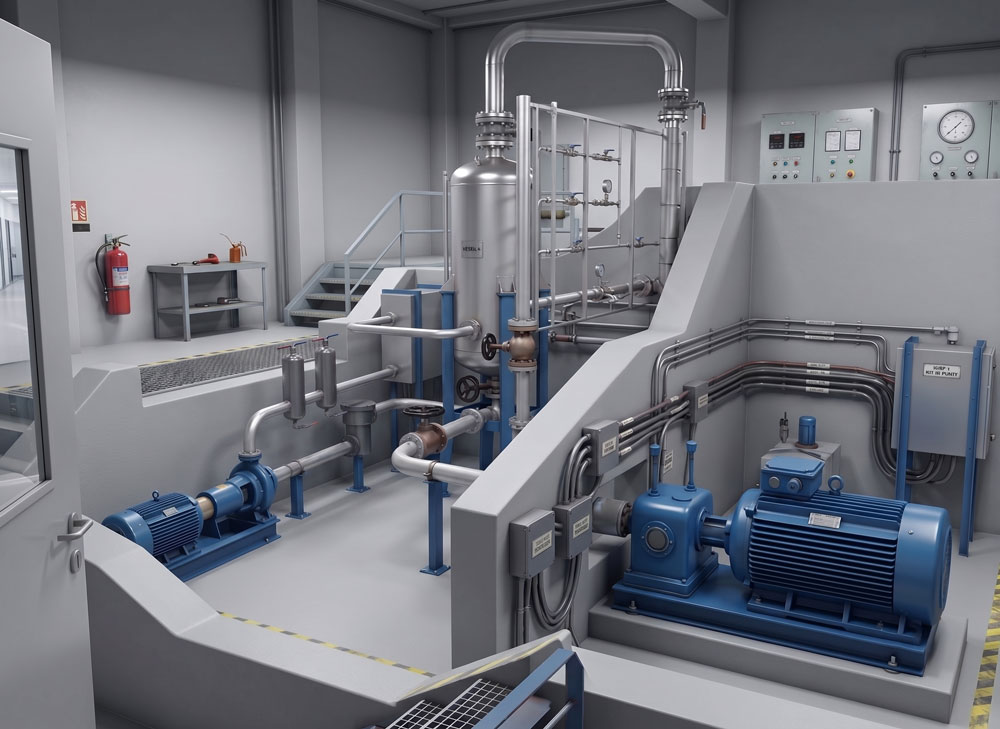

ATF Fuel Pump Test Rig DTSN-82: Qualifying the Pump That Keeps Fuel Injection Fed
A centrifugal fuel booster pump has one job that sounds simple and isn’t: keep positive fuel pressure at the inlet of downstream injection components across the entire flight envelope, from sea-level ground operation to altitude conditions where fuel tank pressure can drop below ambient. Neometrix’s ATF Fuel Pump Test Rig DTSN-82 is purpose-built to run in and qualify exactly that pump — the DTSN-82 centrifugal fuel booster used in certain military aircraft fuel injection systems — using real Aviation Turbine Fuel across the pressures, flows and speeds it will actually see in service.
Controlled Conditions, Not Just a Running Bench
The rig pressurises the ATF tank using shop air and a vacuum pump, reaching inlet absolute pressures from 0.2 to 3.2 kg/cm2 at the unit under test — the low end simulating the altitude cavitation margin a pump has to survive, the high end simulating boosted ground conditions. Delivered flow is measured across the pump’s full operating range of 500 to 150,000 LPH at drive shaft speeds up to 1000 RPM, while a circulating water cooling system holds the fuel within its permissible 20-120°C envelope throughout.
Cleanliness Is Not Optional With ATF
Aviation fuel system components are sensitive to particulate contamination at a level most industrial pumps never have to consider. The rig maintains ATF cleanliness better than NAS 1638 Class-4 throughout the entire test cycle, protecting the DTSN-82’s precision internal clearances from contamination-induced wear during running-in — because a pump that fails prematurely in the field due to test-rig contamination is a worse outcome than a pump that simply wasn’t tested at all.
Built for an ATF Environment, Not Adapted to One
All interconnect wiring is heat- and moisture-resistant, coded, and routed through dedicated cable trays per IS norms — a real consideration in an ATF vapour environment. Every individual component is leak-tested before assembly, and the complete final assembly undergoes a further leak test under full operating pressure. A hard-wired emergency shutdown, independent of the control system, and drive interlocks that won’t allow a start unless fluid conditions are confirmed round out the safety architecture.
Frequently Asked Questions
Why does the rig need to pressurize the ATF tank down to 0.2 kg/cm2 instead of just testing at normal atmospheric pressure?
Because a fuel booster pump in service doesn’t always see comfortable, atmospheric-pressure fuel at its inlet — at altitude, fuel tank pressure can drop meaningfully below ambient, and the pump still has to deliver adequate flow without cavitating under that reduced inlet pressure. Testing only at normal atmospheric conditions would miss exactly the scenario where a marginal pump is most likely to fail in service. By using shop air and a vacuum pump to control ATF tank pressure down to 0.2 kg/cm2 absolute at the unit under test, the rig can verify the pump performs correctly across the full altitude envelope it’s rated for, not just under the easiest ground-level conditions.
Why does ATF cleanliness matter enough to specify NAS 1638 Class-4 for a test rig, rather than just running clean fuel through once?
Because a centrifugal fuel booster pump’s internal clearances are precision-machined, and particulate contamination introduced during the test itself — not just contamination the pump might see later in service — can cause wear that either damages a good pump or masks the true performance of a marginal one. If the rig’s own fuel circuit isn’t held to a strict cleanliness standard throughout running-in and performance testing, contamination from the test process itself can corrupt the results, essentially testing the rig’s cleanliness discipline instead of the pump’s actual performance. Maintaining NAS 1638 Class-4 cleanliness throughout the test cycle keeps the measurement honest.
Get In Touch
For full specifications, RFQs, or a technical discussion about the ATF Fuel Pump Test Rig DTSN-82:
– Product page: ATF Fuel Pump Test Rig DTSN-82
– Email: [email protected]
– Phone: +91-7777-876-876