
Ballistic Evaluation Testing Laboratory: Proving a Panel Stops the Round, Repeatably
A panel stopping one round proves very little. Certifying body armour is a disciplined sequence — condition the sample, fire a calibrated round at a known velocity and yaw, and read the back-face deformation in a clay reference, repeated across calibres, fragments and temperatures until the statistics hold. Neometrix’s Ballistic Evaluation Testing Laboratory is that entire sequence, instrumented end to end and built clause-by-clause to the IS 17051:2018 and NIJ 0106 regimes.
The Range Line, Muzzle to Backing Face
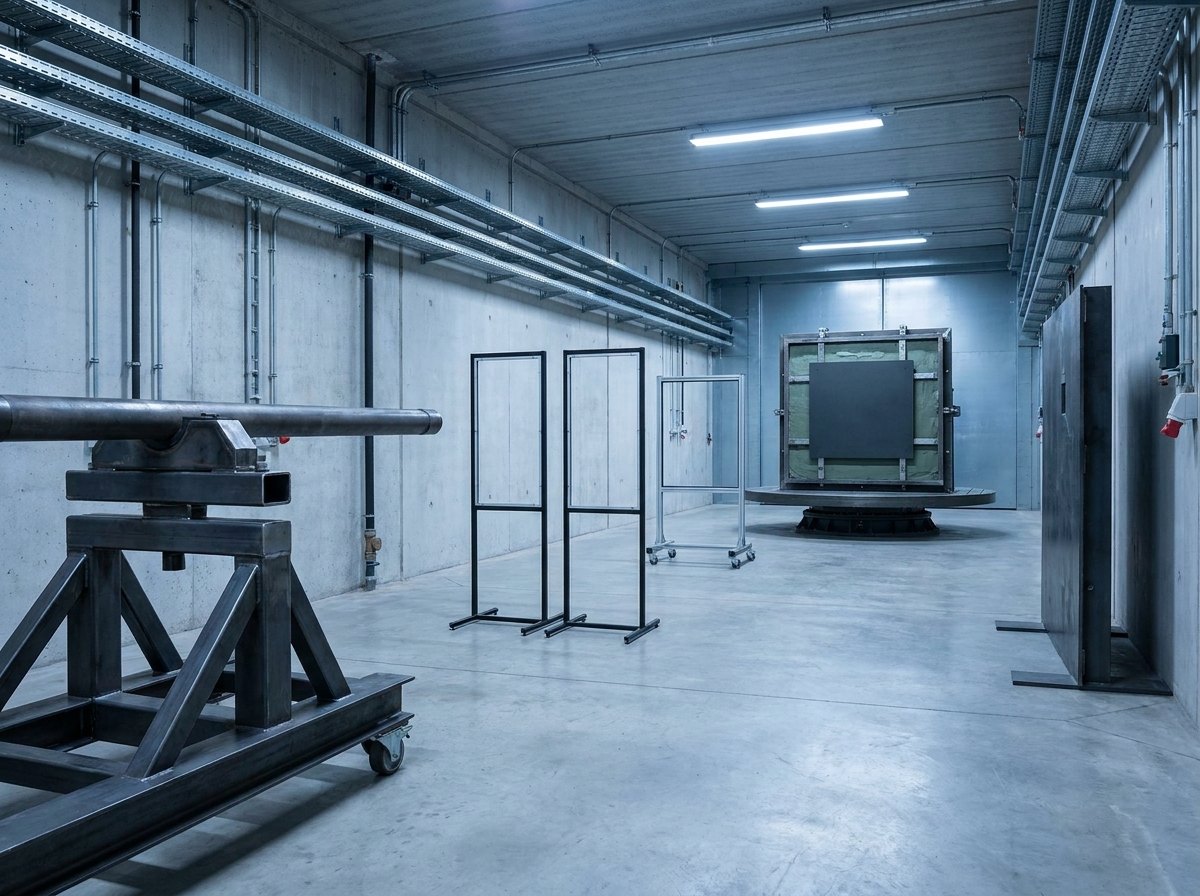
A round leaves a remote-fired EPVAT firing rest, crosses two independent non-contact light-gate screens that time its velocity to 0.1% anywhere from 50 to 1800 m/s, passes a ±0.5° yaw gate, and strikes the armour panel clamped to a 610 x 610 x 140 mm backing-material fixture — whose metallic edges are the reference planes the back-face deformation is measured against. The panel sits on a motorised target table, 900 mm across with 450 kg capacity and 360° stepless rotation, positioned entirely from a 20-metre remote, because everything down-range of the muzzle is behind armour when the shot breaks.
Two Screens, Not One
Two independent light-gate screen sets read strike velocity at the same station, centred 2.5 ± 0.025 m from the backing face — a deliberate redundancy so a rejected shot can be told apart from a rejected panel rather than blamed on a single instrument’s possible error. A separate high-speed gate resolves projectile yaw to ±0.5° over a 45° range, recording obliquity with every shot.
Rounds, Fragments, and the Conditioning That Comes First
NATO/CIP velocity barrels cover the 9×19, 5.56×45, 7.62×39, 7.62×51 and 7.62×54 service calibres, while a fragment barrel and reloading station cover the 17 gr FSP and 2/4/16/64 gr RCC simulators used for V50 ballistic-limit work. Before any of that firing happens, samples pass through a -40 to +180°C environmental chamber, a temperature-and-humidity tumbler at 65°C / 80% RH per NIJ 0101.06, an armour-submersion bath, and drop-test rigs that validate both the clay backing and the hard armour itself.
Frequently Asked Questions
What is V50, and why does the whole range line exist just to measure it?
V50 is the velocity at which a given armour construction stops half of the rounds fired at it — not the velocity at which it stops one round, which is a far less reliable number. Getting a trustworthy V50 figure requires firing a series of calibrated rounds at carefully controlled velocities and averaging the results according to a defined statistical method, which is why the entire range line exists: the remote-fired rest, twin velocity screens, yaw gate and motorised target table all work together to produce many precisely measured shots under repeatable conditions, rather than a single pass/fail result that could just as easily reflect one lucky or unlucky round as it reflects the armour’s actual capability.
Why do the velocity screens need to be independent, rather than using one high-precision instrument?
Because a single instrument gives you no way to distinguish a genuinely marginal shot from an instrument reading you can’t fully trust. With two independent light-gate screen sets timing the same shot at the same station, a discrepancy between them flags a measurement problem immediately, rather than silently corrupting the recorded velocity for that shot. This matters enormously for V50 testing specifically, because the whole statistical method depends on knowing the actual strike velocity of every round with confidence — an unflagged instrument error could shift a calculated V50 result in either direction without anyone knowing it happened.
Get In Touch
For full specifications, RFQs, or a technical discussion about the Ballistic Evaluation Testing Laboratory:
– Product page: Ballistic Evaluation Testing Laboratory
– Email: [email protected]
– Phone: +91-7777-876-876