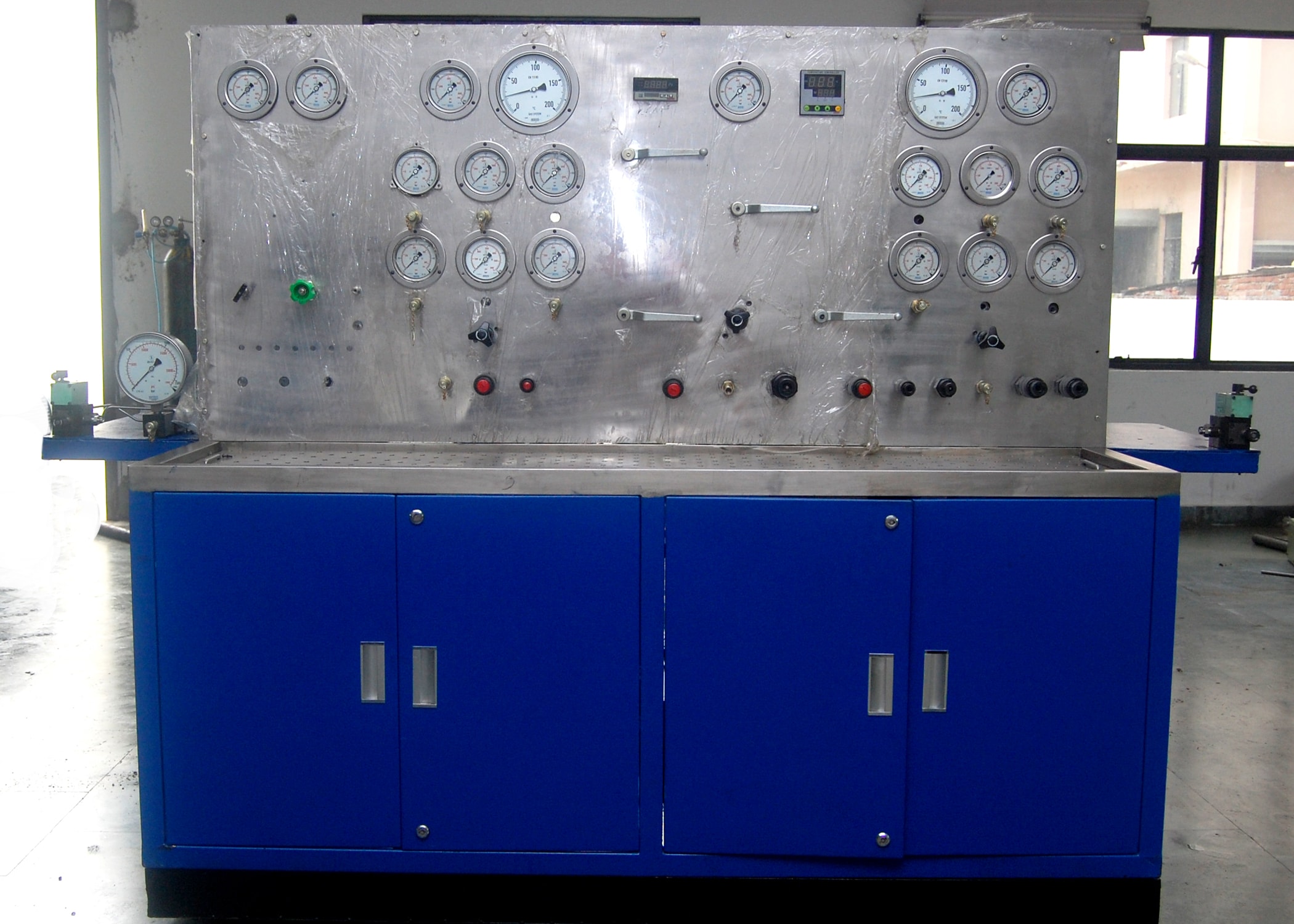

Hydraulic Test Rig HS-748: Eleven Aircraft Hydraulic Assemblies, One Platform
An HS-748 aircraft’s hydraulic system isn’t one component to test — it’s eleven, from cut-out valves and pressure relays to jacks, accumulators, brake assemblies and steering selector valves, each with its own test requirements. Neometrix’s Hydraulic Test Rig HS-748 is a self-contained, general-purpose electro-hydraulic test rig engineered to a governing tender specification, built so all eleven of those assemblies can be tested on a single platform rather than a shelf of dedicated fixtures.
Static and Dynamic, on the Same Rig
The rig supports both static proof-pressure testing and dynamic functional testing, with a static pressure intensifier for high-pressure generation and ease of operation. Two independent hydraulic systems run in parallel — each with its own return line and pressure gauges — and can also be combined when a test calls for it, giving two operators the ability to work independently on different assemblies at the same time.
Nineteen Gauges, Not a Guess
Nineteen pressure gauges, reading in both bar and PSI, are distributed across the rig: seven per hydraulic system, one on the return line, and two on the pneumatic line, backed by three standard pressure transmitters and Minimess-hose-equipped measurement ports. A 0-30 LPM flow meter and a 250-litre SS304 reservoir — complete with level gauge, filler breather, temperature switch and temperature gauge — round out the instrumentation that turns “the valve held pressure” into a documented, repeatable measurement.
Built to Hydraulic Oil MIL-H-5606
The rig is developed specifically for Hydraulic Oil MIL-H-5606 or its equivalent, with filtration capacity up to 2 micron — because the eleven components under test, from the pressure relay’s 5000 PSI static requirement down to the modulator and flow indicator valve, depend on fluid cleanliness the aircraft’s original systems were designed around.
Frequently Asked Questions
Why does a single test rig need to cover eleven different hydraulic components instead of specialising in just the most critical ones, like the brake assembly?
Because an aircraft’s hydraulic system is only as reliable as its weakest tested component, and an MRO facility working to a governing tender specification doesn’t get to choose which of the eleven assemblies matters most — cut-out valves, pressure relays, down-lock and unlock assemblies and jacks, main and nose jacks, accumulators, relief valves, non-return valves, the modulator, flow indicator valve, brake assembly and steering selector valve all need functional and proof-pressure verification before the aircraft returns to service. Building the Hydraulic Test Rig HS-748 to cover all eleven on one platform, with two independent systems allowing two operators to work simultaneously, means a facility doesn’t need eleven separate dedicated fixtures — or the floor space, calibration overhead and downtime that would come with them — to fully qualify a hydraulic overhaul.
Why does the rig have two independent hydraulic systems instead of just one higher-capacity system?
Because the eleven components it tests don’t all need to be tested at once by a single operator, and splitting the rig into two independent systems — each with its own return line and full set of pressure gauges — lets two operators work on two different assemblies simultaneously, which meaningfully speeds up throughput on a busy overhaul line. The two systems can also be combined when a specific test genuinely requires the combined capacity, so the independence doesn’t come at the cost of flexibility — it’s an either/or capability chosen per test, not a permanent limitation.
Get In Touch
For full specifications, RFQs, or a technical discussion about the Hydraulic Test Rig HS-748:
– Product page: Hydraulic Test Rig HS-748
– Email: [email protected]
– Phone: +91-7777-876-876