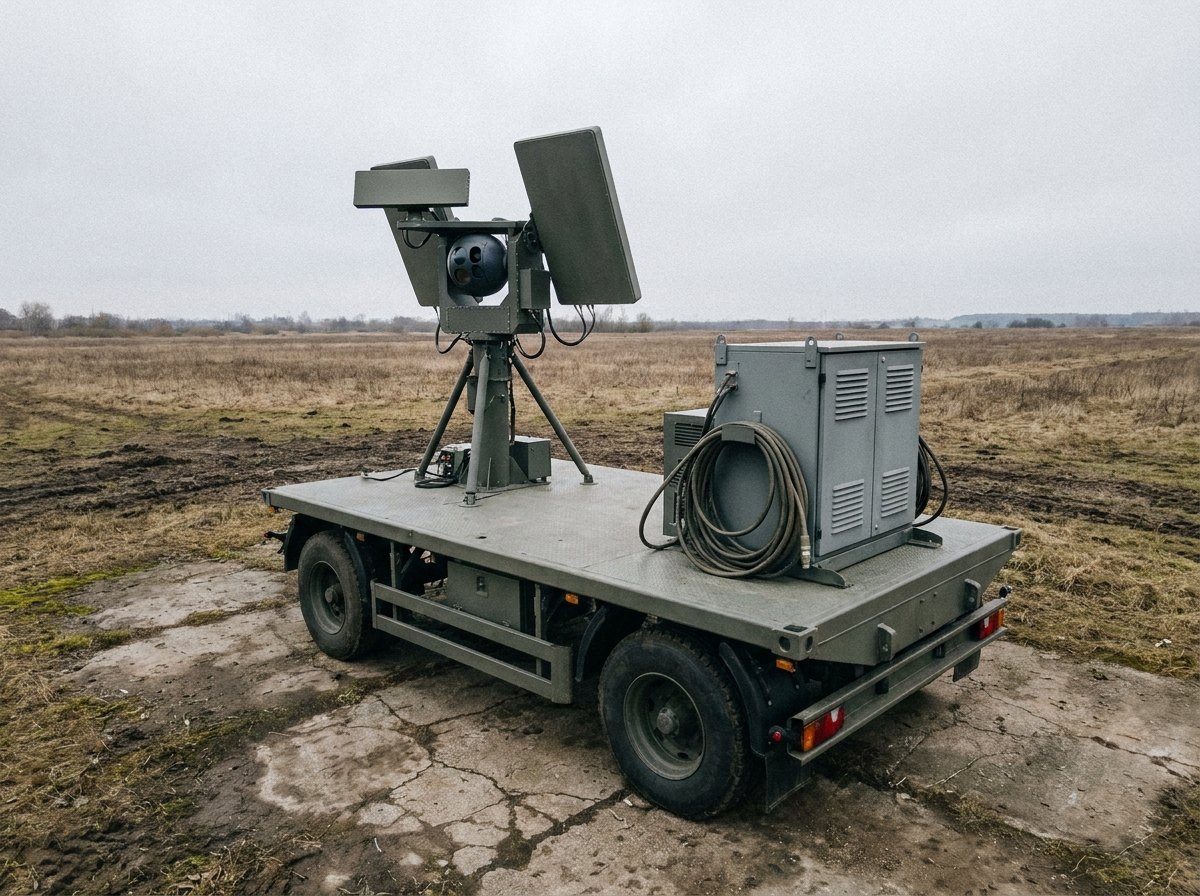

Counter-Drone (C-UAS) System: Seeing the Drone Is Only the First Third of the Job
A small drone costs very little. A swarm of them can watch, harass or attack a base, a convoy or a critical site. Defending against that takes a layered counter-drone (counter-UAS) system that can see the drone, decide what it is and whether to act, and then stop it. No single box does all three well. Neometrix’s role is the part that makes a set of specialist sub-systems into one fielded system: the platform, the power and the integration.
Detect, Decide, Defeat
– Detect: radar, an RF scanner and an electro-optical / infra-red camera are layered so that a small, slow, low target is actually seen and tracked.
– Decide: command-and-control software fuses the sensors, classifies the track as friend or foe, and gives the operator the picture and the decision.
– Defeat: a soft-kill option (denying or taking over the drone’s links) and/or a hard-kill option (an interceptor, net or directed-energy effector), selected to the threat and the rules of engagement. These are described at capability level only.
The Half Neometrix Builds
The kill chain is only as good as the platform that carries it into the field and keeps it powered on watch. Neometrix builds the mobile or fixed carrier, the stabilised pointing pedestal, the silent-watch power, the ballistic and environmental protection, and the mechanical, electrical and data integration that turns the sub-systems into one system.
Honest About What Is Ours
The sensors, the defeat effector and the C2 software are specialist or government-furnished sub-systems from established makers and defence laboratories. Neometrix integrates them and does not build them. The system is engineered to order, and no specific delivered system is claimed. It is defensive in purpose: it protects a force or site from hostile drones.
Where Counter-Drone Systems Go Wrong
Often in the platform and integration, as much as in the sensors. A sensor suite with no silent-watch power cannot stay on watch. A badly integrated set of boxes from different makers fights itself. A platform that cannot be protected or moved stays fixed where the last threat was. And latency in the detect-to-decide chain means the drone is seen too late.
Frequently Asked Questions
Why does a counter-drone system need several sensor types?
Because no single sensor sees every drone. Radar can detect a small, low target, an RF scanner picks up the control link, and an electro-optical / infra-red camera confirms what the target is. Layering them lets command-and-control cross-check a track before the operator decides to act, which reduces both missed detections and false alarms.
What does a prime integrator actually add?
The system around the sub-systems. A prime integrator owns the platform that carries and protects the equipment, the power that keeps it on watch, the pointing and the data integration, so sensors, C2 and effector from different makers work as one chain rather than as separate boxes.
Get In Touch
For specifications, RFQs, or a technical discussion about counter-drone platforms and integration:
– Product page: Counter-Drone (C-UAS) System
– Email: [email protected]
– Phone: +91-7777-876-876