
Heat and Flow, Under Pressure: Inside a Thermal-Hydraulics Test Facility
The behavior that decides whether a power plant or reactor is safe is thermal-hydraulic: how heat moves into the coolant, how the coolant flows, what happens when it starts to boil and whether it keeps circulating when the pumps stop. You cannot study those phenomena in a running plant, because the whole point is to understand them before anything goes wrong. So they are recreated on a dedicated test loop, at real temperatures and pressures, under dense instrumentation. This guide explains how such a facility works, for nuclear and energy researchers, plant designers and procurement teams in the USA, the UK and Europe.
Key Takeaways
– A thermal-hydraulics (TH) facility recreates plant conditions on the ground: high temperature, high pressure, single- and two-phase water and steam.
– Heat and flow are coupled: heat changes the flow (it boils it) and flow changes the heat (it carries it away), so the loop tests them together.
– The hard cases are the critical heat flux (the boiling crisis) and natural circulation (flow by density alone, with no pumps), which underpins passive safety.
– Neometrix builds the loop: high-pressure piping, instrumented test section, pressuriser, condensers, structure, safety and instrumentation and data-acquisition integration. Heater rods, HP pumps and precision instruments are bought in.
– Engineered to order. No delivered facility is claimed.
Why a Test Loop, Not the Plant
The phenomena that decide safety cannot be studied in a running reactor or power plant. A test loop recreates the high-temperature, high-pressure, two-phase conditions on an instrumented rig, where they can be measured, turning a design’s thermal-hydraulic assumptions into measured fact. The results validate the design, the safety case and the analysis codes used to predict plant behavior.
What the Loop Studies
| Phenomenon | Why it matters |
|---|---|
| Critical heat flux (CHF) | The point where a heated surface dries out and its temperature runs away; it sets the safety margin |
| Two-phase flow | Boiling water and steam flow behave very differently from single-phase liquid and are hard to predict |
| Natural circulation | Coolant that keeps flowing by density differences alone is the basis of modern passive safety |
| Boiling heat transfer | Characterizes how efficiently heat leaves a surface at different conditions |
| Flow-accelerated corrosion and erosion | Material degradation tied to flow conditions (listed in the page’s applications) |
What Is in the Loop
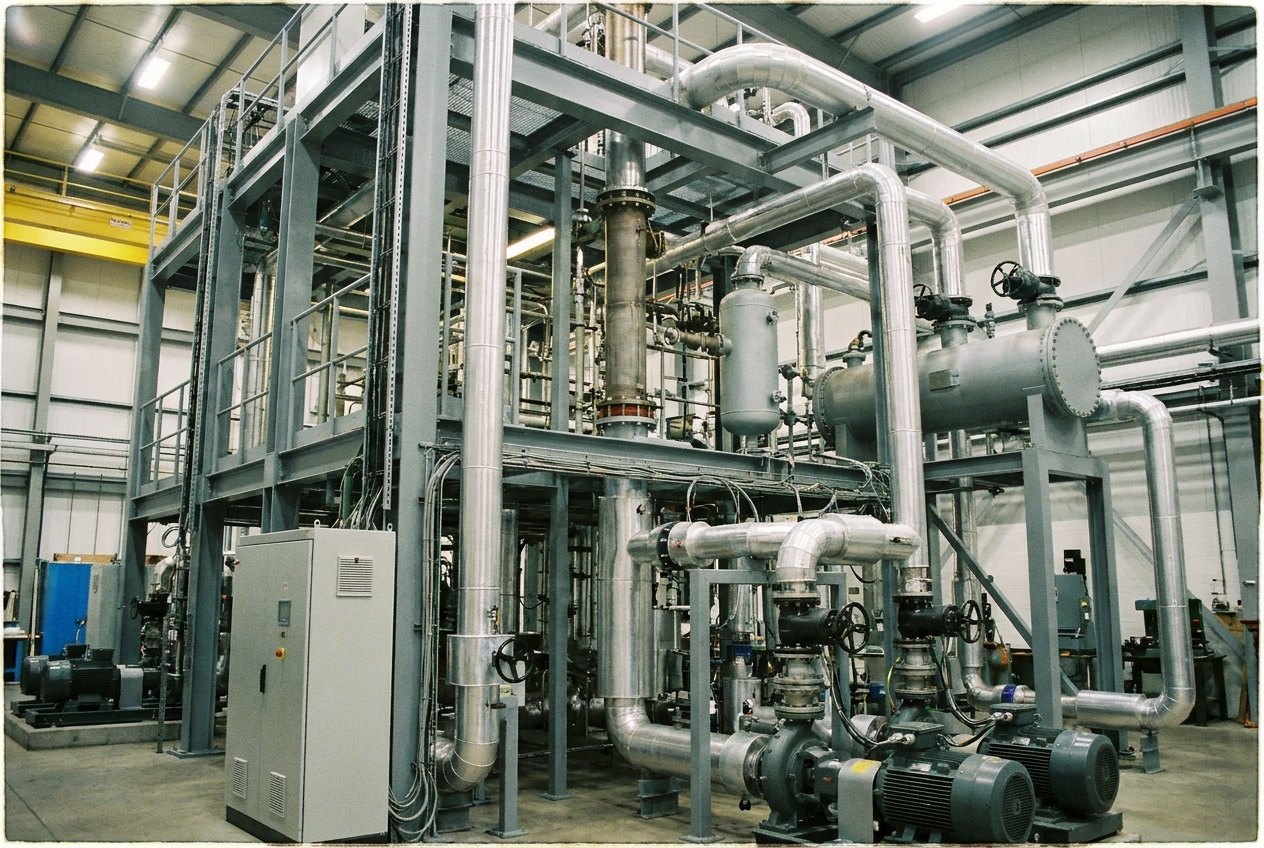
1. Heated test section: heater rods put a measured heat flux into a real flow, with dense instrumentation reading what happens.
2. Pumps and pressuriser: drive the flow (or let it circulate naturally) and hold the loop pressure.
3. Condensers: reject the heat and close the loop.
4. High-pressure, high-temperature piping and multi-storey structure that carry and support the loop.
5. Data acquisition and control: turn the measurements into data engineers can validate against.
Four Configurations
– HTHP forced-circulation loop: pumped circulation with a heated test section, the general-purpose workhorse.
– Natural-circulation / passive-safety loop: circulates by density alone to study and qualify passive cooling and passive decay-heat removal.
– Boiling and critical-heat-flux facility: configured to find the CHF and characterize boiling and two-phase heat transfer.
– Component / test-section loop: built around a specific component or geometry (a heat exchanger, rod bundle, valve or tube) to characterize it at real conditions.
Applications
Reactor thermal-hydraulics and safety research; passive-safety and natural-circulation qualification; critical-heat-flux and boiling studies; flow-accelerated corrosion and erosion studies; thermal-power and process-plant development; and analysis-code validation and benchmarking.
Honest Scope
The instruments and heater rods are specialist bought-in items. What makes them a facility is the loop around them, and building such experimental loops is the Neometrix competence. The page frames the build as being to the pressure-vessel code. Because the physics is subtle and coupled, the loop has to be right and the instrumentation dense.
Standards and Procurement Context for US, UK and European Buyers
Thermal-hydraulic loops combine pressure-equipment codes with nuclear-quality and validation practice. Frameworks buyers commonly reference include:
– United States: ASME Boiler and Pressure Vessel Code (Section VIII for pressure vessels, Section III for nuclear components), ASME B31.1 for power piping, ASME NQA-1 for nuclear quality assurance and NRC requirements such as 10 CFR 50 Appendix B.
– United Kingdom: the Pressure Systems Safety Regulations 2000 (PSSR), and Office for Nuclear Regulation expectations for nuclear-related research facilities.
– European Union: the Pressure Equipment Directive 2014/68/EU with EN 13445 (unfired pressure vessels) and EN 13480 (industrial metallic piping).
– International: IAEA safety standards, OECD Nuclear Energy Agency work on code validation for thermal-hydraulics, and ISO/IEC 17025 for traceable instrument calibration.
– Quality: ISO 9001 and ISO 14001 (listed on the Neometrix page).
Neometrix does not claim certification to these on the page. Send the phenomena, the envelope and the instrumentation and Neometrix replies with a clause-by-clause compliance matrix within two working days.
Buyer’s Checklist: 8 Questions for a Test-Loop Supplier
1. What temperature, pressure and flow range does the loop need to reach, and with what margin?
2. Which phenomena must be studied (CHF, two-phase, natural circulation, component behavior)?
3. How is the test section heated, and how is heat flux measured and controlled?
4. What instrumentation density and data-acquisition rate are needed, and how is it calibrated?
5. How is the loop pressure held and protected, and what safety systems are fitted?
6. How does the design comply with pressure-vessel and piping codes?
7. What is built in-house, and what is bought in (heater rods, pumps, instruments)?
8. What commissioning, training and documentation come with the facility?
Frequently Asked Questions
What is a thermal-hydraulics test facility?
A test loop that recreates the heat and flow conditions of a power plant or reactor, at high temperature and pressure, so the behavior can be measured and the design validated.
What does it study?
Mainly boiling and critical heat flux, two-phase flow and natural circulation, plus component behavior and corrosion tied to flow.
What is critical heat flux?
The point where a heated surface dries out and its temperature runs away; it sets the safety margin for a design.
What does Neometrix build, and what is bought in?
Neometrix builds the loop (piping, test section, pressuriser, condensers, structure, safety and DAQ integration); the heater rods, HP pumps and precision instruments are bought in.
Get in Touch
Send the phenomena, the temperature and pressure envelope and the instrumentation for a clause-by-clause compliance matrix and a budgetary quotation within two working days:
– Product page: Thermal-Hydraulics Test Facility
– Tenders and quotations: [email protected]
– Phone: +91-7777-876-876 (India; dial +91 from the USA, UK and Europe)