
Compressed Natural Gas (CNG) has become one of the most widely adopted alternative fuels for commercial and passenger vehicles worldwide — offering lower emissions and lower fuel cost compared to petrol and diesel. But CNG fuel systems operate at pressures up to 350 bar, and any undetected leak in a high-pressure gas circuit creates a fire and explosion hazard that conventional inspection methods cannot reliably catch.
Automated leak testing — using pressure decay, differential pressure, and helium mass spectrometry methods — is the only way to verify that every CNG circuit leaving a production line, retrofit centre, or component factory is genuinely leak-tight before it reaches the road.
Why CNG Leak Testing Cannot Be Left to Visual Inspection
A leak in a CNG system is frequently invisible and inaudible at the threshold that matters for safety. Microscopic leaks at threaded fittings, valve seats, regulator diaphragms, and weld joints can release gas at rates well below human detection thresholds — yet still represent unacceptable risk in an enclosed engine bay or vehicle cabin over the vehicle’s operating life.
This is why automotive and component-level CNG leak testing standards (ISO 15500 series, ARAI, AIS norms in India, and equivalent regulations internationally) specify quantitative leak rate limits and require instrumented, repeatable test methods — not visual or soap-bubble checks — for production release.
Leak Testing Methods for CNG Systems
Pressure Decay Testing
The component or circuit is pressurised to a specified test pressure and isolated. Pressure is monitored over a defined hold period. Any leak causes a measurable pressure drop. Temperature compensation is essential — uncorrected temperature drift can produce false leak indications or mask real leaks.
Differential Pressure Testing
A reference (known leak-free) volume is pressurised alongside the test component. The differential pressure between the two is monitored — this cancels out common-mode effects like ambient temperature drift, increasing sensitivity and test speed compared to single-channel pressure decay.
Helium Mass Spectrometry
For the highest sensitivity requirements — critical components, high-performance regulators, cylinder valves — the test component is exposed to helium (a small, inert tracer gas) and a mass spectrometer detects helium molecules passing through any leak path. This method detects leak rates orders of magnitude smaller than pressure-based methods, at the cost of longer cycle time and higher equipment complexity.
Why Temperature Compensation is Critical
Gas pressure is a function of temperature as well as leak rate (ideal gas law: PV = nRT). A small ambient temperature change during a pressure decay test can produce a pressure change that swamps the signal from a genuine small leak — or, conversely, can mask a real leak if temperature happens to be falling during the test. Production-grade CNG leak testers must measure temperature continuously and apply real-time compensation to the pressure signal, isolating the true leak-driven pressure change from thermal effects.
International Standards and Compliance
| Standard/Body | Region | Scope |
|---|---|---|
| ISO 15500 series | International | CNG fuel system components for vehicles |
| ARAI (Automotive Research Association of India) | India | Type approval testing for CNG vehicle systems |
| AIS (Automotive Industry Standards) | India | CNG component and vehicle safety norms |
| ECE R110 | International/Europe | CNG and LNG vehicle equipment approval |
| FMVSS 304 | USA | Compressed natural gas fuel container integrity |
| SAE J2343 | USA/International | Recommended practice for LNG and CNG fuel systems |
Applications
Automotive OEMs: End-of-line leak testing for every CNG-powered vehicle before it leaves the production line — verifying circuit integrity in compliance with ARAI, AIS, ECE R110, and global type-approval norms.
Component manufacturers: Regulator testing, nozzle and valve integrity tests, and cylinder valve inspection using high-sensitivity methods including mass spectrometry for critical components.
R&D and validation labs: Leak rate benchmarking of new component designs, and temperature-compensated long-duration pressure holding tests to characterise leak behaviour over time and thermal cycling.
Service stations and retrofit centres: Quick leak-tightness verification of retrofitted CNG systems, and leak verification after servicing existing CNG vehicle systems.
Neometrix CNG Vigilant
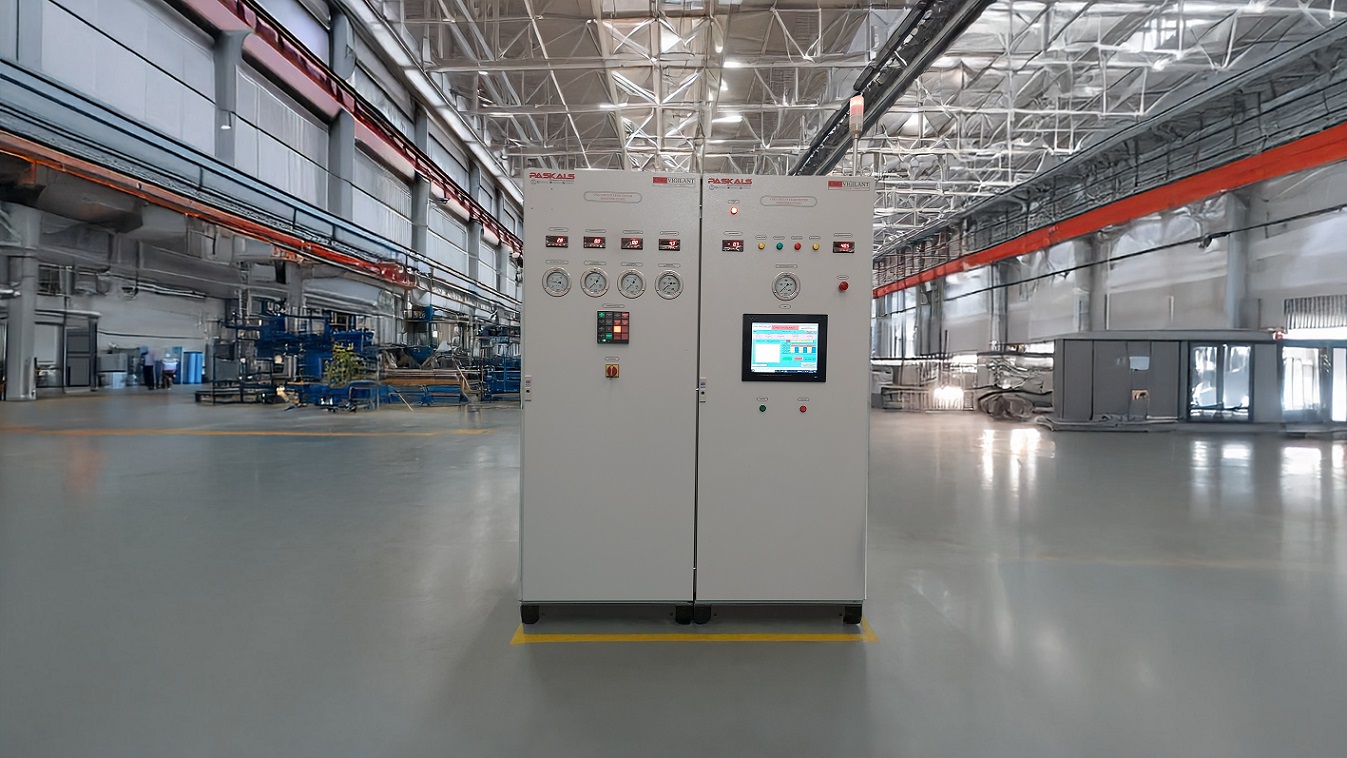
CNG Vigilant is a microprocessor-controlled, fully automatic leak tester that evaluates CNG circuit and component integrity under high-pressure conditions up to 350 bar.
Two configurations:
- Vigilant Ver. 0.30 — combines pressure decay and differential pressure methods with proprietary temperature compensation, for cost-effective, high-speed production testing
- Vigilant Ver. 0.34 — incorporates helium mass spectrometry for ultra-high sensitivity leak testing of critical components and high-performance applications
Features include built-in gas recycling, remote control operation, user-configurable test parameters, and real-time data logging.
→ View Full Specifications
→ Request a Quote
FAQ
Q: What pressure does CNG Vigilant test at?
A: CNG Vigilant tests CNG circuits and components under high-pressure conditions up to 350 bar — covering the full operating pressure range of automotive CNG fuel systems, from cylinders through regulators to the engine fuel rail.
Q: What is the difference between pressure decay and differential pressure leak testing?
A: Pressure decay monitors absolute pressure drop in a single isolated test volume over time. Differential pressure testing compares the test volume against a sealed reference volume simultaneously, cancelling out common environmental effects like ambient temperature drift. Differential methods are generally faster and more sensitive for production-line testing; pressure decay is simpler and sufficient for many applications when properly temperature-compensated.
Q: When is helium mass spectrometry leak testing necessary instead of pressure-based methods?
A: Helium mass spectrometry is used when leak rate sensitivity requirements exceed what pressure-based methods can reliably detect — typically for critical components like cylinder valves and high-performance regulators where even very small leaks must be caught. It detects leak rates orders of magnitude smaller than pressure decay or differential pressure methods, at the cost of longer test cycles and more complex equipment.
Q: What standards govern CNG vehicle leak testing in India?
A: ARAI (Automotive Research Association of India) and AIS (Automotive Industry Standards) govern type approval testing for CNG vehicle systems in India, referencing the ISO 15500 series for component-level requirements. Internationally, ECE R110 covers CNG and LNG vehicle equipment approval, and in the USA, FMVSS 304 covers compressed natural gas fuel container integrity.
Q: Why is temperature compensation essential in CNG leak testing?
A: Gas pressure changes with temperature independent of any leak, per the ideal gas law. Without real-time temperature compensation, a pressure decay test can produce false leak indications from ambient temperature drift, or mask a genuine leak if temperature happens to fall during the test window. Production-grade systems like CNG Vigilant measure temperature continuously and apply compensation algorithms to isolate true leak-driven pressure changes.
Neometrix Defence Ltd. designs and manufactures the CNG Vigilant automated leak testing system for automotive OEMs, component manufacturers, and R&D facilities. [email protected] | +91-7777-876-876