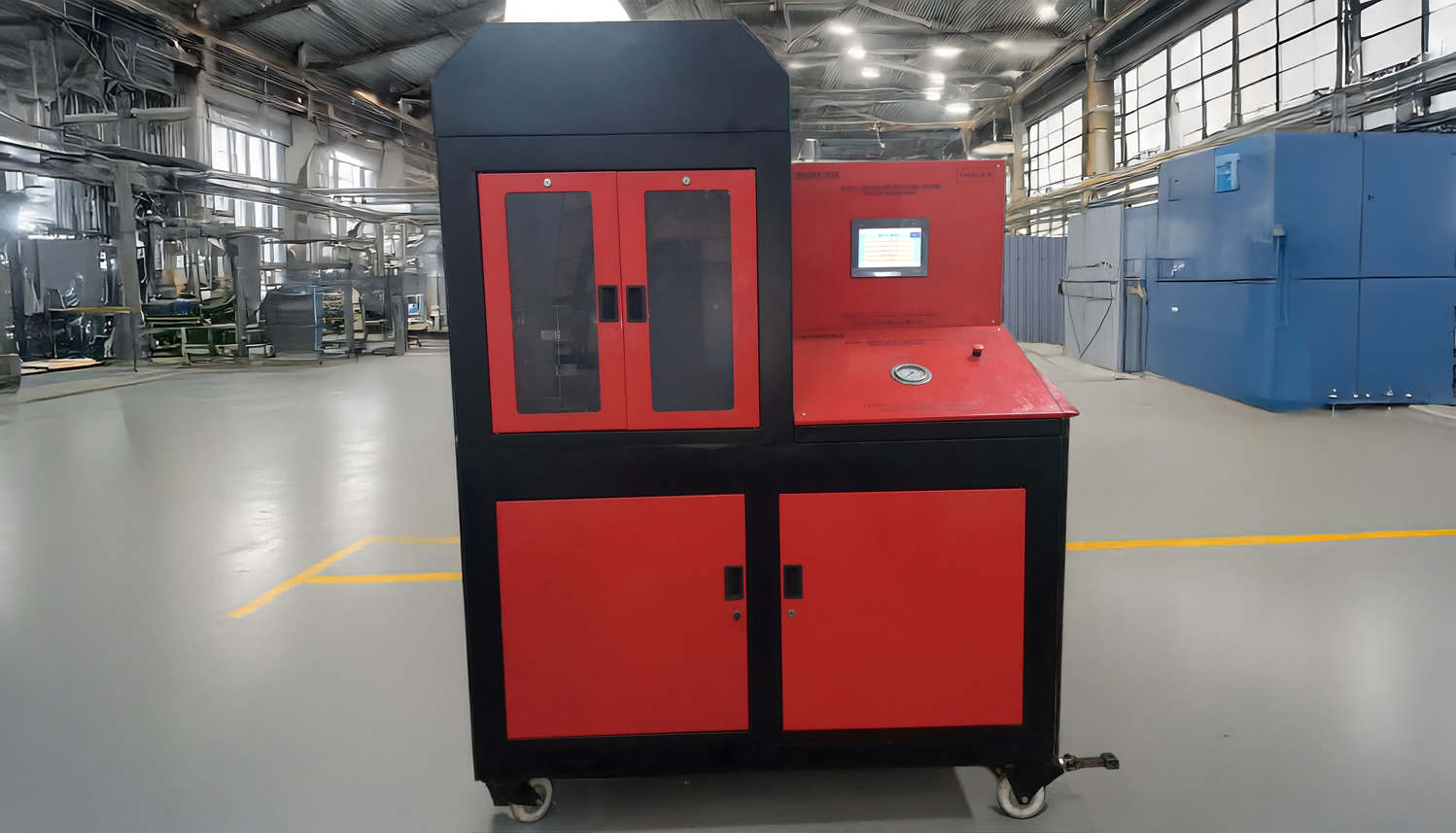

Components used in aerospace, automotive, medical, and energy applications rarely experience a single static pressure load in service — they experience repeated pressurisation and depressurisation cycles over their operating life. A solenoid valve in an aircraft, a fuel injector in a diesel engine, or a catheter in a medical device must survive thousands or millions of pressure cycles without leaking, cracking, or degrading. A PLC-controlled autoclave pressure tester is the laboratory instrument that simulates this cyclic loading in a compressed, accelerated test programme.
Unlike a simple proof-pressure test bench that applies a single pressure event, an autoclave pressure tester programmatically cycles pressure up, holds, and releases — repeating the sequence for the number of cycles needed to demonstrate fatigue life, leak-proof integrity, and long-term reliability under realistic service conditions.
How a PLC-Controlled Autoclave Pressure Tester Works
The chamber: Components under test are loaded into a sealed stainless steel chamber (a 13-litre SS304 chamber holding up to 12 small-to-medium components per batch is a typical configuration). The chamber is filled with a test medium (air, hydraulic oil, or water depending on the application) and connected to the pressure control circuit.
Pressure profiling: The PLC-HMI interface allows the operator to programme: ramp-up time (typically 5–15 minutes to reach target pressure), hold duration (from 1 second to 24 hours, depending on the test requirement), and number of cycles (commonly thousands, sometimes well beyond 10,000 for fatigue qualification).
Automated cycle execution: Once programmed, the system runs unattended — filling, ramping pressure, holding, depressurising, and repeating — for the full programmed cycle count, with no manual intervention required.
Data acquisition: Pressure, and often temperature, are logged continuously throughout the test. Live graphing during the test allows engineers to monitor for anomalies (a sudden pressure drop indicating a leak or failure) in real time, with full data export for post-test analysis and certification documentation.
Why Cyclic Testing Matters More Than Single-Event Proof Testing
A component can pass a single proof-pressure test — holding rated pressure for a few minutes without failure — and still fail catastrophically after 500 pressure cycles in service, because cyclic loading induces fatigue mechanisms (crack initiation and growth, seal degradation, material work-hardening) that a single static test cannot reveal.
This is why aerospace, automotive, and medical device qualification programmes specify cyclic pressure testing as a mandatory step, separate from and in addition to proof and burst pressure testing.
Applications by Industry
Aerospace and Defence: Life-cycle validation of solenoid valves, actuators, and pressure switches under repeated pressurisation; leak-proof testing of sensor casings under simulated flight pressure cycling.
Automotive: Pressure fatigue and burst testing of fuel injectors, braking system components, and turbocharger seals — components that see millions of pressure cycles over a vehicle’s service life.
Medical Devices: Certification of catheter integrity, implant enclosures, and pressure-sensitive drug delivery systems, where repeated pressurisation must not compromise sterility barriers or mechanical integrity.
Energy and Oil & Gas: Testing hydrogen-compatible fittings, gas cylinder components, and safety valves under cyclic pressure — particularly relevant as hydrogen infrastructure expands and material compatibility under repeated pressure cycling becomes a critical qualification parameter.
Industrial R&D: Composite and polymer fatigue simulations; burst and yield testing for advanced materials under realistic cyclic service conditions rather than single-event loading.
Key Functional Capabilities
| Parameter | Typical Range |
|---|---|
| Chamber volume | 13 litres (SS304), up to 12 units per batch |
| Maximum pressure | Up to 150 bar |
| Ramp-up time | 5–15 minutes (programmable) |
| Hold duration | 1 second to 24 hours |
| Number of cycles | Thousands, extendable well beyond 10,000+ |
| Control interface | PLC with touchscreen HMI |
| Data output | Live graphing, real-time logging, data export |
Neometrix PLC Controlled Autoclave Pressure Tester
A high-performance, PLC-controlled system for cyclic high-pressure testing and leak-proof validation of small to medium-sized components. The 13-litre SS304 chamber holds up to 12 units per batch, with programmable pressure profiles up to 150 bar, automated filling and draining, advanced safety interlocks, real-time data logging, and a touchscreen HMI.
→ View Full Specifications
→ Request a Quote
FAQ
Q: What is the difference between proof pressure testing and cyclic autoclave testing?
A: Proof pressure testing applies a single overload pressure event and verifies the component survives without permanent deformation or leakage — it’s a one-time structural check. Cyclic autoclave testing repeatedly pressurises and depressurises the component, often for thousands of cycles, to reveal fatigue failure modes — crack initiation, seal degradation, material work-hardening — that a single proof test cannot detect. Both tests are typically required for full component qualification, with cyclic testing demonstrating service-life durability rather than just immediate structural integrity.
Q: How many components can be tested simultaneously in an autoclave pressure tester?
A: This depends on chamber size and component dimensions. A typical configuration with a 13-litre SS304 chamber can hold up to 12 small-to-medium components per batch, allowing efficient batch testing rather than testing one component at a time — significantly improving throughput for production qualification testing.
Q: What test media are used in autoclave pressure testing?
A: The test medium depends on the application and the failure mode being investigated. Air or nitrogen is common for leak-proof and pneumatic component testing. Hydraulic oil is used when simulating actual service fluid conditions for hydraulic components. Water is used for hydrostatic-style testing where compressibility effects need to be minimised. The PLC control system manages fill, pressurise, hold, and drain cycles appropriately for whichever medium is selected.
Q: Why is cyclic pressure testing increasingly important for hydrogen system components?
A: As hydrogen infrastructure expands, components must demonstrate compatibility with repeated high-pressure hydrogen cycling — hydrogen embrittlement and material degradation mechanisms can be cycle-dependent rather than purely pressure-magnitude dependent. Cyclic autoclave testing with hydrogen-compatible fittings and materials is becoming a standard qualification step for hydrogen safety valves, fittings, and cylinder components.
Neometrix Defence Ltd. manufactures PLC-controlled autoclave pressure testers for aerospace, automotive, medical, and energy sector component qualification. [email protected] | +91-7777-876-876