
Aircraft fuel tanks present an explosion risk whenever the air-fuel vapour mixture in the ullage (the space above the liquid fuel) reaches a flammable composition. This risk has caused catastrophic aircraft losses including TWA Flight 800 in 1996, leading to regulatory requirements for fuel tank explosion suppression systems on transport-category aircraft and military platforms. The primary technology mandated or widely adopted is the On-Board Inert Gas Generating System — OBIGGS.
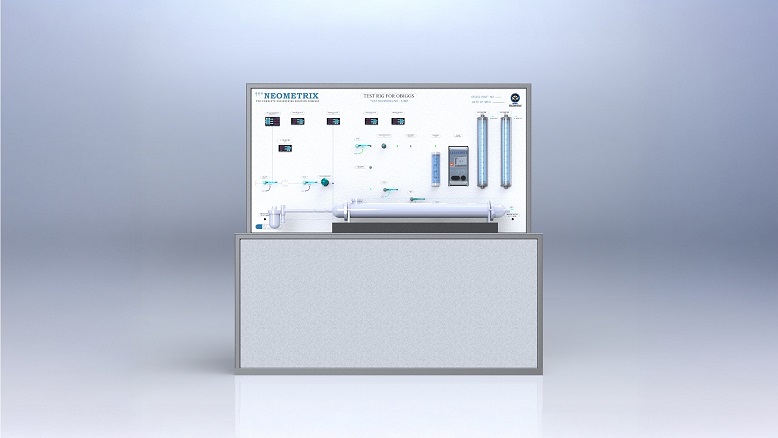
An OBIGGS test rig is the ground station platform used to qualify, certify, and maintain OBIGGS units — precisely replicating the bleed-air conditions the system receives in flight, measuring the oxygen concentration in the inert gas output, and verifying the system meets its performance specification before installation on an aircraft.
Why Fuel Tank Ullage Can Be Explosive — And How OBIGGS Prevents It
Jet fuel has a lower explosive limit (LEL) and upper explosive limit (UEL) in air. Below the LEL, the mixture is too lean to ignite. Above the UEL, it is too rich. Between LEL and UEL — the flammable range — any ignition source can detonate the mixture.
At many operating conditions (particularly during descent when the tank is partially filled with warm fuel and cooling rapidly), the ullage composition falls within the flammable range. Ignition sources include fuel pump arcing, lightning strikes, static discharge, and combat damage (for military aircraft).
OBIGGS prevents this by separating nitrogen-enriched air from engine bleed air and flowing it into the fuel tank ullage, displacing oxygen and keeping the ullage composition below 12% oxygen by volume — the threshold below which it cannot support combustion.
How OBIGGS Works
Bleed air extraction: Compressed air is tapped from the engine compressor section (typically 200–300°C, 4–7 bar). This is the same bleed air used for the Environmental Control System (ECS).
Pre-treatment: Multi-stage filtration and heat exchangers remove particulates, oil carryover, and moisture to ISO 8573-1 Class 1.1.1 — protecting the hollow fibre membrane separator that is the core of the system.
Hollow fibre membrane separation: Oxygen molecules, being smaller and more permeable through the hollow fibre membrane material, diffuse through the membrane wall faster than nitrogen. By controlling the pressure differential and flow velocity through the membrane module, a nitrogen-enriched air (NEA) stream exits one side and an oxygen-enriched air (OEA) stream is vented overboard.
Tank inerting flow: NEA flows into the fuel tank ullage through distribution nozzles. The OEA (enriched in oxygen compared to ambient air) is vented overboard through a check valve.
Oxygen monitoring: The oxygen concentration in the NEA delivered to the tank is continuously monitored — the system must maintain below 12% O₂ at the tank inlet throughout the flight envelope.
What an OBIGGS Test Rig Must Do
Bleed-air simulation: The test rig must supply heated, pressurised air to the OBIGGS unit at the exact temperature (up to 300°C), pressure (0.5–12 bar), flow rate (up to 1,000 LPM), humidity, and contamination level that the OBIGGS would receive from the engine bleed air system in flight.
Mass flow measurement: Precisely measures NEA output flow rate — critical for verifying the system can deliver adequate inerting flow at all flight conditions.
Oxygen concentration measurement: This is the primary performance metric. An oxygen analyser with ±0.02% accuracy continuously measures O₂ content in the NEA output — the system must maintain below specification limits (typically 9–12% O₂) throughout the test envelope.
Pressure and differential pressure monitoring: Tracks pressure across the membrane module and in the output stream to characterise membrane performance and detect degradation.
Data acquisition and reporting: PLC/HMI with custom SCADA software automates test sequences, captures data at 1–10 Hz across all channels, and generates certification-ready test reports (CSV/PDF/XML export).
Regulatory Framework
| Regulation/Standard | Region | Scope |
|---|---|---|
| FAA AC 25.981-2B | USA | Fuel tank flammability reduction methods |
| EASA AMC 25.981 | Europe | Acceptable means of compliance — fuel tank inerting |
| MIL-STD-810G | USA/NATO | Environmental testing (transport, temperature, vibration) |
| SAE ARP 1481 | USA/International | Fuel tank inerting performance requirements |
| FAA FAR 25.981 | USA | Fuel tank ignition prevention regulation |
Deployments
The Neometrix OBIGGS test rig has been deployed for systems used on F-16, Rafale, Eurofighter, A-330 MRTT, KC-135, military helicopters, and UAVs.
Applications
Aerospace OEM qualification: New OBIGGS designs are qualified on test rigs per SAE ARP 1481 and FAA/EASA regulations before aircraft type certification.
MRO depot maintenance: OBIGGS units removed from aircraft during maintenance are tested on the rig to verify performance before reinstallation.
Research and development: Test rigs support development of next-generation membrane materials, improved separator designs, and optimised control algorithms.
Military airworthiness acceptance: Military OBIGGS units are acceptance-tested per MIL-STD-810G and applicable military specifications.
Neometrix Test Rig for OBIGGS
A turnkey ground-station platform replicating bleed-air conditions (pressure 0.5–12 bar, flow up to 1,000 LPM, temperature and humidity controlled) with differential pressure, mass flow, and oxygen concentration measurement (0–100% O₂ at ±0.02% accuracy). PLC/HMI with custom SCADA for automated test sequences and certification-ready report generation. Meets MIL-STD-810G, FAA/EASA, and SAE inerting standards.
→ View Full Specifications
→ Request a Quote
FAQ
Q: What is OBIGGS and why is it required on modern aircraft?
A: OBIGGS (On-Board Inert Gas Generating System) prevents fuel tank explosions by continuously supplying nitrogen-enriched air to the fuel tank ullage, maintaining oxygen concentration below 12% (below which combustion cannot be sustained). FAA regulation 14 CFR 25.981 (for US-certified aircraft) and EASA CS-25.981 require fuel tank ignition prevention measures on new transport-category aircraft. Following the TWA 800 accident and subsequent NTSB investigations, fuel tank flammability reduction became a mandatory requirement for new designs and retrofit programmes.
Q: What oxygen concentration must OBIGGS maintain in the fuel tank ullage?
A: Below 12% oxygen by volume is the generally accepted threshold below which the fuel-air mixture in the ullage cannot sustain ignition and combustion — this is the primary performance requirement. SAE ARP 1481 provides the detailed performance standards. Some specifications are more stringent — particularly for military aircraft and aircraft with specific fuel types that have different flammability envelopes. The OBIGGS test rig measures oxygen concentration in the NEA output at ±0.02% accuracy to verify this requirement is met throughout the test envelope.
Q: What is the hollow fibre membrane separation principle used in OBIGGS?
A: OBIGGS uses hollow fibre membranes made from a polymer material that is preferentially permeable to oxygen — oxygen molecules diffuse through the membrane wall faster than nitrogen due to differences in molecular size and membrane solubility. Feed air (bleed air) enters the hollow fibres under pressure; oxygen preferentially permeates through the membrane wall, exiting as oxygen-enriched air (OEA) that is vented overboard; the remaining gas — depleted of oxygen, therefore nitrogen-enriched air (NEA) — exits the fibre ends and flows to the fuel tank. The separation efficiency depends on membrane material, fibre length, pressure differential, and temperature.
Q: What does the bleed-air simulation capability of an OBIGGS test rig need to provide?
A: The test rig must replicate the actual bleed air conditions the OBIGGS receives in flight: temperature (200–300°C from engine compressor — the test rig pre-heats supply air to this temperature), pressure (0.5–12 bar at the OBIGGS inlet, varying with engine power setting), flow rate (up to the maximum demand of the OBIGGS, typically several hundred LPM), humidity (as specified in the test protocol), and contamination (oil carryover, particulates at ISO 8573-1 levels). Without accurate bleed-air simulation, the test rig cannot verify OBIGGS performance in flight representative conditions.
Q: Why is OBIGGS testing important for military aircraft in addition to commercial aircraft?
A: Military aircraft face additional fuel tank explosion risks beyond those of commercial aircraft: combat damage creating ignition sources (bullet strikes, fragmentation), lower-altitude operations with fuel temperatures in the flammable range more frequently, and different fuels with different flammability envelopes. MIL-STD-810G environmental testing requirements add qualification demands beyond civilian standards. The Neometrix OBIGGS test rig has been deployed for military aircraft including F-16, Rafale, Eurofighter, A-330 MRTT, KC-135, and military helicopters.
Neometrix Defence Ltd. designs and manufactures OBIGGS test rigs for military and civilian aerospace qualification and MRO. [email protected] | +91-7777-876-876