
Recover, Purify, Recharge. One Closed Loop, Laboratory-Certified.
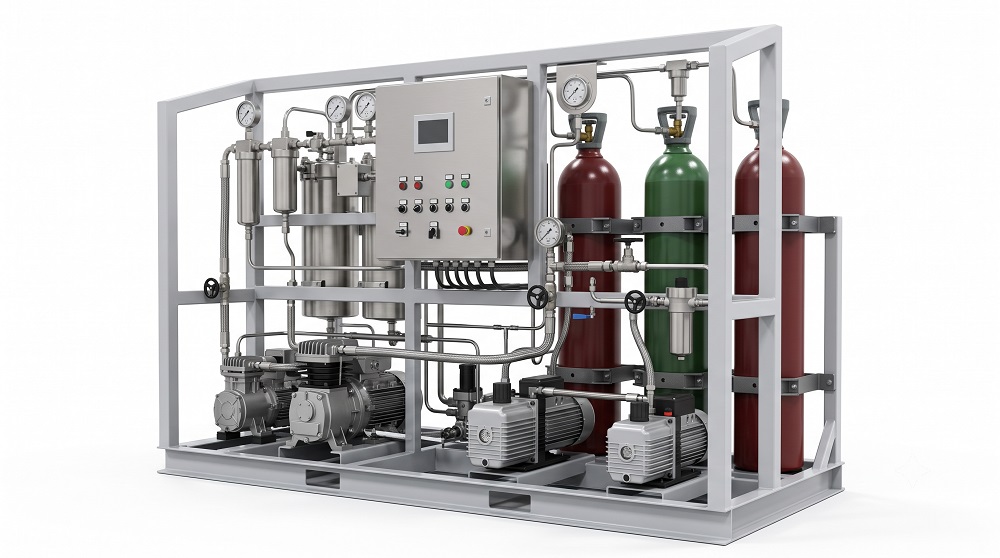
Halon-1211 and Halon-1301 haven’t been manufactured for new production in decades, which means every kilogram already in service is a resource to be reclaimed, not replaced. Neometrix’s Halon Reclamation & Refilling Facility automates that closed loop — evacuating spent Halon, purifying it, and recharging it — to better than 98% mass-balance efficiency and ISO 7201 / ASTM D7673 purity, skid-mounted and PLC-controlled for deployment in hangars, labs, plants, or as a trailer-mounted rapid-response unit.
Why Recovery Needs Refrigeration, Not Just Filtration
Spent Halon is evacuated to deep vacuum and routed through three-stage filtration — acid removal, a moisture trap with indicator, and a particulate filter — but filtration alone doesn’t separate Halon from the non-condensable gases mixed in during storage and handling. Cascaded refrigeration down to –70°C for Halon-1301 and –20°C for Halon-1211 condenses the agent itself out of that mixture, with non-condensable gas vented separately, which is what actually gets recovery efficiency above 98%.
Two Pump Modes for Two Different Recovery Conditions
Dual air-driven Haskel pumps operate in gravity, pump-only, or vacuum-assist modes depending on how much residual pressure is left in the source vessel — a nearly empty extinguisher needs a different pumping strategy than one still holding significant pressure. That flexibility is what sustains 200 tons/year throughput at 1.5 kg/min across 280 working days, rather than a single fixed pumping mode that’s efficient in some conditions and slow in others.
A Laboratory on the Same Skid as the Recovery Hardware
Gas chromatography, mass spectrometry, Karl Fischer moisture titration, residue testing, and boiling-point analysis certify each batch before recharge — not as a separate quality step bolted on afterward, but as an integrated part of the same closed loop. Reclaimed Halon that hasn’t been independently verified against ISO 7201 / ASTM D7673 isn’t actually certified for reuse, regardless of how well the recovery hardware performed.
Built to Deploy Where the Cylinders Already Are
A trailer-mounted variant delivers plug-and-play Halon recovery within 48 hours to remote or emergency sites, leveraging its own onboard power and compressed-air supply — because centralizing every reclamation job at one fixed facility means shipping pressurized Halon cylinders long distances, adding logistics risk that a mobile unit avoids by going to the cylinders instead.
Frequently Asked Questions
Why does recovering Halon require refrigeration down to -70°C instead of just filtering out the impurities?
Because filtration removes solid particulates, acidic byproducts, and moisture, but it can’t separate Halon vapor from the non-condensable gases — air, nitrogen, and other residual gases — that end up mixed in with it during storage, handling, and the evacuation process itself. Cascaded refrigeration solves this differently: cooling the recovered gas mixture down to -70°C for Halon-1301 (or -20°C for Halon-1211) condenses the Halon itself out of the mixture as a liquid, while the genuinely non-condensable gases stay in vapor form and can be vented off separately. This condensation step is what allows the facility to reach better than 98% mass-balance recovery efficiency — filtration alone, without the refrigeration stage, would leave meaningful amounts of recoverable Halon trapped in a gas stream that gets vented rather than reclaimed.
Why does the facility use two different pumping modes instead of one continuous pump for recovery?
Because the pressure condition of the source cylinder varies significantly from job to job, and a single fixed pumping approach can’t handle that range efficiently. A fire extinguisher or flight bottle that’s still holding substantial residual pressure can be recovered efficiently just by letting that pressure differential do most of the work (a gravity or pump-only mode), while a nearly depleted vessel needs active vacuum assistance to pull out the remaining Halon that isn’t going to flow out on its own. Dual air-driven Haskel pumps operating in gravity, pump-only, and vacuum-assist modes let the system match its recovery strategy to the actual condition of each source vessel, which is part of what sustains a rated throughput of 200 tons per year at 1.5 kg/min rather than being efficient only under one specific starting condition.
Get In Touch
For full specifications, RFQs, or a technical discussion about the Halon Reclamation & Refilling Facility:
– Product page: Halon Reclamation & Refilling Facility
– Email: [email protected]
– Phone: +91-7777-876-876