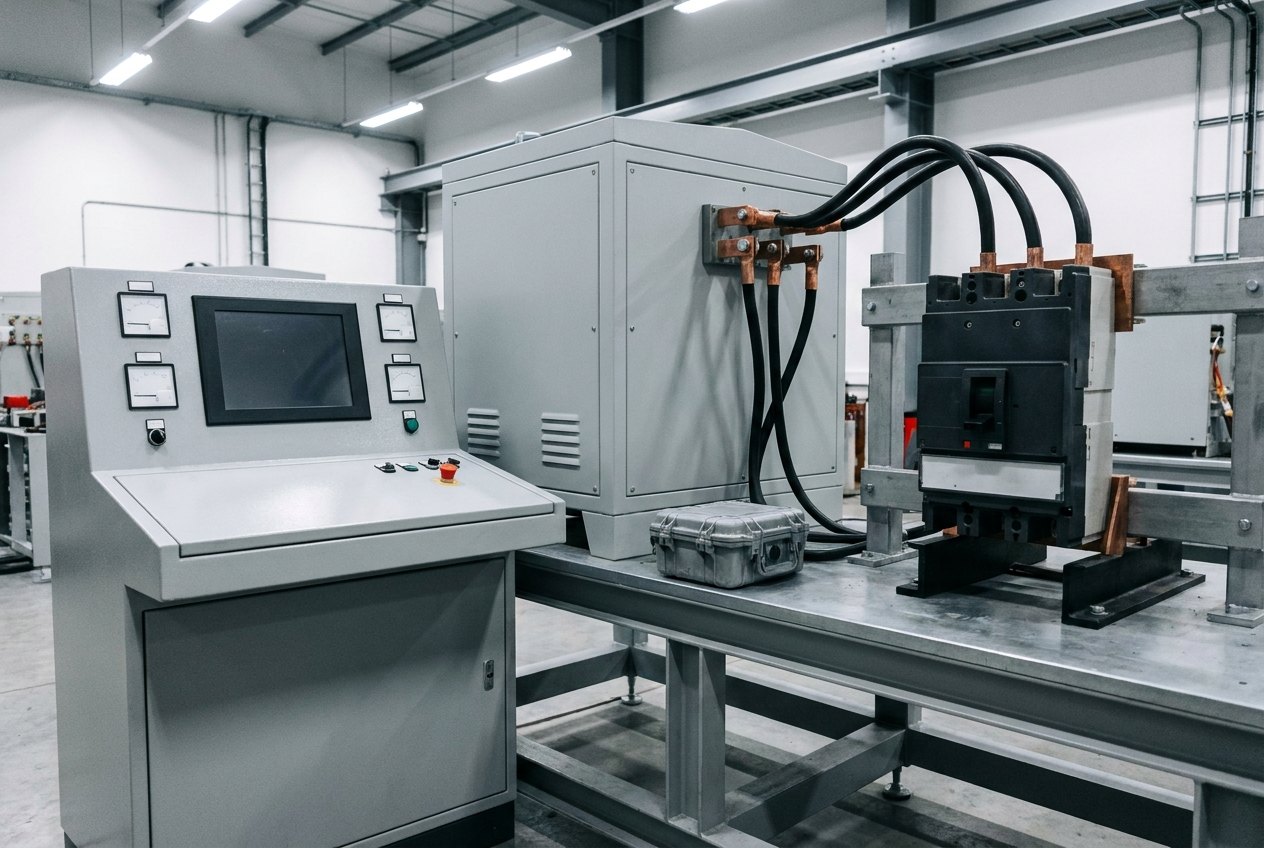

Circuit-Breaker & Relay Test Bench: Prove It Trips Before It Has To
A circuit breaker or protective relay spends almost its whole life doing nothing. Then, in a fault, it has milliseconds to trip and clear the circuit. If it is mis-set, mechanically sluggish or has degraded contacts, it fails exactly when everything depends on it. You cannot wait for a real fault to find out, so you inject a controlled one on a bench and confirm the device operates to its characteristic. That is what the Neometrix Circuit-Breaker & Relay Test Bench is for.
Inject the Fault, Measure the Response
– Breakers (primary injection): a large current is driven through the breaker to trace its time-current tripping curve, covering the thermal and magnetic trip.
– Relays (secondary injection): a test set applies precise current and voltage to verify pickup, dropout and operating time against the setting. A numerical relay is verified by three-phase injection across its protection functions.
– The mechanism itself: opening and closing time, pole discrepancy, contact resistance (a micro-ohm measurement that reveals eroded or loose contacts), insulation resistance, and the trip and close coils and spring-charge motor.
The Bench Is the Engineering
The specialist relay test set and the precision micro-ohmmeter are bought-in instruments. Neometrix engineers what makes them a safe, repeatable bench: the high-current injection source (transformer, variac and heavy busbar), the fixturing for the device, the control console and routing, measurement integration, automation and reporting, and the safety interlocks.
Four Variants
– LV breaker test bench: MCB / MCCB / ACB, with trip characteristic, timing, contact resistance and coil testing.
– Protective-relay test bench: secondary injection and numerical-relay testing.
– Contact-resistance and timing set: the mechanism-condition check, in maintenance as well as manufacture.
– Automated switchgear test line: a sequenced routine or production test bench with recipes and reporting.
The standards referenced are IEC 60947, IEC 60255 and IEC 62271. The class is engineered to order, and no specific delivered system is claimed.
Where Switchgear Testing Goes Wrong
In the setup, the source and the safety, not the pass/fail. An under-rated injection source cannot reach a breaker’s magnetic-trip current, a poor connection adds resistance that corrupts the reading, an uncalibrated test set misjudges a relay’s pickup, and high-current testing without guarding and interlocks is a safety failure regardless of the result.
Frequently Asked Questions
Why test a breaker with high primary current?
Because the magnetic trip of a breaker operates at fault-level current, and the only way to verify its characteristic is to drive that current through it. An injection source that cannot reach the trip current simply cannot test the device, which is why the source is sized to the breaker class being tested.
What does contact resistance tell you?
It is a micro-ohm measurement across closed contacts. A rising value indicates eroded, contaminated or loose contacts, which heat up under load and can degrade the breaker’s ability to carry or interrupt current. It checks the condition of the mechanism rather than the trip setting.
Get In Touch
For specifications, RFQs, or a technical discussion about switchgear test benches:
– Product page: Circuit-Breaker & Relay Test Bench
– Email: [email protected]
– Phone: +91-7777-876-876