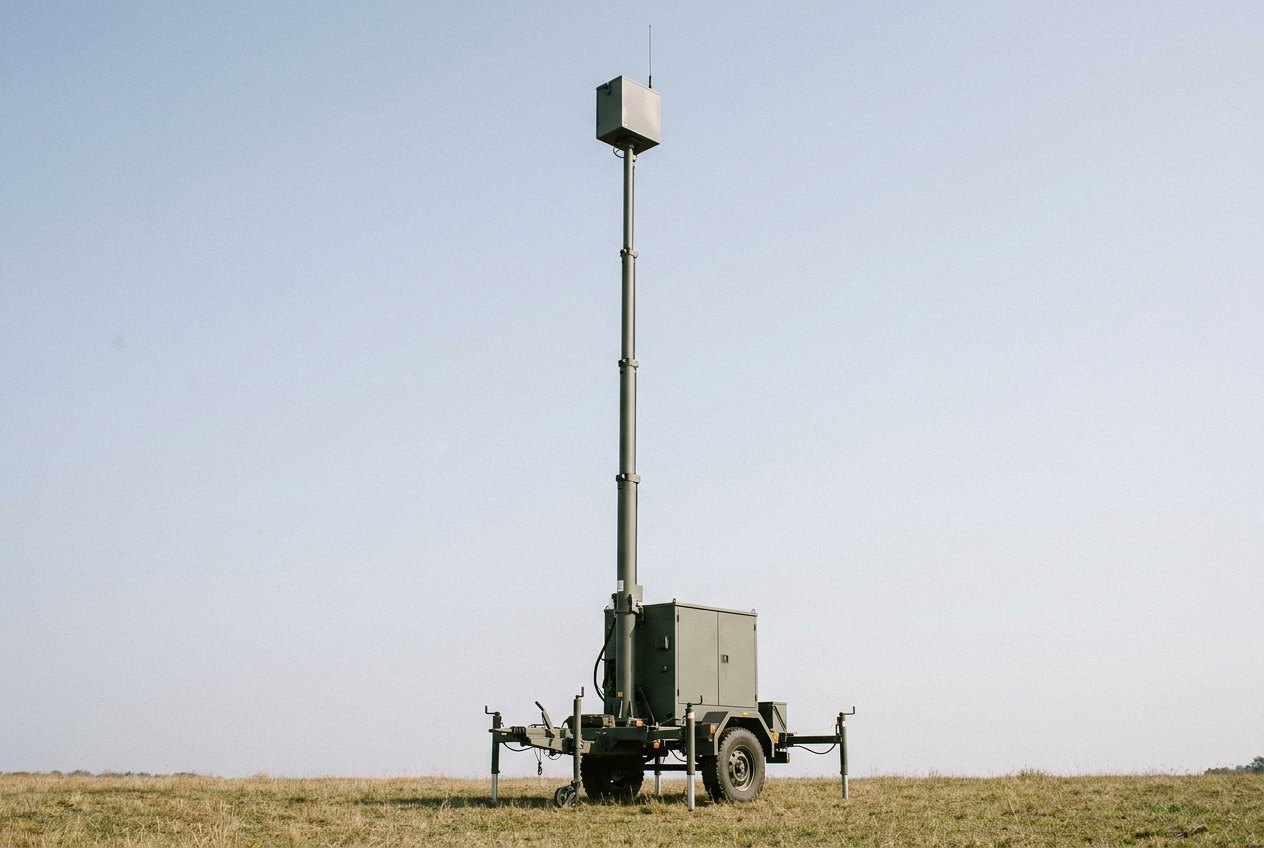

Telescopic & Hoistable Masts: How to Raise a Payload, Hold It Steady, and Pack It Away Fast
Height buys line-of-sight, range and coverage. A communications antenna reaches farther, a camera sees over the terrain, a light covers more ground. But the equipment has to come back down to move, and go back up quickly at the next site. That is the job of a telescopic, hoistable mast, and it is harder than it looks: a payload on a tall mast is a lever arm in the wind, and keeping it pointed where it should be is a bigger engineering problem than lifting it.
This guide is for engineers, program managers and procurement teams in the USA, the UK and Europe who specify, buy or integrate deployable masts. It explains how these masts work, what actually drives the design, what to ask a supplier, and where Neometrix fits.
Key Takeaways
– A hoistable mast raises a payload (antenna, sensor or camera head, light) to working height, holds it steady, and retracts it for transport.
– Three drive types dominate: pneumatic (light and fast), electromechanical (heavier payloads and holds height without power) and hydraulic (the heaviest loads).
– The number that matters is not height alone but payload x height x wind, held steady.
– A mechanical lock, a levelled base and, where needed, outriggers or guy lines are what keep a raised payload aligned.
– Neometrix builds the mast, drive, base, lock, control and actuation and integrates them onto a vehicle, trailer or shelter. The payload is customer-furnished or specialist.
Why Height Is the Advantage
Modern field operations depend on elevation. Radio range is limited by line-of-sight, sensors lose coverage behind terrain and clutter, and area lighting works best from above. Raising the payload is often the cheapest way to extend coverage, which is why masts appear on command posts, communications vehicles, observation systems, perimeter lighting and fixed-site installations alike.
The catch is mobility. A mast that stays up is a tower; a mast that deploys, works and stows is a vehicle system. The design goal is a payload at height, steady and aligned, and then back in a transport envelope in minutes.
How a Telescopic Mast Works
A telescopic mast is a set of nested tubes that extend from a short stowed length to full height. Four subsystems do the work:
– Telescopic sections: nested tubes that give a compact stowed length and a tall working height.
– Drive: the system that extends and retracts the sections.
– Lock: a mechanical lock that holds the height safely without relying on continuous air or power.
– Base and stability: a levelled base, with outriggers or guy lines where the wind load demands it.
On top sit the control and actuation (controller, height feedback, interlocks, operator interface) and the payload interface the equipment mounts to.
Choosing the Drive
| Drive | Strengths | Typical fit |
|---|---|---|
| Pneumatic | Light and fast up and down | Rapid deployment of lighter payloads |
| Electromechanical (ballscrew, rack or winch-and-cable) with mechanical lock | Carries heavier payloads; holds height without power | Heavier payloads and long dwell times |
| Hydraulic | Handles the heaviest payloads | Heavy-lift and large-payload masts |
The drive is chosen to the payload weight, the working height and how fast the mast must go up.
The Real Problem: Holding the Payload Steady
Lifting a payload is the easy half. Holding it steady at height is the engineering. A raised payload behaves like a lever arm: wind pushes on the mast and the payload, and any sway or drift moves a camera’s aim or an antenna’s alignment.
Four design levers keep it steady:
1. A levelled base. The mast must stand true on uneven ground.
2. Outriggers or guy lines. These widen the support footprint and carry wind loads.
3. A stiff mast. Section stiffness limits deflection under load.
4. A mechanical lock and a wind rating. The lock holds height without power, and the wind rating tells you the conditions the mast is designed to work in.
A mast with no stated wind rating is a risk on a bad day, and one that is slow to deploy or stow defeats the point of a mobile system.
What to Specify: Payload x Height x Wind
If you are writing a requirement, start with these inputs:
– Payload: mass, size, center of gravity, wind area, and the mounting interface.
– Working height: and the stowed (transport) height limit.
– Wind condition: state design wind speed in both m/s and mph (1 m/s is about 2.24 mph), plus whether it applies while extended, in operation, or in survival conditions.
– Platform: portable, vehicle-mounted, trailer-mounted, shelter-mounted or fixed.
– Deployment time: how fast it must go up and come down.
– Power and controls: available air, electrical or hydraulic power, and the operator interface you need.
Deployment Configurations
Neometrix’s catalogue describes four common configurations:
– Pneumatic rapid-deployment mast: a compressed-air telescopic mast, light and fast, for lighter payloads.
– Motorized locking mast: electromechanical (ballscrew, rack or winch) with a mechanical lock that holds height without power, for heavier payloads and long dwell.
– Vehicle or trailer mast system: a self-contained mobile mast with levelling, power and control: deploy, raise, work, stow and move.
– Mast control and actuation system: the controller, HMI and actuation (control block, height feedback, interlocks) that drives an existing or new mast.
Where Masts Are Used
– Mobile and rapid-deployment masts in the field
– Vehicle- and trailer-mounted mast systems
– Communications and antenna elevation
– Observation and sensor elevation (generic payloads)
– Area and perimeter lighting masts
– Fixed-site and perimeter masts
Standards and Procurement Context for US, UK and European Buyers
A deployable mast sits at the intersection of structures, machinery safety and environmental robustness. These are the reference frameworks buyers in the three regions commonly specify against:
– United States: ANSI/TIA-222 (structural standard for antenna-supporting structures and antennas), MIL-STD-810 (environmental engineering and test methods) for military programs, and OSHA workplace-safety requirements for operation and maintenance.
– United Kingdom: the Supply of Machinery (Safety) Regulations and UKCA marking for machinery placed on the Great Britain market, and DEF STAN requirements for MOD programs.
– European Union: the Machinery Directive 2006/42/EC (being replaced by Machinery Regulation (EU) 2023/1230, which applies from January 2027), CE marking, and the Eurocodes for wind actions and mast structures (EN 1991-1-4 and EN 1993-3-1).
– Alliance programs: NATO STANAG and national defence specifications as called up by the customer.
A note on honesty: Neometrix does not claim certification to these standards on its product page. The product is prototype and engineered to order, and no specific delivered mast is claimed. What Neometrix offers is to respond to your specification with a clause-by-clause compliance matrix within two working days, so your engineers can see exactly what is met, what is proposed and what is not.
What Neometrix Builds, and What It Does Not
The split is deliberate:
– Built by Neometrix: the mast structure, the extension drive, the base and levelling, the lock, the control and actuation, and the integration onto a vehicle, trailer or shelter.
– Not built by Neometrix: the payload. The antenna, sensor, camera or light is customer-furnished or specialist, and Neometrix provides the machine that carries it and the interface it mounts to.
This is a lifting and positioning machine. It raises and holds a payload; it is not a sensor or a weapon.
Buyer’s Checklist: 8 Questions to Ask Any Mast Supplier
1. What is the maximum payload at full height, and how is the wind area of that payload accounted for?
2. What wind speed is the mast designed to hold in extended, working and survival conditions, in m/s and mph?
3. What holds the mast at height if power or air is lost?
4. How is the base levelled and stabilized on uneven ground, and are outriggers or guys required?
5. What is the stowed length and the deployment and stowing time?
6. How is height feedback provided, and what interlocks protect the operator and the payload?
7. Which standards and national requirements does the design reference, and can you provide a compliance matrix?
8. Who integrates the mast onto the vehicle, trailer or shelter, and who owns the payload interface?
Frequently Asked Questions
What is a hoistable or telescopic mast, and why elevate a payload?
It is a machine that raises a payload (communications antenna, sensor or camera head, light) to working height, holds it steady, and retracts it for transport. Height buys line-of-sight, range and coverage.
How does it hold the payload steady?
Through a levelled base, outriggers or guys, a stiff mast, a mechanical lock and a wind rating. The lock holds height without continuous air or power.
Pneumatic or motorized drive: which is better?
Neither in general. Pneumatic is light and fast and suits rapid deployment of lighter payloads; electromechanical with a mechanical lock carries heavier payloads and holds height without power; hydraulic handles the heaviest loads. The right drive follows from payload weight, height and deployment speed.
What payloads can it carry?
Communications antennas, sensor or camera heads, lights and other mission equipment. The payload is customer-furnished or specialist.
Get in Touch
Send the payload, the height and the platform and get a clause-by-clause compliance matrix and a budgetary quotation within two working days:
– Product page: Telescopic & Hoistable Mast
– Tenders and quotations: [email protected]
– General enquiries: [email protected]
– Phone: +91-7777-876-876 (India; dial +91 from the USA, UK and Europe)