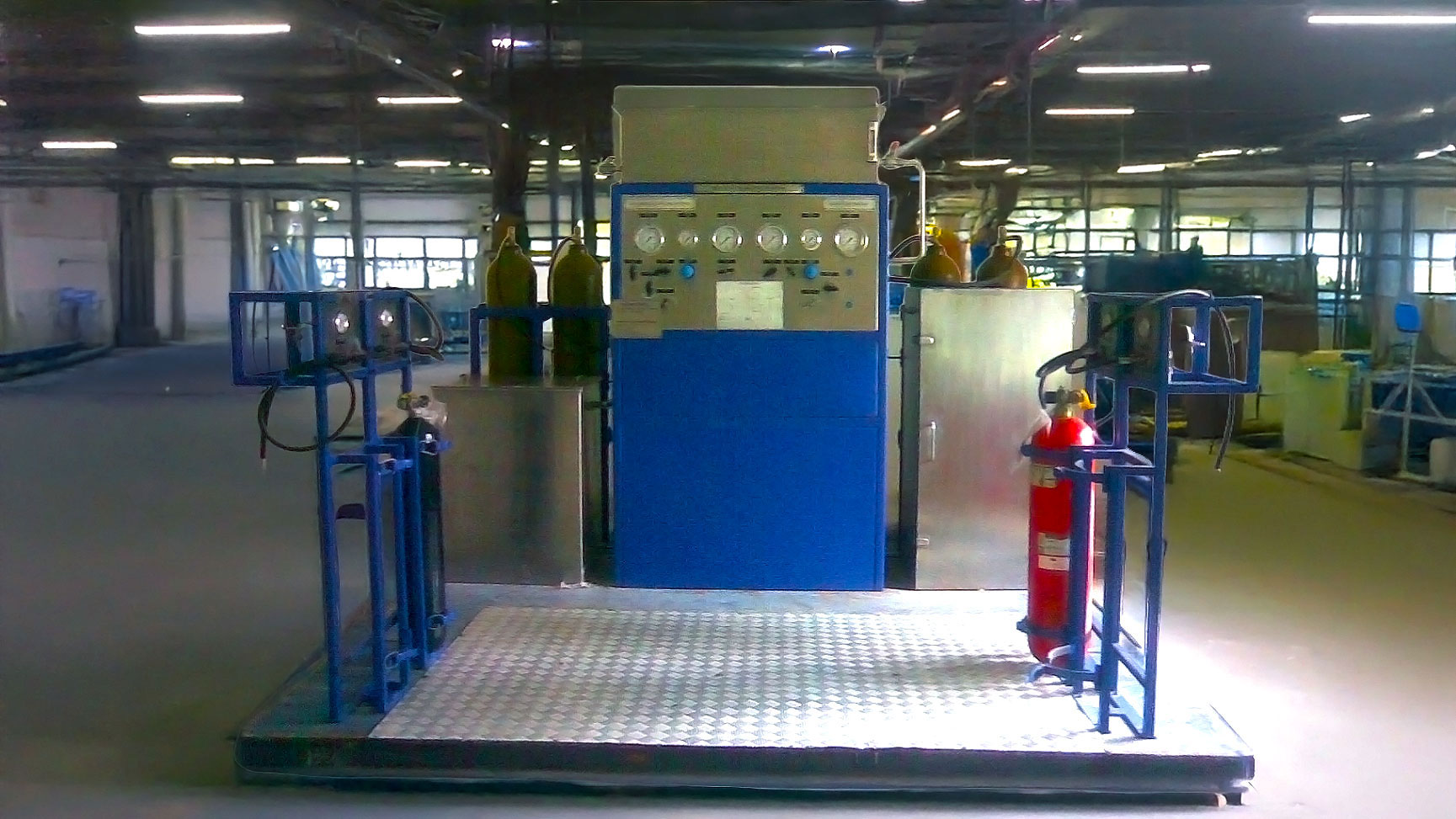

Helium Charging Station: Decanting at 125 Bar, Hydrostatic Testing at 690 Bar, Recharging at 400 Bar
A helicopter’s emergency flotation bottle only matters in the one moment it’s actually needed — which is exactly why depot-level maintenance can’t treat recharging it as a simple refill. Neometrix’s Helium Charging Station integrates gas recovery, hydrostatic certification, and high-pressure refilling into a single mobile unit: decanting residual helium at 125 bar, pressure-testing the bottle with water to 690 bar, and recharging it with high-purity helium to 400 bar — without moving the bottle between machines.
Why Decant Before You Test
Residual helium in a flight bottle gets recovered at approximately 125 bar into a recovery cylinder before hydrostatic testing begins, rather than simply vented to atmosphere. Beyond the straightforward cost of losing usable helium, decanting first also means the bottle arrives at the hydrostatic test stage empty and under controlled conditions — not carrying an unknown residual pressure that would complicate a clean pressure-integrity test.
Water to 690 Bar, With an Auto-Stop That Actually Matters
A Haskel ASF-100 air-driven liquid pump, running a 100:1 amplification ratio, pressurizes plain water up to 690 bar to check the bottle’s structural integrity — auto-stopping at a preset test pressure (450 bar as standard, adjustable up to 690 bar) so the test can’t inadvertently over-stress a bottle that’s already showing signs of weakness. Only a bottle that passes this hydrostatic check moves on to being recharged with helium.
Why Every Booster on This Skid Is Pneumatic
Haskel gas and liquid boosters, driven entirely by compressed air rather than electricity, operate without heat, flame, or sparks, offer infinitely variable cycling speed, and — critically — stall safely at pressure rather than continuing to push once resistance builds. For high-pressure helium and hydrotest work specifically, an air-driven system is an inherently safer choice than an electrically driven pump that doesn’t have that same built-in stall behaviour.
One Skid, Three Operations, No Bottle Handoff
Decanting, hydrostatic testing, and refilling all happen on the same mobile frame, connected to a common high-pressure manifold and run from one central control panel. Moving a bottle between three separate pieces of equipment for three separate operations introduces handling risk and paperwork gaps at every transfer point — consolidating the whole cycle onto one skid removes both.
Frequently Asked Questions
Why would a helium charging station decant residual helium from a bottle before hydrostatic testing it, instead of just venting the gas and moving straight to the test?
Because decanting first solves two problems at once instead of accepting a trade-off. Simply venting the residual helium to atmosphere wastes a valuable gas that can instead be recovered into a recovery cylinder at around 125 bar and reused. But there’s a second, arguably more important reason: decanting brings the bottle into the hydrostatic test stage in a known, controlled state — empty of gas — rather than carrying some unknown residual pressure that would need to be accounted for or that could complicate interpreting the water-pressure integrity test cleanly. Recovering the helium first, using a pneumatic gas booster, means the bottle arrives at the 690-bar hydrostatic test step as a clean, empty vessel every time, which supports both a more reliable test result and better gas economy across the whole depot maintenance cycle.
Why does this station use air-driven pneumatic boosters for both the helium and the hydrostatic-test pumping, instead of electric pumps?
Because for high-pressure helium handling and hydrostatic testing specifically, pneumatic drive has safety characteristics that an electric pump doesn’t automatically have. Haskel-type air-driven gas and liquid boosters operate without heat, flame, or electrical sparks near the high-pressure gas and fittings being worked on, which matters in a maintenance environment. They also offer infinitely variable cycling speed for fine control during a test or fill, and — importantly — they stall safely at pressure: if the booster reaches the pressure its air-drive can no longer overcome, it simply stops rather than continuing to force pressure upward or overheating the way an electric motor working against a stalled load might. That stall-safe behavior is a meaningful safety margin when the pressures involved reach 400 bar for helium fill and up to 690 bar for hydrostatic testing.
Get In Touch
For full specifications, RFQs, or a technical discussion about the Helium Charging Station:
– Product page: Helium Charging Station
– Email: [email protected]
– Phone: +91-7777-876-876