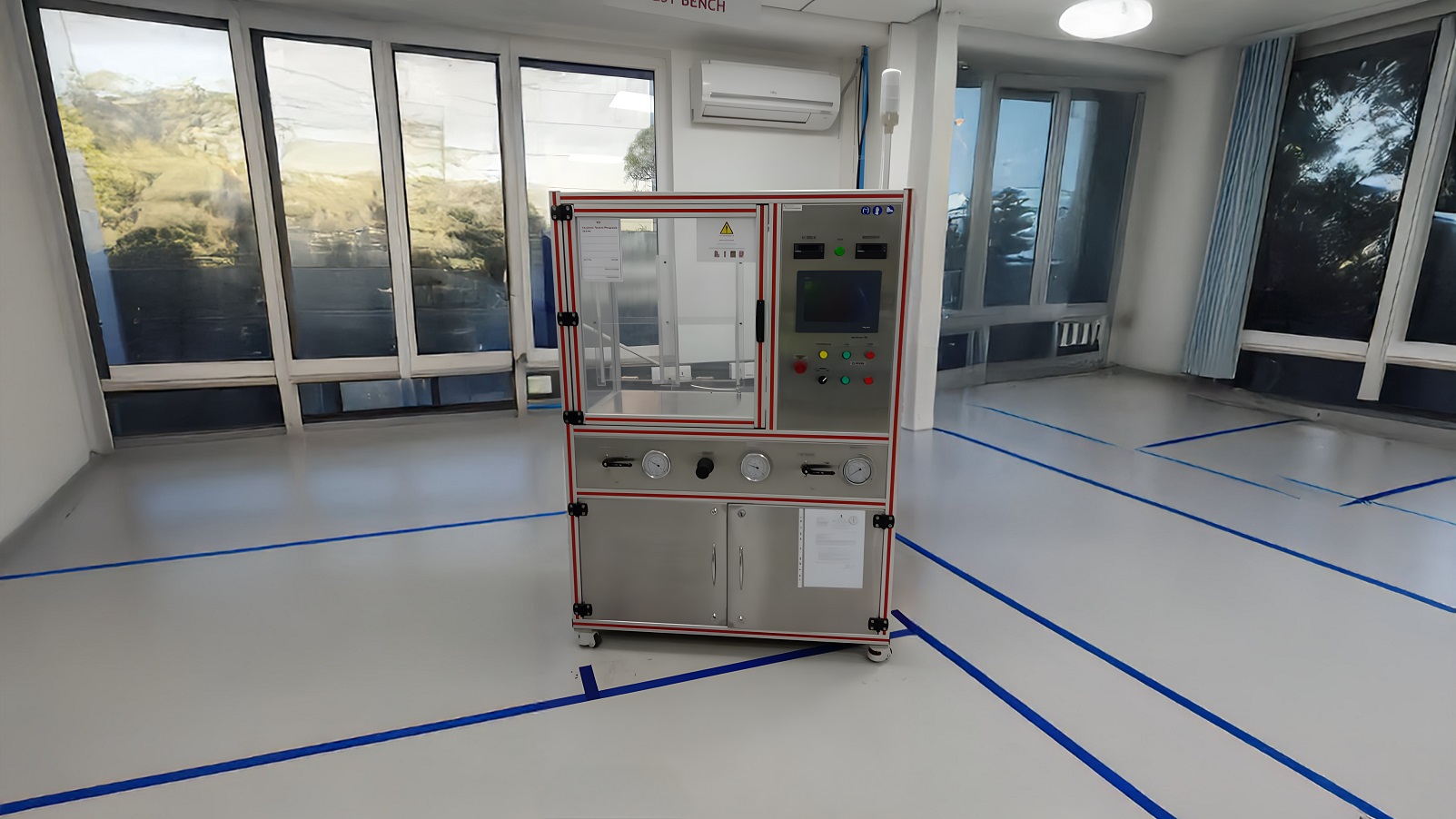

High Pressure Leak Testing Machine: Four Test Modes Up to 250 Bar
Not every component fails the same way, and not every test needs to look for the same thing. Neometrix’s High Pressure Leak Testing Machine is a fully automated pneumatic test system built to cover that range — from a quick static pressure-decay pass to a multi-stage stepwise ramp simulating years of cyclic loading — across components from 1.2 to 20 liters in volume, at pressures up to 250 bar.
An Air Booster, Not a Compressor Room
Test pressure comes from an air-driven, Haskel-equivalent gas booster feeding a 44:1 dome-loaded regulator capable of 5000 psi output, backed by 6-liter receiver tanks at both 350 bar (high pressure) and 16 bar (low pressure). That amplification ratio is what lets a modest compressed-air supply — 6 to 8 bar filtered dry air — generate genuinely high test pressures on demand, rather than requiring a dedicated high-pressure compressor plant.
Four Protocols, Each Built for a Different Failure Mode
Static pressure decay fills the device under test to setpoint and watches for drop beyond a defined threshold — the standard pass/fail leak check. Pressure vs. time profiling adds real-time graphical plotting for endurance and burst-limit evaluation. Direct outlet pressure mode gives real-time control straight to the outlet port for calibration or single-point validation. Stepwise pressure ramp applies multi-stage increases, each held for a set duration, to simulate cyclic loading on parts prone to pressure-dependent deformation.
The System Won’t Pressurize Past Its Own Limits
A spring-loaded relief valve set between 275 and 344 bar, a pilot pressure switch at 300 bar, Ham-Let pneumatically actuated ball valves, and an interlocked emergency-vent path all sit between the booster and the DUT — fail-safe protection that operates independently of the PLC logic driving the test sequence itself.
Instrumentation Built to Trust
WIKA 0–400 bar SS316L glycerine-filled gauges sit alongside 0.25% full-scale digital transmitters (4–20 mA, SS316 wetted parts), giving both an analog reference and a precise digital reading on every test — because a leak test is only as credible as the pressure measurement it’s built on.
Frequently Asked Questions
Why does this machine need four different test modes instead of one standard leak test?
Because different components fail in different ways, and a single test method can’t catch all of them efficiently. Static pressure decay — filling a component to a target pressure and watching for drop beyond a threshold — is the fast, standard pass/fail check for most parts. But a component with pressure-dependent deformation or a valve with internal moving parts needs different evaluation: stepwise pressure ramp applies multi-stage increases to simulate the cyclic loading a part actually experiences in service, while direct outlet pressure mode allows real-time tuning and single-point validation for parts with dynamic internal flow paths. Having all four modes on one PLC-controlled platform means a single machine can be reconfigured for whichever failure mode actually matters for the component in front of it, rather than requiring separate dedicated rigs for each test type.
Why does the machine use an air-driven booster and dome-loaded regulator instead of just a bigger compressor?
Because reaching 250 bar test pressure directly from a compressed-air supply would require a compressor plant sized for that peak pressure continuously — expensive, and mostly unnecessary since the machine only needs to reach that pressure during an actual test, not continuously. Instead, an air-driven, Haskel-equivalent gas booster combined with a 44:1 dome-loaded regulator amplifies a modest 6-8 bar filtered air supply up to 5000 psi output on demand, with 6-liter receiver tanks providing buffered high-pressure and low-pressure reserves. This lets the machine reach genuinely high test pressures using standard shop-floor compressed air as its input, rather than requiring a dedicated high-pressure air installation.
Get In Touch
For full specifications, RFQs, or a technical discussion about the High Pressure Leak Testing Machine:
– Product page: High Pressure Leak Testing Machine
– Email: [email protected]
– Phone: +91-7777-876-876