
CBRN Decontamination and Collective Protection: Clean It Off, Keep It Out
A chemical, biological, radiological or nuclear (CBRN) event contaminates two things at once: the people, vehicles and equipment that were exposed, and the air everywhere around them. Neither problem is solved by solving the other. You have to wash contamination off what was hit, and separately filter the air so the places where people shelter, work and receive treatment stay clean. This guide explains both defensive systems, for defense, civil-protection and procurement teams in the USA, the UK and Europe.
This is protective, defensive equipment. It defends against contamination; it is not a weapon.
Key Takeaways
– Decontamination washes contamination off people, vehicles and equipment with heated water and dosed decon agent, then monitors to a verified clean result.
– Collective protection (ColPro) filters incoming air through a pre-filter and an NBC filter (HEPA plus impregnated activated carbon), holds the space at slight over-pressure and uses an airlock.
– A serious CBRN posture needs both: one cleans what the threat landed on, the other keeps it out of where people must breathe.
– Neometrix builds the apparatus and the filtration / over-pressure system; filter media, CBRN detectors and decon agents are bought in.
– Engineered to order. No specific delivered system is claimed.
System 1: Decontamination (Clean It Off)
The process the page describes has four stages:
1. Pre-wash removes gross contamination.
2. Dosed decon agent is sprayed on to neutralize what remains.
3. Dwell and scrub gives the agent contact time to loosen and react.
4. Hot-water rinse and monitoring confirms the person, vehicle or item is clean.
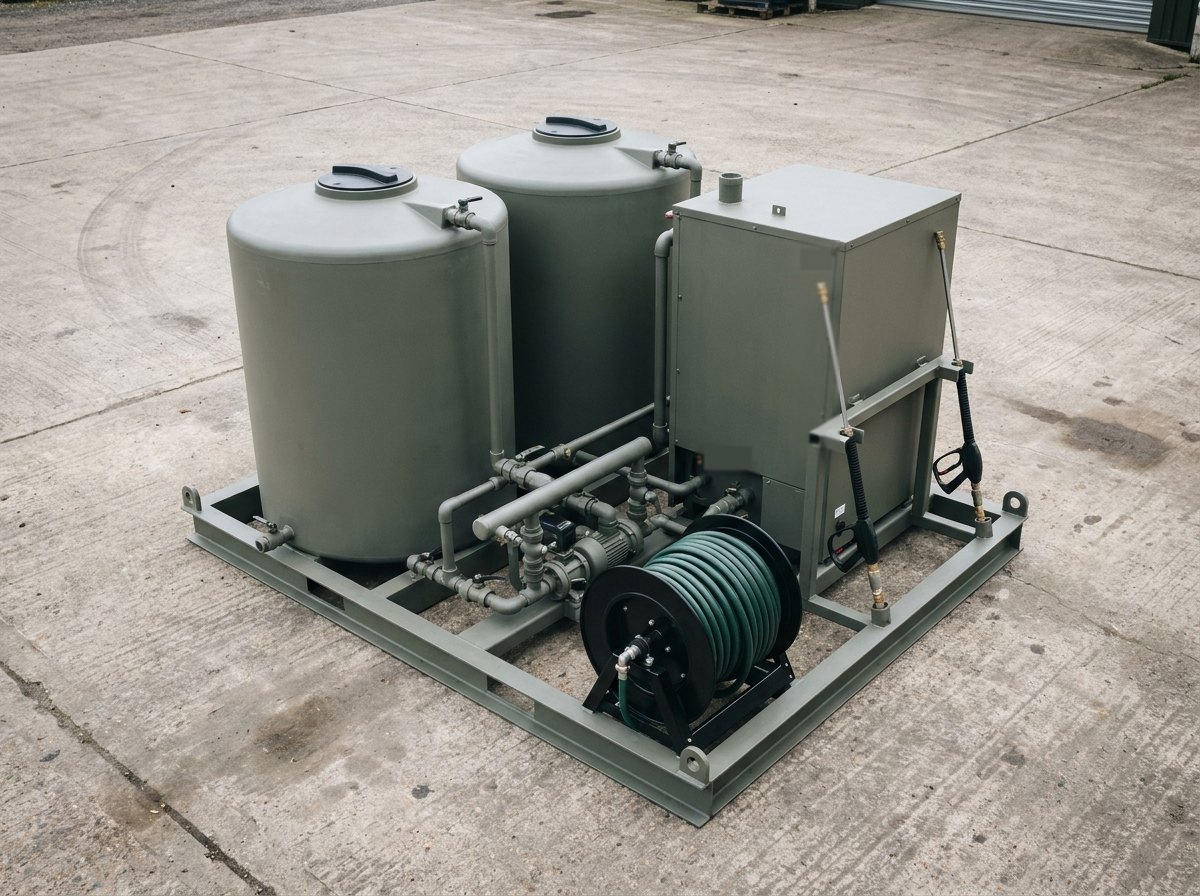
Mechanically it is a fluid system: a hot-water / steam heater, pumps, agent dosing and proportioning, tanks, hose reels and lances, mounted on a skid or trailer for field use.
System 2: Collective Protection (Keep It Out)
Outside air is drawn through a particulate pre-filter that protects the main filter from dust and aerosol, then an NBC filter (HEPA plus impregnated activated carbon) that stops both particulate and gaseous contamination. An over-pressure fan pushes the clean air into the shelter or cabin so that it sits at a slight positive pressure, and an airlock lets people enter and leave without letting contamination leak in.
Four Fits
| Configuration | What it does |
|---|---|
| Personnel decontamination | Heated showers and lines with dosed agent for people, including casualties, to a monitored clean result, with run-off contained |
| Vehicle, equipment and terrain | Higher-flow lances, arches and dosing for large items, vehicles, aircraft, hardstandings and routes |
| Collective protection (shelter / cabin) | NBC filtration, over-pressure and airlock fitted to a shelter, command post or cabin |
| Mobile decon-and-ColPro unit | A trailer or skid combining the decon apparatus and a ColPro set as one deployable package |
Where CBRN Protection Goes Wrong
– Too little contact time or the wrong agent leaves contamination behind.
– Lost over-pressure (a stuck fan, a leaking seal, an airlock left open) means the shelter is no longer protected.
– A filter run past its capacity without monitoring quietly stops filtering.
The remedy is a decon process matched to the threat and monitored to a clean result, a shelter built to hold over-pressure with a real airlock, and filter capacity and change-out engineered in. CBRN protection is only worth the leak it does not have.
Applications
Personnel decontamination lines; vehicle, aircraft and equipment decontamination; terrain and hardstanding decontamination; collective protection for shelters and command posts; collective protection for vehicles and cabins; and field-hospital and clean-area protection.
The Honest Split
Neometrix builds the decon apparatus (heater, pumps, dosing, tanks, lances, skid) and the collective-protection system (filter housing, over-pressure blower, airlock, ducting, controls) and integrates them. The NBC filter media, CBRN detectors and decon agents are bought in specialist items. The page frames the work as the hardened, protective side of Neometrix’s field-shelter and gas / air-handling competence.
Standards and Procurement Context for US, UK and European Buyers
CBRN protection is governed by threat-specific and national requirements. Frameworks commonly referenced include:
– NATO and allied: STANAG and AEP publications on CBRN defense, including collective protection and decontamination, used for interoperability across NATO members.
– United States: MIL-STD and MIL-SPEC requirements, and for civilian protective respiratory equipment the NIOSH CBRN approvals.
– United Kingdom: DEF STAN requirements and Ministry of Defence CBRN doctrine.
– European Union: EN standards for respiratory protective devices and filters (for example the EN 14387 gas filters and EN 143 particle filters), the Machinery Directive 2006/42/EC and CEN work on CBRN protection.
– Air filtration: EN 1822 and ISO 29463 for HEPA / ULPA filter classification.
– Quality: ISO 9001 and ISO 14001 (listed on the Neometrix page).
Neometrix does not claim certification to these on the page. Specifications follow the threat, the throughput and the platform, and Neometrix replies with a clause-by-clause compliance matrix and a budgetary quotation within two working days.
Buyer’s Checklist: 8 Questions for a CBRN Protection Supplier
1. Which threats (chemical, biological, radiological, nuclear) must it protect against, and which are covered by the filter media?
2. What decon throughput (people per hour, vehicles per hour) and water / agent consumption does it need?
3. How is the decontamination monitored to a verified clean result?
4. How is run-off contained and handled?
5. What over-pressure does the shelter hold, and what alarms warn of loss?
6. How is the airlock designed to avoid cross-contamination?
7. How is filter capacity monitored, and how are filters changed safely?
8. Who supplies the filter media, detectors and agents, and what is the support and training package?
Frequently Asked Questions
What is the difference between decontamination and collective protection?
Decontamination washes contamination off people, vehicles and equipment that were exposed. Collective protection filters the air and holds over-pressure so a shelter or cabin stays clean. They answer the same threat from opposite ends.
How does an NBC filter work?
Air passes first through a particulate pre-filter, then through a HEPA layer that stops particles and aerosols and a bed of impregnated activated carbon that adsorbs gases and vapors.
What are the over-pressure and the airlock for?
Over-pressure makes air leak outward through any gap instead of inward, and the airlock lets people pass without opening the clean space directly to the contaminated outside.
Do you make the filter media, detectors and decon agents?
No. Those are specialist items that are bought in; Neometrix builds and integrates the apparatus and the filtration and over-pressure system.
Get in Touch
Send the threat, the throughput and the platform for a clause-by-clause compliance matrix and a budgetary quotation within two working days:
– Product page: CBRN Decontamination & Collective Protection System
– Tenders and quotations: [email protected]
– Phone: +91-7777-876-876 (India; dial +91 from the USA, UK and Europe)