
Prove It Before It Flies: A Ground-Test Bench Set for Drones
A drone earns its flight time on the ground. Every gram and every watt on a small aircraft is contested, and the arithmetic is unforgiving: the powertrain turns electrical watts into grams of thrust, and its efficiency sets the flight time. A few percent lost in a poor motor-propeller match is minutes lost in the air, and you cannot see those percent by flying. You see them on a calibrated thrust stand. This guide explains the three benches that move discoveries from the air, where they cost airframes, to the ground, where they cost an afternoon, for UAS developers, test engineers and program managers in the USA, UK and Europe.
Key Takeaways
– The bench set has three benches: a propulsion thrust stand, a 3-DOF attitude rig and an integration and readiness bench.
– The thrust stand measures thrust, torque, RPM and electrical power, producing the thrust map and efficiency in grams per watt.
– The 3-DOF rig frees roll, pitch and yaw while holding position, so the flight controller can be tuned without free flight.
– The readiness bench restrains the whole aircraft and runs the pre-flight gate: run-up, actuation and control checks, sensor alignment, electrical load and endurance soak, all recorded.
– Every bench is caged, interlocked and calibrated. The aircraft is customer-furnished; Neometrix builds the test machines.
Why the Bench Comes First
The cheapest place to find a problem is on a bench with the aircraft bolted down. The Neometrix page names the shortcuts that cost programs the most:
– A powertrain chosen from datasheets instead of a calibrated stand silently gives away flight time.
– Controller gains tuned in free flight pay for every mistake with an airframe.
– A first flight used as the integration test discovers wiring, alignment and interference problems at the worst moment.
– Uncaged bench running treats a spinning propeller as if it were harmless.
The Three Benches
| Bench | What it does | What you get |
|---|---|---|
| Propulsion thrust stand | Runs motor, propeller and ESC together as the set they will fly as | Thrust-versus-throttle map, grams-per-watt efficiency curve, motor-propeller match, endurance and thermal behavior |
| 3-DOF attitude rig | Gimballed fixture that frees roll, pitch and yaw and holds position | Controller bring-up, tuning and provocation (oscillation, saturation, recovery) without a crash |
| Integration and readiness bench | Restrains the complete aircraft on a hold-down cradle | A procedural, recorded pre-flight gate |
1. The Thrust Stand
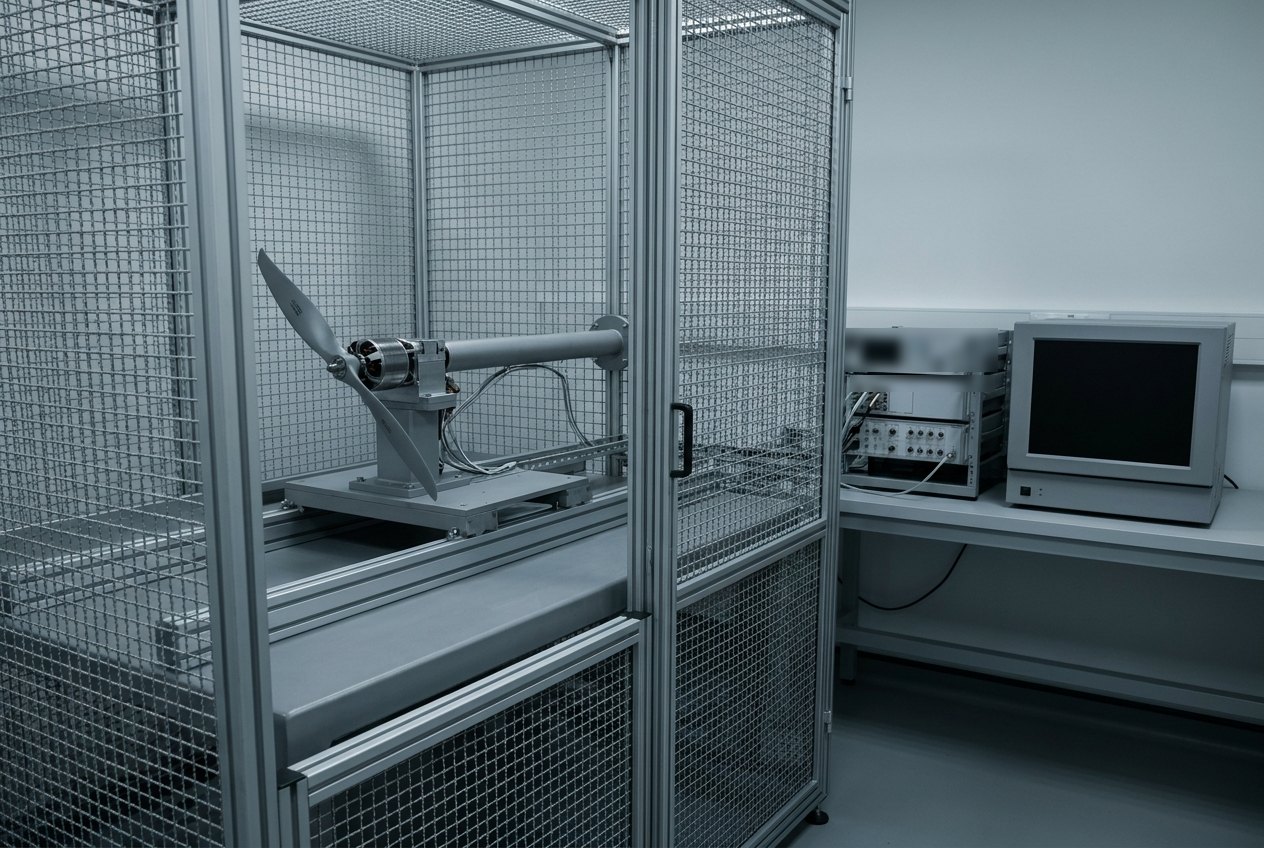
A load cell reads thrust and a reaction transducer reads torque, while RPM and electrical power are captured through a power analyzer, with temperatures and vibration alongside. Sweeps produce the thrust map and efficiency curve. Sustained runs produce endurance and thermal data. This is where propellers are chosen and datasheet claims meet a calibrated instrument.
2. The 3-DOF Attitude Rig
The aircraft sits at the center of a gimballed fixture. The flight controller can be brought up from first power-on, its gains tuned and its responses provoked. Every misbehavior ends as a wobble on the rig rather than a crash.
3. The Readiness Bench
The gate runs as a procedure: powertrain run-up, actuation and control checks, navigation-sensor alignment, electrical load and an endurance soak. Every step is instrumented and recorded as evidence, so first flight confirms what the bench already proved.
Safety and Data
The spinning propeller is the managed energy. Every bench has a safety cage and interlocks, with calibrated, synchronized data capture from end to end. Fixturing adapts the benches to the aircraft class, which can be a small multirotor, a heavy-lift platform or a fixed-wing UAS.
What Neometrix Builds, and What It Does Not
Neometrix builds the bench and rig structures, the gimbal mechanics, safety cages and interlocks, fixturing, electrical and DAQ integration and calibration. Load cells, torque transducers, power analyzers and instruments are bought-in. The aircraft is customer-furnished: Neometrix builds the test machine, much as its mast elevates a customer’s payload. It is engineered to order and no delivered bench is claimed.
Standards and Procurement Context for US, UK and European Buyers
UAS programs are shaped by airworthiness and operations rules plus test-equipment practice:
– United States: FAA UAS rules, ASTM F38 committee standards (such as ASTM F3298 on the design, construction and verification of lightweight UAS), RTCA DO-160 for environmental conditions on airborne equipment and MIL-STD-810 for defense programs.
– United Kingdom: UK Civil Aviation Authority UAS regulations and DEF STAN for MOD programs.
– European Union: the EU UAS framework (Regulations (EU) 2019/945 and 2019/947), the ASD-STAN EN 4709 series on UAS, and the Machinery Directive 2006/42/EC (replaced by Regulation (EU) 2023/1230 from January 2027) for the caged test equipment.
– International: ISO 21384 on UAS requirements and ISO/IEC 17025 for traceable calibration of the measurement chain.
Neometrix does not claim certification to these on the page. Send the aircraft class, envelope and tests and Neometrix replies with a clause-by-clause compliance matrix within two working days.
Buyer’s Checklist: 8 Questions for a UAS Test-Bench Supplier
1. What thrust, torque, RPM and power range does the stand cover for our largest motor and propeller?
2. How are load, torque and power channels calibrated, and is the capture synchronized?
3. How does the 3-DOF rig handle our aircraft’s mass, size and center of gravity?
4. Can the readiness bench run our pre-flight procedure and record it as evidence?
5. How are the cages and interlocks designed for a spinning propeller or rotor?
6. What fixturing is needed for different aircraft, and how fast are changeovers?
7. What outputs and reports are produced, and in what format?
8. What is built, what is bought in, and what training and support are included?
Frequently Asked Questions
What does a drone thrust stand measure?
Thrust, torque, RPM and electrical power for the motor, propeller and ESC together, from which it derives efficiency in grams per watt, the thrust map, the motor-propeller match and endurance.
Why tune a flight controller on a 3-DOF rig?
Because roll, pitch and yaw are free while position is held, so oscillation and saturation show up as a wobble on the gimbal instead of a crash.
What is the readiness gate?
A recorded procedure run on the restrained aircraft: run-up, actuation checks, sensor alignment, electrical load and endurance soak.
Does Neometrix supply the aircraft?
No. The aircraft is customer-furnished. Neometrix builds the test benches.
Get in Touch
Send the aircraft class, the test envelope and the tests you run for a clause-by-clause compliance matrix and a budgetary quotation within two working days:
– Product page: UAS Propulsion & Flight-Readiness Test Bench
– Tenders and quotations: [email protected]
– Phone: +91-7777-876-876 (India; dial +91 from the USA, UK and Europe)