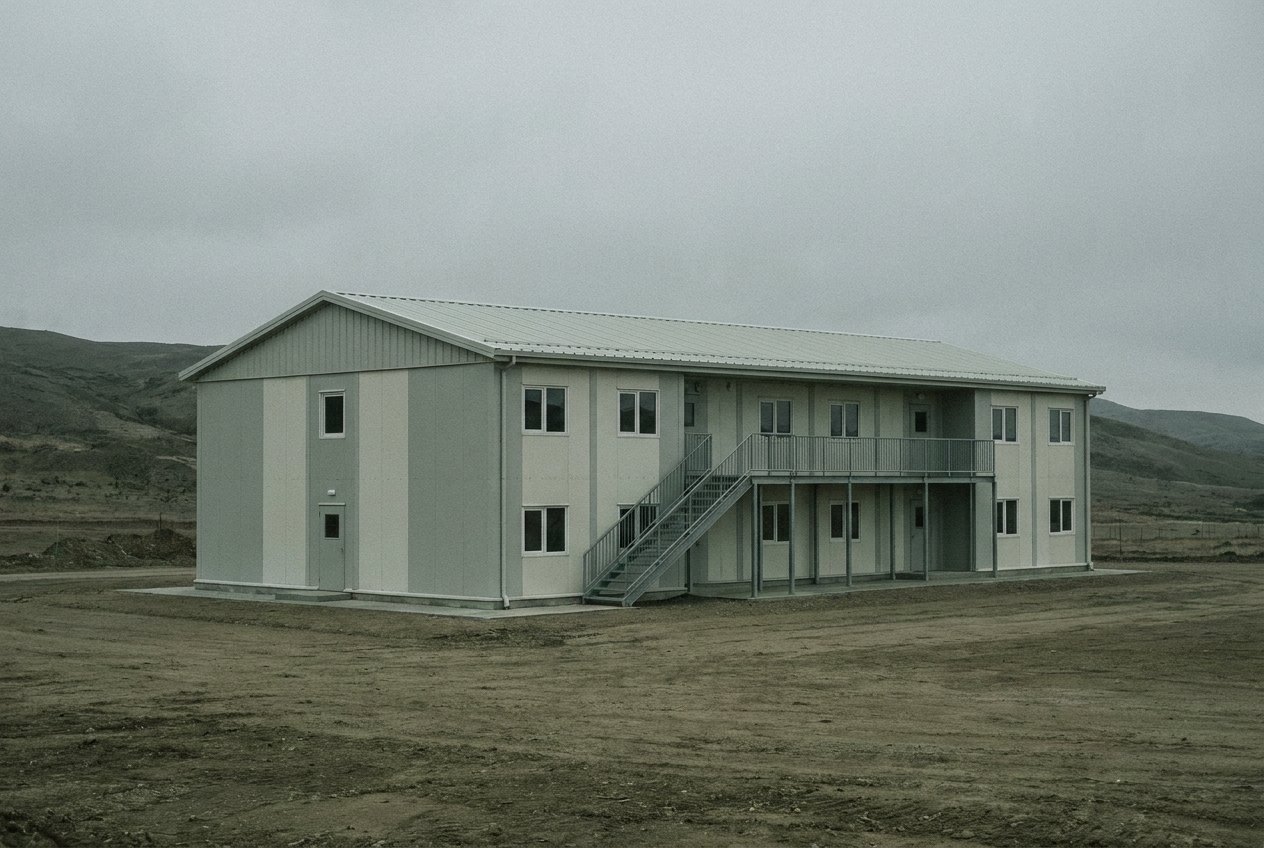

House the Force, Faster: Light-Gauge Steel and Prefab Panel Accommodation
Soldiers have to live somewhere, and the demand for accommodation never stops: at military stations at scale, and most acutely at high-altitude and forward posts, where the building season is short and every day counts. Conventional wet masonry is slow. It needs curing, it is weather-limited, and in remote areas the logistics of sand, cement, water and skilled labor are painfully hard. This guide explains the dry, fast alternatives, for infrastructure engineers, program managers and procurement teams in the USA, the UK and Europe.
Key Takeaways
– A living accommodation shelter is a real, permanent-quality building built dry and fast, not a temporary hut.
– The two methods are a light-gauge steel frame (LGSF) and prefabricated insulated panels (PUF sandwich panels on a frame).
– Configurations run single or double storey, housing 10 to 100+ men (officers, JCOs and other ranks).
– Neometrix delivers it turnkey: design, supply and construction, from the frame to handover.
– It houses people, not equipment: it is the living building alongside the technical shelter. The panels and steel sections are bought in.
The Problem With Wet Masonry
Wet masonry needs curing time, depends on the weather and demands a supply chain of sand, cement, water and skilled labor. At forward and high-altitude posts all of those are scarce, and the building season is short. The dry methods take the slow, wet, weather-dependent work off the site: components are manufactured, transported and assembled.
Two Methods, One Principle
Light-Gauge Steel Frame (LGSF)
A cold-formed galvanized-steel frame of studs, joists and roof trusses, erected dry and bolted or screwed together, then sheathed, insulated and clad. The Neometrix page describes it as dimensionally accurate, strong, non-combustible, termite-proof and low-maintenance, and capable of carrying a proper single- or double-storey building.
Prefabricated Insulated Panels
PUF (polyurethane-foam) sandwich panels on a frame give a quick, weathertight, well-insulated hut, ideal where the need is a rapid, warm shelter in a cold or high-altitude site.
| LGSF building | Prefab PUF-panel shelter | |
|---|---|---|
| Typical use | Permanent single or double-storey quarters | Rapid single-storey huts |
| Speed | Fast | Fastest |
| Strength | Frame carries multi-storey blocks | Light structures |
| Best for | Barrack blocks, quarters at scale | Cold and remote sites needing quick, warm cover |
Turnkey: Design, Supply, Construct
Most requirements are supply and construction: the customer wants a finished, habitable building, not a kit. Neometrix designs to the number of men, the storeys, the site and the code; supplies the steel frame, the envelope and the fittings; and constructs it on site, fully fitted out with partitions, electrical, plumbing and finishes. One responsibility runs from the frame to the handover.
Four Configurations
– LGSF double-storey living shelter: the accommodation workhorse, for officers, JCOs or other ranks.
– Prefab PUF-panel shelter or hut: a rapid, warm, single-storey insulated shelter.
– High-altitude and forward-post accommodation: engineered for a short building season and severe climate: dry-built, heavily insulated, all-terrain.
– Turnkey station accommodation block: a barrack block at scale (40 to 100+ men) with full ablutions and services.
Applications
Officer, JCO and other-ranks living accommodation; high-altitude and forward-post housing; rapid and temporary accommodation; military-station barrack blocks at scale; disaster-relief and transit accommodation; and site, camp and project accommodation.
Related Neometrix Shelters
The living shelter is the sibling of the Field Technical Shelter, which houses equipment, and it pairs naturally with the Fuel-Cell Hybrid Power System for silent power at a forward post.
Standards and Procurement Context for US, UK and European Buyers
Buildings are specified through structural, fire and thermal codes. Commonly referenced frameworks include:
– United States: the International Building Code (IBC), AISI S100 and S240 for cold-formed steel design and framing, ASTM E84 for surface burning characteristics and, for military construction, the Unified Facilities Criteria (UFC).
– United Kingdom: the Building Regulations and BS EN 1993-1-3 (Eurocode 3 for cold-formed members) with its UK National Annex.
– European Union: EN 1993-1-3 for cold-formed steel, EN 14509 for self-supporting double-skin metal-faced insulating panels, EN 13501-1 for reaction-to-fire classification and EN ISO 6946 for building-component thermal resistance.
– Quality: ISO 9001 and ISO 14001 (listed on the Neometrix page).
Neometrix does not claim certification to these building codes on the page. Send the number of men and the site, and Neometrix replies with a clause-by-clause compliance matrix and a budgetary quotation within two working days.
Buyer’s Checklist: 8 Questions for an Accommodation Supplier
1. How many men, which ranks and how many storeys does the block need to house?
2. What is the site: altitude, snow load, wind, seismic zone and access for transport?
3. What insulation performance and fire classification does the envelope achieve?
4. Is the offer supply only or full supply and construction, with fit-out and services?
5. What is the erection time per block, and what crew and equipment are needed?
6. How are the steel sections protected against corrosion?
7. What is bought in (panels, steel sections), and what is designed and built in-house?
8. What handover documentation, warranty and maintenance support apply?
Frequently Asked Questions
What is a living accommodation shelter?
A permanent-quality building for housing troops, built with a light-gauge steel frame or insulated panels using dry, fast methods instead of slow wet masonry.
What is LGSF?
Light Gauge Steel Frame: cold-formed galvanized-steel studs, joists and trusses erected dry and then insulated and clad.
Can it be built at high altitude or in forward areas?
Yes. That is where dry, fast construction helps most, because masonry is slowest and most weather-limited there.
How is it different from the field technical shelter?
The technical shelter houses equipment; the living shelter houses people.
Get in Touch
Send the number of men and the site for a clause-by-clause compliance matrix and a budgetary quotation within two working days:
– Product page: Living Accommodation Shelter
– Tenders and quotations: [email protected]
– Phone: +91-7777-876-876 (India; dial +91 from the USA, UK and Europe)