
Never Stop, Never Touch: Replenishment-at-Sea and Fuelling-at-Sea Systems
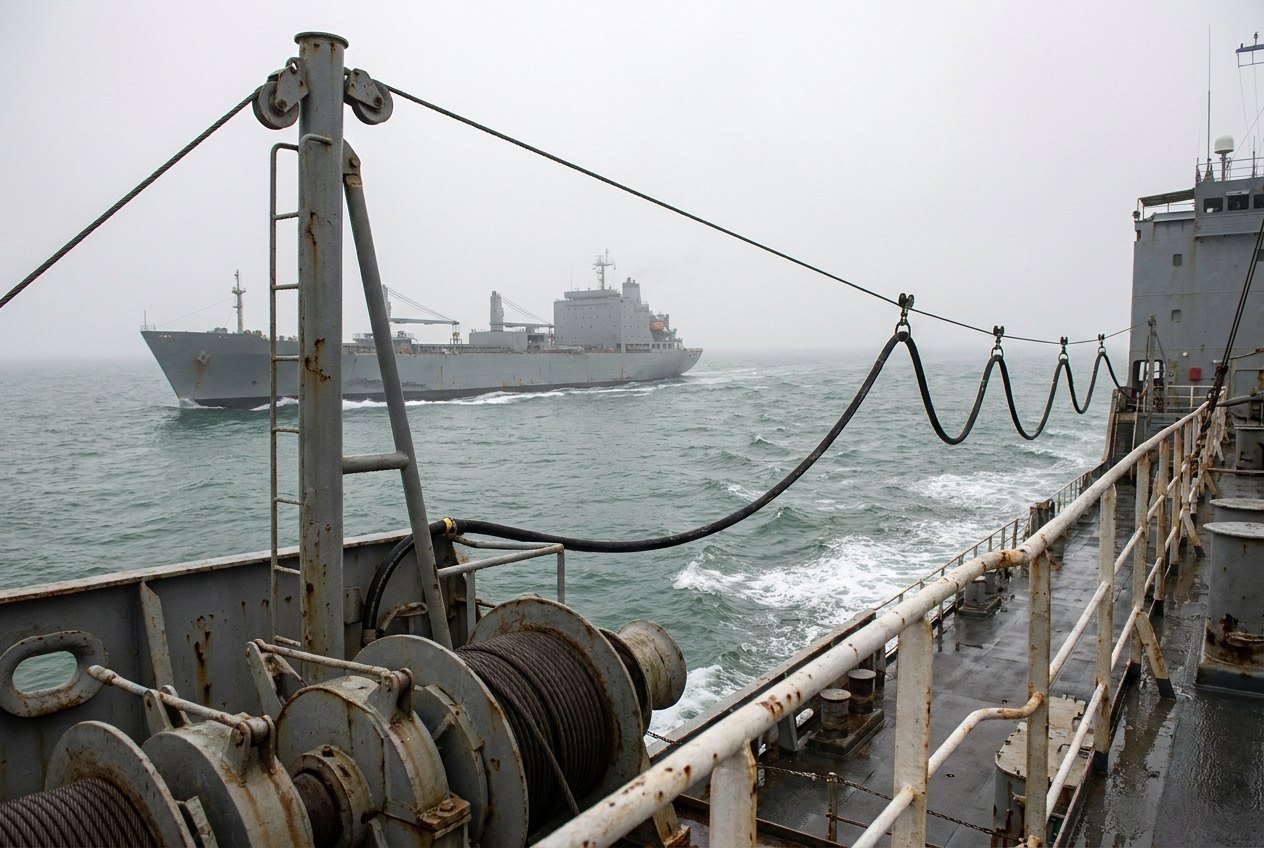
A warship’s reach is her tanker’s. Every ship sails with an expiry date: the day her fuel, water and provisions run out. Ports extend it but surrender the sea. A replenishment rig extends it without going anywhere: a tanker or store ship steams alongside, the rig spans the gap and the fleet takes on fuel, fresh water, provisions and spares underway, with ships never stopping and never touching. This guide explains how the rig holds a wire, a hose and a swinging load across a moving gap, for naval engineers, logistics planners and procurement teams in the USA, the UK and Europe.
Key Takeaways
– Ships transfer fuel, stores and people while 30 to 60 metres apart (about 98 to 197 feet), both making way, joined only by the rig.
– Two rig families: the jackstay highline for traveller-borne stores (heavy rigs to the 2-tonne class) and the spanwire fuel rig for hose strings.
– The core discipline is constant tension: winches pay and recover continuously so the wire stays taut, never snatched.
– Breakaway couplings and emergency releases are designed in from the first drawing, so the ships can always part cleanly without spill.
– Neometrix supplies the structures, winches, transfer gear, controls, installation and trials, plus refit and overhaul. Engineered to order; no delivered system is claimed.
The Moving Gap
The engineering problem is the gap itself: it moves, all the time, in every axis. Two hulls roll and sheer out of phase, so the gap breathes by metres on every swell. A fixed-length wire would slacken and then snatch, multiplying loads through the rig, the structure and the cargo. The machine must hold a wire, a hose and a swinging load across that gap for hours, safely.
Jackstay: How Stores Cross
A highline is rigged and tensioned from a kingpost on one ship to a high point on the other. A traveller block rides it, carrying the load in a sling or basket. Inhaul and outhaul winches walk the traveller across (out with the load, back for the next lift) while the highline’s own winch holds tension through every roll. Heavy rigs move stores up to the 2-tonne class. Light rigs handle light loads and, under the navies’ own procedures, personnel transfer.
Spanwire: How Fuel Crosses
The hose string rides the tensioned wire on saddles, spaced by saddle whips so the hose hangs in even bights. It ends in a probe that drives into a bell-mouth receiver on the receiving ship, self-aligning and self-sealing, made for a moving target. Between pump and probe sit breakaway couplings: deliberately the weakest link, engineered to part cleanly and seal both ends if the ships open beyond the rig’s reach. Neometrix describes this as the fuel-transfer discipline of its aircraft refuellers applied between hulls.
Constant Tension Is the Whole Game
Every primary wire lives on a constant-tension winch that pays and recovers continuously, holding the set tension both ways. The page frames it as the discipline of Neometrix’s davit recovery gear applied to a whole rig instead of one boat. Above it stands the rule that makes the connection safe at all: the emergency breakaway, by which the entire rig (wires, hoses, traveller) can let go cleanly at any moment.
| Tension to hold | Why |
|---|---|
| Wire never allowed to slacken | A slack-then-loaded wire snatches and multiplies loads |
| Connection always ready to part | Two ships joined by wire must always have a clean way apart |
Four Variants
– Heavy and light jackstay rigs: kingpost stores rigs to the 2-tonne class with traveller, inhaul and outhaul and highline tension, plus light rigs for light loads and personnel transfer.
– Spanwire fuelling rigs: saddled hose strings, probe and receiver, breakaway couplings, for fuel and fresh water underway, with derrick rigs where specified.
– Reception outfits: the receiving ship’s set (high points, sliding blocks, fairleads, deck rollers and fuel reception) for new-build programs and ships joining the fleet.
– Refit, overhaul and trials: re-roping, winch overhaul, controls renewal and support through the load tests and sea trials that keep rigs certified.
Applications
Fleet tankers and replenishment ships; combatants’ reception outfits; patrol-vessel new-build programs; coast-guard and offshore-support fleets; shipyard installation and sea trials; and refit, re-roping and winch overhaul.
Standards and Procurement Context for US, UK and European Buyers
Underway replenishment is governed by allied procedures plus equipment and class rules. Commonly referenced frameworks include:
– NATO and allied: NATO ATP-16 (Replenishment at Sea) and the associated STANAG documents that let allied ships replenish from each other.
– United States: US Navy underway-replenishment publications such as NWP 4-01.4 and MIL-STD requirements for shipboard equipment.
– United Kingdom: DEF STAN requirements and Royal Navy replenishment procedures, plus the Lifting Operations and Lifting Equipment Regulations (LOLER) for lifting gear.
– European Union and class societies: naval class rules from bodies such as Lloyd’s Register, Bureau Veritas and DNV, and the Machinery Directive 2006/42/EC (replaced by Regulation (EU) 2023/1230 from January 2027) for non-military installations.
– Quality: ISO 9001 and ISO 14001 (listed on the Neometrix page).
Neometrix does not claim certification to these on the page. Send the ships and the transfer requirement and Neometrix replies with a clause-by-clause compliance matrix within two working days.
Buyer’s Checklist: 8 Questions for a RAS / FAS Supplier
1. Which ships, which distances apart and which closing speeds is the rig designed for?
2. What load ratings apply (jackstay stores to the 2-tonne class, fuel flow rate for spanwire)?
3. How does the constant-tension system behave across the full ship-motion envelope?
4. How are breakaway couplings and emergency releases designed, tested and verified?
5. Is the offer a delivering-ship rig, a reception outfit or both?
6. How are probe and receiver compatibility handled with allied ships?
7. What load tests and sea trials are included to certify the rig?
8. What refit, overhaul and spares support is offered for rigs in service?
Frequently Asked Questions
Why replenish at sea instead of in port?
Because ports surrender the sea. Replenishing underway extends a fleet’s range without stopping.
How does the jackstay rig work?
A tensioned highline carries a traveller block with the load, walked across by inhaul and outhaul winches while the highline winch holds tension.
How does fuel cross safely between moving ships?
Over a spanwire on saddles, ending in a probe and receiver, with breakaway couplings that part cleanly and seal if the ships drift apart.
What does constant tension do?
It pays and recovers wire continuously as the gap breathes, so the wire stays taut and no load arrives as a snatch.
Get in Touch
Send the ships and the transfer requirement for a clause-by-clause compliance matrix and a budgetary quotation within two working days:
– Product page: Replenishment-at-Sea & Fuelling-at-Sea System
– Tenders and quotations: [email protected]
– Phone: +91-7777-876-876 (India; dial +91 from the USA, UK and Europe)