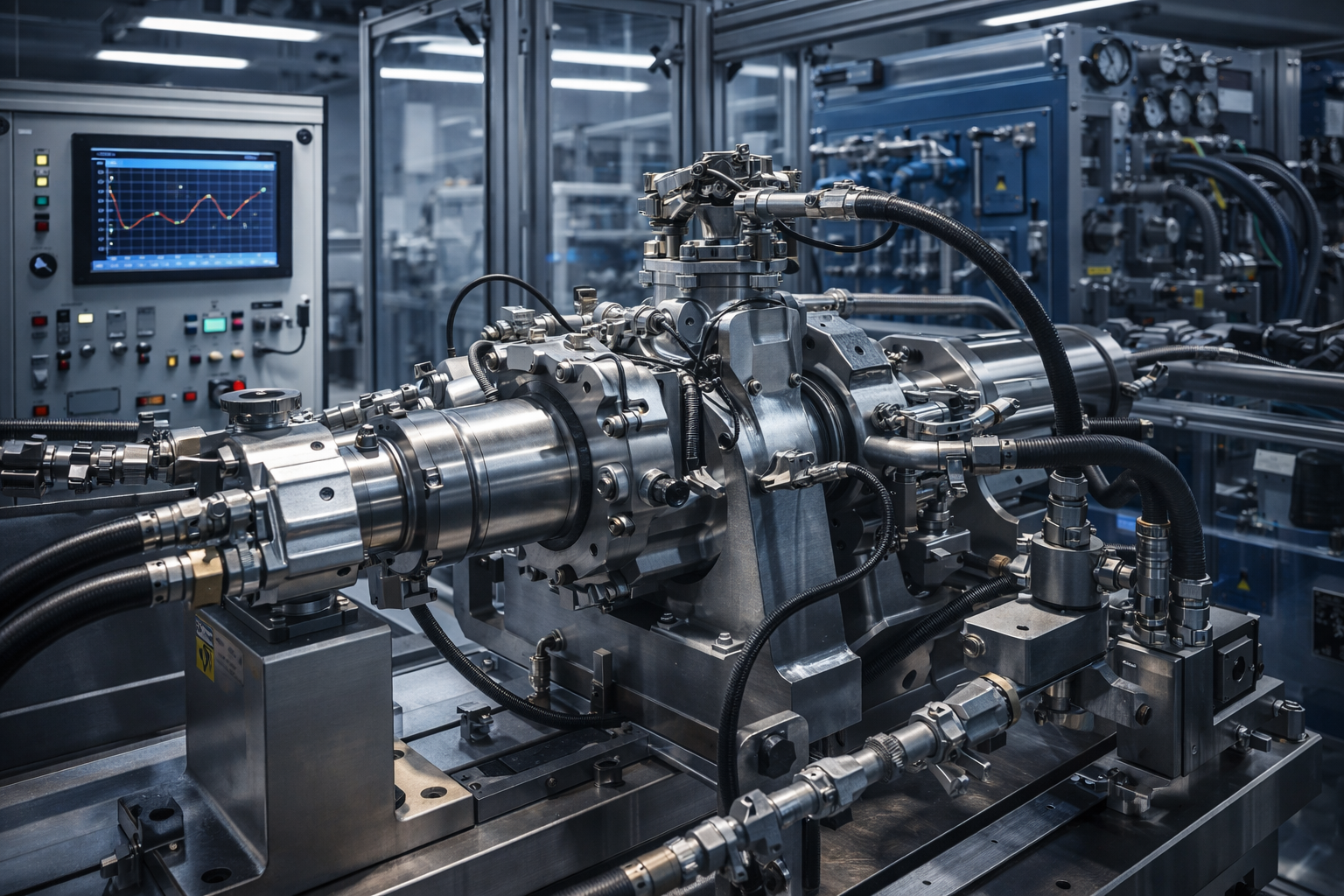
In modern rotary-wing aviation, the main rotor actuator plays a mission-critical role in controlling blade pitch and ensuring stable flight dynamics. As helicopters operate under extreme aerodynamic loads and variable environmental conditions, precision main rotor actuator testing has become essential for maintaining safety, performance, and regulatory compliance.
Importance of Main Rotor Actuator Testing
The main rotor system directly influences lift generation, maneuverability, and vibration control. Any deviation in actuator performance can affect pitch response, cyclic control, or collective stability. Therefore, aerospace manufacturers and MRO facilities rely on advanced hydraulic actuator testing methodologies to validate system integrity before installation or after overhaul.
Testing ensures:
-
Accurate pressure response under dynamic load
-
Smooth displacement and stroke consistency
-
Leak-proof hydraulic sealing
-
Reliable operation under simulated flight conditions
-
Compliance with aerospace certification standards
Advanced Testing Technologies
Modern aerospace testing facilities integrate servo-controlled hydraulic systems, high-precision sensors, and automated data acquisition platforms. These systems replicate real-time flight loads and monitor actuator behavior with micro-level accuracy.
Closed-loop control systems allow engineers to simulate cyclic and collective pitch commands while recording performance metrics such as pressure stability, flow rate, displacement accuracy, and response time. Such data-driven testing enhances repeatability and ensures traceable validation records.
Safety, Reliability & Lifecycle Validation
Beyond functional checks, endurance testing and pressure cycling tests evaluate long-term durability of main rotor actuators. By simulating thousands of operational cycles, engineers can identify fatigue risks, sealing wear, and performance degradation before field deployment.
This predictive validation approach significantly reduces in-service failures and enhances overall aircraft reliability.
Industry Impact
With increasing demand for high-performance helicopters in defense, emergency services, offshore operations, and commercial aviation, the need for robust aerospace hydraulic actuator testing continues to grow. Precision testing not only supports regulatory compliance but also strengthens confidence in flight control systems.
As aviation technology advances, main rotor actuator testing remains a cornerstone of safe and efficient rotary-wing operations—ensuring that every takeoff, hover, and landing is backed by uncompromised engineering validation.
Aerospace Test Equipment for USA, UK, Europe & the Middle East: Neometrix aerospace testing systems are trusted by MRO operators and defence OEMs across the United States, United Kingdom, Europe, and the UAE. Our systems meet AS9100, MIL-STD, and EASA-aligned maintenance requirements. International commissioning and calibration support is available for all regions.