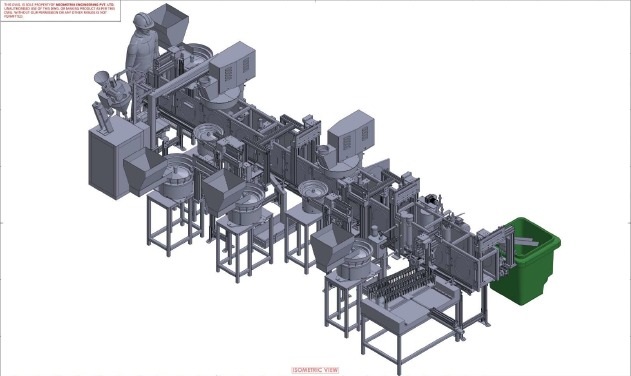

Non-lethal munitions — stun grenades and dye marker grenades — play an increasingly important role in law enforcement, riot control, military operations, and training scenarios where the objective is to neutralise threats or mark targets without causing permanent injury or fatality. The production of these devices combines precision engineering with demanding safety requirements: pyrotechnic charges must be metered to sub-gram accuracy, assembled under strictly controlled anti-static conditions, and handled in ATEX-compliant environments throughout the manufacturing process.
A Stun Composition and Dye Marker Filling and Assembling Machine automates the complete production cycle — from shell feeding through composition filling, cap assembly, and labelling — in a single integrated line that maintains the precision and safety standards required for certified non-lethal munition production.
The Two Grenade Types and Their Production Requirements
Stun Grenade Assembly
A stun grenade produces a disorienting combination of acoustic blast (approximately 180 dB at close range) and intense optical flash (exceeding 5 million cd/m²) without fragmentation. The pyrotechnic composition — typically a precisely weighed mix (~30g) of aluminium powder, magnesium carbonate, and potassium perchlorate — must be metered to sub-gram accuracy per device. Variation in charge weight directly affects blast and flash output, affecting both effectiveness and safety margins.
Safety requirements during filling include in-line inerting to prevent static build-up, grounded and anti-static transfer lines, filling under positive pressure to exclude external oxygen, and operator physical separation from the filling process.
Dye Marker Grenade Assembly
A dye marker grenade releases opaque coloured smoke on ignition, used for target marking, perimeter identification, and search-and-rescue signalling. The composition — typically 3–7g of a chlorate-lactose-dye mixture — requires precise metering to ensure consistent smoke density and duration. A scavenging air-scrub station at discharge captures excess pigment to prevent cross-contamination between production batches of different dye colours.
Key Production Capabilities
Gravimetric metering: A precision gravimetric filling module doses each charge to the specified weight (e.g., 41 ± 2g for stun shells) — weighing each charge before deposition to ensure accuracy regardless of powder flow variability. This is significantly more accurate than volumetric dispensing, which is affected by density variation in the pyrotechnic material.
Eight synchronised automation stations: The production line integrates multiple stations covering shell feeding, air-cleaning of shell interiors, composition filling, cap assembly, dual igniter installation, epoxy bonding, servo-controlled tightening of closures, final cleaning, and QR-code labelling — all synchronised for continuous production.
Mitsubishi FX5U PLC and 7-inch HMI: Full automation control with recipe management for different device types and charge weights, operator interface, and production monitoring.
Full batch traceability: Digital weight and torque logging for every unit, QR-code batch identification, and automated rejection handling for units outside tolerance. Each device can be traced to its production batch, operator shift, and all measured parameters.
Production rate: Up to 500 units per hour for the stun shell variant — the throughput required for production-scale non-lethal munition supply.
Safety Architecture
Pyrotechnic filling operations require comprehensive safety measures beyond those of standard industrial automation:
ATEX certification: All electrical equipment in the filling zone must be ATEX-certified for use in explosive atmospheres, with appropriate equipment category for the zone classification.
Anti-static protection throughout: Grounded transfer lines, anti-static conveying surfaces, ionising air bars where needed, operator grounding, and conductive flooring prevent electrostatic accumulation that could ignite pyrotechnic material.
Positive pressure exclusion: Filling occurs under slight positive pressure with controlled atmosphere to exclude ambient oxygen and prevent moisture ingress.
Blast-rated enclosures: Critical filling stations are enclosed in blast-rated panels that contain any accidental ignition event without propagating to adjacent stations.
Automatic shutdown: Any sensor detecting out-of-tolerance conditions — weight, pressure, atmosphere composition — triggers automatic line stop before the defective unit progresses.
Applications
Police and paramilitary forces: Production of stun grenades and dye marker grenades for riot control, hostage rescue, and special operations units.
Military non-lethal capability: Training round production and operational non-lethal munition supply for military units where escalation management is required.
Export and supply programmes: Certified production for export to approved defence customers and allied nation supply under relevant export control frameworks.
Neometrix Stun Composition & Dye Marker Filling & Assembling Machine (Model A3679)
Fully automated, flameproof production system processing stun grenades and dye marker grenades on a single line. Up to 500 units per hour. Gravimetric filling accuracy, eight synchronised stations, Mitsubishi FX5U PLC, full batch traceability. ATEX-compliant design with comprehensive anti-static and blast containment safety systems.
→ View Full Specifications
→ Request a Quote
FAQ
Q: Why is gravimetric filling used rather than volumetric dispensing for pyrotechnic charges?
A: Pyrotechnic powders and compositions have variable bulk density — even within a single production batch, density can vary due to particle size distribution, humidity, and compaction effects. Volumetric dispensing (filling by volume) translates this density variation directly into charge weight variation. Gravimetric filling weighs each charge before deposition, compensating for density variation and maintaining weight accuracy to sub-gram levels regardless of material flow variability. For stun grenades where charge weight directly determines blast and flash output, gravimetric accuracy is essential for both performance consistency and safety margin maintenance.
Q: What is ATEX certification and why is it required for pyrotechnic filling equipment?
A: ATEX (from French “ATmosphères EXplosibles”) is the European regulatory framework for equipment used in explosive atmospheres — defined as environments where flammable gases, vapours, dusts, or fibres may form explosive concentrations. Pyrotechnic filling operations create dust environments with ignition-sensitive materials that qualify as explosive atmospheres. ATEX certification verifies that electrical equipment in these zones cannot produce sparks, hot surfaces, or electromagnetic effects capable of igniting the atmosphere. ATEX equipment categories (1, 2, 3) match zone classifications (0, 1, 2) based on the probability and duration of the explosive atmosphere.
Q: What is full batch traceability in non-lethal munition production?
A: Full batch traceability means every completed device can be linked — through digital production records — to its production batch, the specific raw material batches used, the production date and shift, the operator(s) who handled it, and all measured parameters (fill weight, torque values, dimensional checks) recorded during production. QR codes on each device or container link to this database. For defence procurement, traceability is a quality assurance requirement enabling investigation of any field performance anomaly and supporting recall if a production defect is identified. It also satisfies export control record-keeping requirements.
Neometrix Defence Ltd. designs and manufactures stun and dye marker grenade filling and assembling machines for non-lethal munition production. [email protected] | +91-7777-876-876