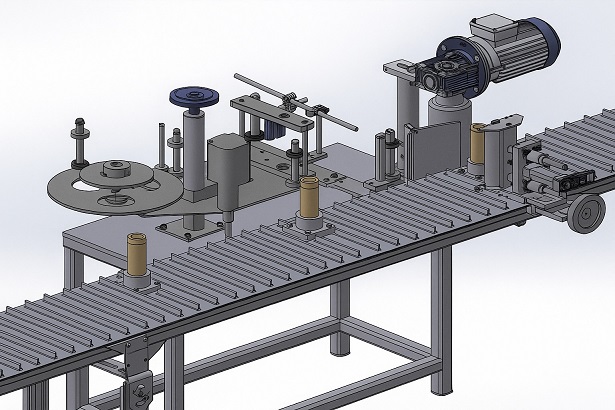

Stun shell cartridges — used in baton launchers and similar non-lethal delivery systems — combine a precise flash/bang composition with a reliable ignition system in a robust shell body designed to deliver disorientation at a safe standoff distance. The production of these devices requires an automated line capable of high throughput (hundreds of units per hour) while maintaining the gravimetric accuracy, assembly quality, and batch traceability demanded by defence procurement and safety regulations.
The Neometrix Stun Shell Composition Filling and Assembling Machine is a fully automated, flameproof production system capable of 500 stun shells per hour — performing the complete production cycle from empty shell body to finished, labelled, quality-verified cartridge without manual intervention at the critical filling and assembly stages.
Complete Production Cycle — Eight Stations
Station 1 — Shell feeding: Vibratory hopper singulates shell bodies from bulk supply and orients them for entry into the production line. Sensors verify correct orientation before each shell enters the filling sequence.
Station 2 — Air cleaning: Retractable high-pressure air knives scour internal and external shell surfaces, removing dust, oil, or residual debris. Clean shell interiors are essential for accurate fill weights and reliable composition-to-igniter contact.
Station 3 — Gravimetric composition filling: The core precision operation. A gravimetric metering module doses exactly 41 ± 2g of stun composition (metal-based flash powder) into each shell body. The module weighs the charge during deposition and adjusts dispensing to compensate for flow rate variation — achieving target weight accuracy regardless of powder batch variation.
Station 4 — Cap assembly: Closure cap is pressed onto the filled shell body with controlled force, sealing the composition and providing the mounting surface for the ignition system.
Station 5 — Dual igniter installation: Two igniters are installed per shell, providing redundant ignition reliability. Presence and orientation sensors verify correct igniter installation before the line advances.
Station 6 — Epoxy bonding: Structural epoxy is applied and cured to secure the assembly against the mechanical stresses of launch and handling.
Station 7 — Servo-controlled tightening: A servo-torque station applies final closure torque to the specified value, with torque and angle logged digitally for every unit. Out-of-tolerance torque triggers automatic rejection.
Station 8 — Final cleaning and QR labelling: External surfaces are cleaned, and a QR code label is applied encoding the unit’s serial number, batch, and production data — linking each device to its complete production record.
Key Performance Specifications
| Parameter | Specification |
|---|---|
| Production rate | Up to 500 units per hour |
| Fill weight | 41 ± 2g (gravimetric control) |
| Igniter configuration | Dual igniter per shell |
| Control system | Mitsubishi FX5U PLC, 7-inch HMI |
| Traceability | Full batch — weight, torque, QR per unit |
| Rejection handling | Automated — out-of-tolerance units diverted |
Why Dual Igniters
Single-igniter designs have a failure mode — if the igniter fails to fire, the shell does not function. In operational scenarios where non-lethal response is required, a dud round could create a dangerous gap in the response capability. Dual igniters provide redundancy: either igniter firing causes the shell to function. This significantly increases reliability in field conditions where temperature, humidity, and handling history may degrade individual igniter performance.
Applications
Law enforcement and paramilitary: Stun shells for baton launcher systems used by police, rapid response forces, and paramilitary units in riot control and civil disturbance management.
Military non-lethal operations: Crowd control in military operations where escalation to lethal force must be avoided, and for training exercises requiring realistic non-lethal munition simulation.
Correctional facilities: Managed disturbance response in prison environments.
Export programmes: Supply to approved allied and friendly nation law enforcement and military customers under relevant export control authorisations.
Neometrix Stun Shell Composition Filling & Assembling Machine
Fully automated, flameproof 8-station production line. 500 units/hour. 41 ± 2g gravimetric fill accuracy. Dual igniter assembly. Servo torque control with digital logging. QR batch traceability. Mitsubishi FX5U PLC with recipe management. ATEX-compliant design with anti-static systems and automatic rejection handling.
→ View Full Specifications
→ Request a Quote
FAQ
Q: Why is 500 units per hour significant for stun shell production?
A: Police and paramilitary organisations procuring stun shells for operational readiness require production at meaningful scale — a contract for tens of thousands of rounds needs a production rate that can fulfil it within a reasonable timeframe. At 500 units/hour, a single shift produces 4,000 shells; two-shift operation produces 8,000 per day. This is the scale at which automated production becomes economically and operationally viable for defence supply compared to manual or semi-manual production methods, which are also less consistent and more hazardous for the workforce.
Q: What is metal-based flash powder and why must it be handled with such precision?
A: Metal-based flash powders — typically mixtures of fine aluminium or magnesium with oxidisers such as potassium perchlorate — are highly sensitive to friction, impact, electrostatic discharge, and heat. They are energetically much more reactive than standard industrial powders. This is why the filling process requires ATEX-certified equipment, anti-static measures on all contact surfaces and transfer systems, positive-pressure controlled atmosphere, and grounded, spark-free tooling throughout. The sensitivity also drives the requirement for sub-gram filling accuracy — variation in charge weight affects both the acoustic and optical output and the safety margins of the device.
Q: How does automated rejection handling work in a pyrotechnic filling line?
A: Each station that makes a measurement (fill weight station, torque station, sensor checks) compares its result against the specified tolerance band. If a unit falls outside tolerance at any station, the PLC records the rejection reason and routes that shell to a reject divert mechanism before it reaches the next station. The rejected shell is collected in a secure container for disposition (typically rework or destruction, depending on the rejection stage and nature). Critically, the line does not halt — it continues processing subsequent shells while flagging the reject. The digital log records every rejection with reason, timestamp, and unit identifier for quality analysis.
Neometrix Defence Ltd. designs and manufactures stun shell filling and assembling machines for non-lethal munition production. [email protected] | +91-7777-876-876