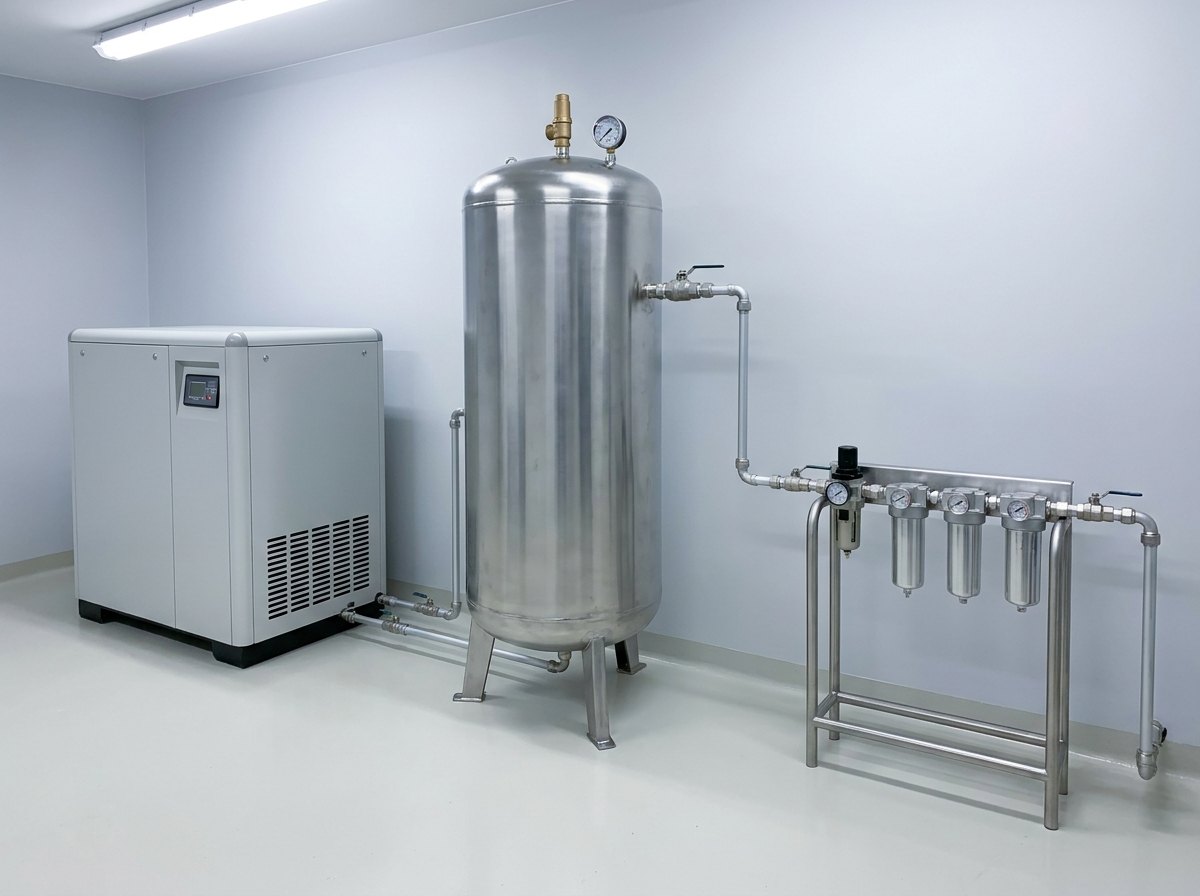

Compressed air is the utility that most facilities treat as a commodity — install a compressor, add some pipe, and the system works. For general-purpose applications like pneumatic tooling and workshop equipment, this approach is adequate. For instrument air serving control valves, positioners, and pneumatic instruments in a process plant; for aerospace test facilities where compressed air contacts aircraft systems; for medical facilities where breathing air quality is a patient safety requirement; and for food and beverage production where air contacts product — “good enough” is not a specification.
In these applications, compressed air quality is specified against ISO 8573-1, the international standard that classifies compressed air by its content of particles, water, and oil. The most demanding quality class — ISO 8573-1 Class 1 — requires particle counts below 20,000 particles per cubic metre at sizes 0.1-0.5 micron, dew point at pressure below -70°C, and oil content below 0.01 mg/m³. Achieving this requires more than a standard compressor with a filter.
The Three Contaminants and How They Get Into Compressed Air
Oil: Standard rotary screw and reciprocating compressors use oil for lubrication and sealing. Even with high-efficiency oil separators and coalescing filters, oil carryover into the compressed air stream is unavoidable — typically 1-5 mg/m³ in the compressed air downstream of a standard compressor. For instrument air and other critical applications, this is unacceptable.
Oil-free compressors (dry-running screw, scroll, or centrifugal compressors with no lubrication in the compression chamber) produce air with oil content below 0.01 mg/m³ — Class 1 per ISO 8573-1. These compressors are more expensive than oil-injected types but are the only technically sound solution for oil-sensitive applications.
Moisture: Atmospheric air contains water vapour. When compressed, the air’s carrying capacity for water vapour drops — at 7 bar, it can carry approximately one-eighth of the water it could at atmospheric pressure. The rest precipitates as liquid water or aerosol. This water damages pneumatic instruments, promotes corrosion in downstream distribution, and causes problems in any application where moisture cannot be tolerated.
Desiccant dryers — either heated or heatless regenerative types — adsorb water from the compressed air stream and achieve pressure dew points of -40°C (heatless) to -70°C (heated regenerative). Refrigerant dryers achieve +3°C dew point, which is adequate for many applications but not for Class 1 instrument air or aerospace use.
Particles: Compressors introduce wear debris, atmospheric dust, and rust particles from distribution pipework. Multi-stage filtration — typically coarse prefiltration (3-5 micron), fine filtration (0.01 micron), and activated carbon adsorption for oil vapour removal — in sequence after drying achieves the particle and oil content levels required for Class 1 air.
The Standard Instrument Air Treatment Train
A proper instrument air treatment train in sequence:
- Oil-free compressor (or standard compressor + coalescing filter for less critical applications)
- Aftercooler and moisture separator (removes bulk condensate)
- Refrigerant or desiccant dryer (achieves required dew point)
- Particulate filter (removes fine particles post-dryer)
- Activated carbon adsorber (removes residual oil vapour)
- Final particulate filter (removes carbon fines from adsorber)
- Distribution manifold with individual outlet regulators
Regional Applications
Gulf oilfield and petrochemical: Onshore and offshore process facilities across Saudi Arabia, UAE, Kuwait, Qatar, and Oman use vast quantities of instrument air for control valve actuators, positioners, and pneumatic logic systems. ARAMCO Engineering Standards (SAES), Abu Dhabi National Energy Company (TAQA), and equivalent national operator standards all specify compressed air quality for instrument service — typically ISO 8573-1 Class 2 for general instrument air and Class 1 for critical analytical and clean room applications.
Aerospace and defence test facilities: Test cells and laboratories testing aircraft systems require compressed air that meets the purity requirements of the aircraft systems themselves — MIL-PRF-5607 (compressed air, breathable) or ISO 8573-1 Class 1 for instrument supply.
Pharmaceutical and medical: Clean room environments, sterile manufacturing, and medical gas pipelines require air quality per ISO 8573-1 Class 1 or better. In the UK, HTM 02-01 specifies medical compressed air quality requirements for NHS and private hospital installations.
Food and beverage: Where compressed air contacts product or packaging, ISO 8573-1 Class 1 oil content is required to prevent contamination. Middle Eastern and Gulf food production facilities increasingly require ISO 8573-1 certification from their compressed air systems.
Neometrix Dry Oil-Free Compressed Air System
A complete engineered compressed air system producing ISO 8573-1 Class 1 quality instrument air — from oil-free compressor through aftercooling, desiccant drying, multistage filtration, and activated carbon adsorption to distribution manifold. Designed for aerospace, defence, process industry, and medical facility applications.
→ View Full Specifications
→ Request a Quote
FAQ
Q: What is ISO 8573-1 and what do the class numbers mean for compressed air quality?
A: ISO 8573-1 is the international standard for compressed air quality. It classifies air separately for three contaminants: solid particles, water (expressed as pressure dew point), and oil content. Class numbers range from 0 (most stringent) to 5 or 6 (least stringent) for each contaminant. Class 1 for particles requires fewer than 20,000 particles per cubic metre in the 0.1-0.5 micron range, dew point at pressure below -70°C, and oil content below 0.01 mg/m³. A complete air quality designation might be ISO 8573-1:2010 [1:2:1] meaning Class 1 particles, Class 2 water (dew point below -40°C), Class 1 oil — this would be typical for instrument air in a Gulf process plant. The standard provides a common language for specifying and verifying air quality across different regions and industries.
Q: What is the difference between a refrigerant dryer and a desiccant dryer for compressed air?
A: A refrigerant dryer cools the compressed air to approximately +3°C, at which point most of the water vapour condenses and is removed. The pressure dew point achieved is approximately +3°C. This is adequate for general-purpose compressed air but not for instrument air requiring -40°C dew point or better. A desiccant dryer passes compressed air through a bed of desiccant material (activated alumina or molecular sieve) that adsorbs water at pressure. Heatless desiccant dryers achieve pressure dew points of -40°C; heated regenerative dryers achieve -70°C or lower. The desiccant is regenerated by passing a portion of the dried air (heatless) or heated air (heated) through the saturated bed to drive off the adsorbed moisture. Desiccant dryers consume more energy than refrigerant dryers but achieve significantly lower dew points.
Neometrix Defence Ltd. designs and installs dry oil-free compressed air systems for aerospace, defence, process industry, and medical facility applications. [email protected] | +91-7777-876-876