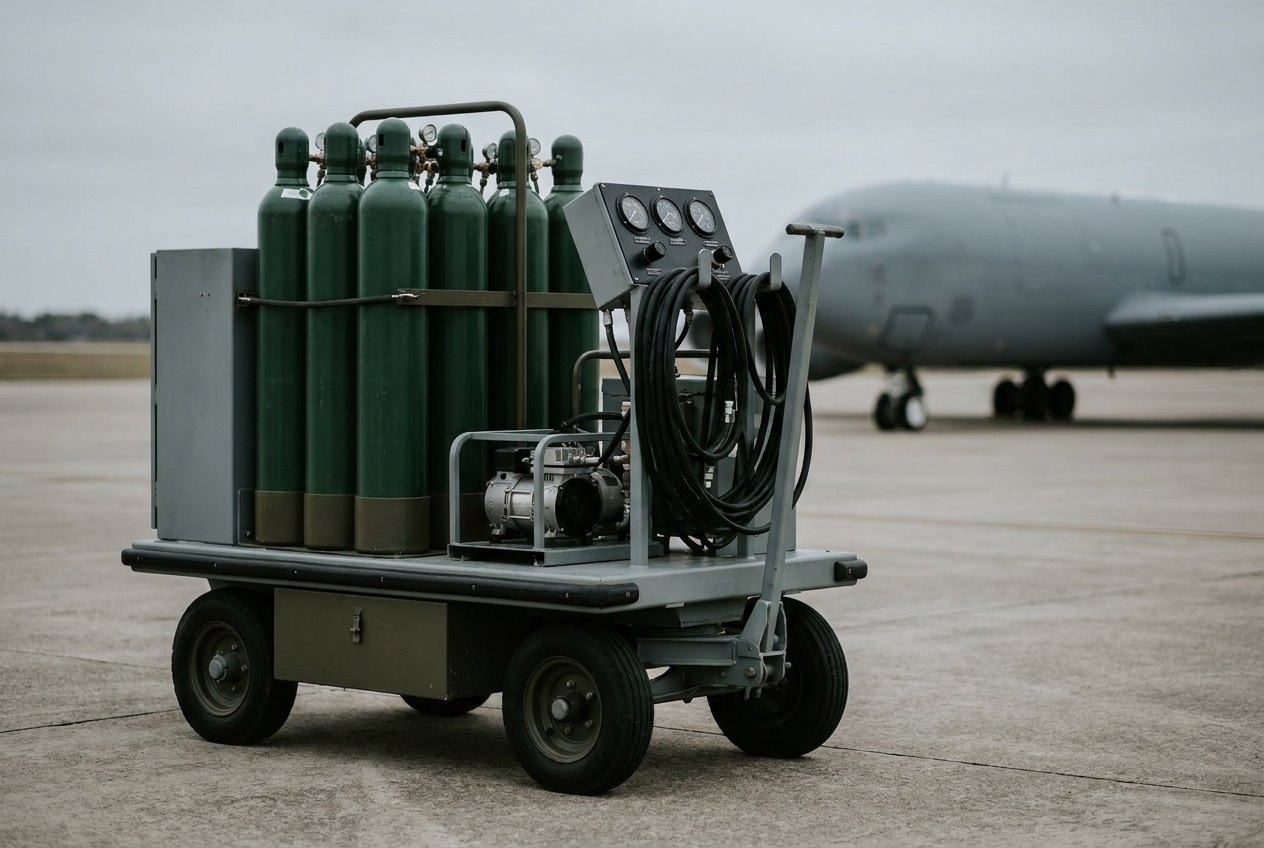

Aircraft Oxygen Systems: From the Ground Charging Cart to the Aircrew Mask
Above roughly 10,000 ft (about 3,050 m) there is no longer enough oxygen in each breath, and judgment, vision and consciousness fade, often without warning. Fighter aircrew routinely fly to 40,000 ft (about 12,200 m) and beyond, where they need not just extra oxygen but oxygen delivered under positive pressure to force it into the lungs. The aircraft oxygen system is the life-support equipment that makes that possible, and because a failure is fatal, it is charged, delivered and tested to a discipline all of its own.
This guide is written for aviation maintainers, ground-support engineers, program managers and procurement teams in the USA, the UK and Europe. It explains the two halves of an aircraft oxygen system, why cleanliness is the central hazard, and what Neometrix builds (and what it does not).
Key Takeaways
– An aircraft oxygen system has two halves: the ground system that charges, distributes and tests oxygen, and the airborne system (regulator and mask) that delivers it.
– On the ground, an oil-free high-pressure booster compresses oxygen to the aircraft’s charging pressure, typically about 150-200 bar (2,176-2,901 psi).
– Everything must be oil-free and oxygen-clean: high-pressure oxygen in contact with any hydrocarbon can ignite violently.
– Neometrix’s ground system is its demonstrated build; the airborne regulator and mask are offered as indigenization and integration.
– Regulators and masks should be tested on a dedicated facility before flight.
The Problem: Above 10,000 Feet You Cannot Breathe Ambient Air
At sea level air is about a fifth oxygen, and that is enough. Climb, and the pressure falls until each breath carries too little oxygen to support the brain. Judgment and vision degrade first and the effect can be insidious: crews may not realize it is happening. At combat altitudes the aircraft must supply oxygen under positive pressure, which is why every combat aircraft carries a life-support oxygen system.
The Two Halves of the System
1. On the Ground: Charge It, and Charge It Clean
The aircraft’s oxygen has to be put aboard and kept ready. That ground job includes:
– An oil-free high-pressure booster that compresses oxygen to the aircraft’s charging pressure
– Charging trolleys that connect the supply to the aircraft
– A mobile charging-and-distribution vehicle that takes oxygen to the flight line
– An oxygen test facility that verifies regulators and masks
Everything is scrupulously oil-free and oxygen-clean, because high-pressure oxygen in contact with oil, grease or other hydrocarbons is a fire hazard.
2. In the Air: Deliver It at the Right Pressure
Airborne, stored or generated oxygen passes through a demand / pressure regulator, the precision heart of the system. The regulator senses altitude and delivers oxygen to the aircrew mask at the correct flow and pressure, adding oxygen as the aircraft climbs and switching to positive pressure breathing at high altitude.
Stored Oxygen, LOX or OBOGS?
Aircraft oxygen can come from three types of source, and the ground support requirement differs for each:
| Source | How it works | Ground-support implication |
|---|---|---|
| Charged cylinders (gaseous) | High-pressure oxygen stored on board | Needs oil-free charging and oxygen-clean handling |
| Liquid oxygen (LOX) | Liquid stored and converted to gas | Needs LOX servicing and handling |
| OBOGS (on-board oxygen generating system) | Generates oxygen from engine bleed air | Less ground charging, but regulators and masks still need testing |
The Neometrix page notes that the charging pressure, booster capacity, regulator and test facility all follow from the aircraft, its oxygen source, the aircrew and the flight envelope.
The Honest Split: What Neometrix Builds
Neometrix is explicit about what is its own and what is indigenized:
– Built by Neometrix (demonstrated competence): the oil-free booster, charging trolleys, mobile charging-and-distribution vehicle and oxygen test facility, on its high-pressure gas and aircraft ground-support competence.
– Offered as indigenization and integration: the airborne demand regulator and aircrew mask, with the precision regulator internals and specialist mask components co-developed or bought in.
The product is engineered to order. No specific delivered system is claimed.
Why an Oxygen System Is Unforgiving
The Neometrix page identifies three areas where oxygen systems go wrong:
1. Cleanliness. A trace of oil or grease in a high-pressure oxygen line can ignite it. A booster or regulator that is not oxygen-clean is a hazard, not just a fault.
2. Pressure. Charging must be to the aircraft’s rated pressure.
3. The regulator. One that mis-schedules flow or pressure with altitude starves the aircrew of oxygen at exactly the wrong moment, and a system not tested before flight is trusting a life-support device it has not proven.
The remedy is end-to-end oil-free, oxygen-clean practice, charging to rated pressure, schedule-verified regulators and pre-flight testing. The measure of an oxygen system is that the aircrew never have to think about it.
Variants and Applications
Four configurations cover the scope:
– Oxygen charging and booster plant: the oil-free booster and trolleys that put oxygen aboard, oxygen-clean.
– Mobile oxygen charging and distribution vehicle: a self-contained flight-line vehicle that carries, boosts and distributes oxygen to the aircraft on the apron.
– Aircrew oxygen delivery: the demand/pressure regulator and mask, offered as indigenization and integration.
– Portable sets and oxygen test facility: portable aircrew sets, and the test facility that verifies regulators and masks before flight.
Applications include fighter aircrew oxygen charging and delivery, transport and trainer aircrew oxygen, combat free-fall/para oxygen recharge, flight-line oxygen charging and distribution, oxygen-equipment repair, overhaul and test, and high-flow gaseous oxygen ground supply. Rotary-wing helicopter oxygen has its own page in the Neometrix catalogue.
Standards and Procurement Context for US, UK and European Buyers
Oxygen service is governed by cleanliness, material-compatibility and purity frameworks. These are commonly referenced:
– United States: ASTM G93 (cleanliness levels and cleaning methods for oxygen-enriched environments), CGA G-4.1 (cleaning equipment for oxygen service), MIL-PRF-27210 and SAE AS8010 for aviator’s breathing oxygen purity, and, for civil aircraft, 14 CFR 91.211 on supplemental oxygen use.
– United Kingdom: DEF STAN requirements on MOD programs, and the Supply of Machinery (Safety) Regulations for machinery placed on the Great Britain market.
– European Union: EIGA Doc 33 (cleaning of equipment for oxygen service), ISO 15001 on oxygen compatibility, the Pressure Equipment Directive 2014/68/EU and the Machinery Directive 2006/42/EC (being replaced by Regulation (EU) 2023/1230 from January 2027).
Neometrix does not claim certification to these on its product page. The system is engineered to order, and the company replies to a specification with a clause-by-clause compliance matrix within two working days.
Buyer’s Checklist: 8 Questions for Oxygen-Service Equipment Suppliers
1. Is the equipment oil-free and oxygen-clean end to end, and how is cleanliness verified and documented?
2. What charging pressure and booster capacity does it support, and for which aircraft types and oxygen sources?
3. How are materials selected for oxygen compatibility?
4. What safety devices protect against over-pressure and ignition risk?
5. Can the system charge and test at the flight line?
6. How are regulators and masks tested, and across what altitude schedule?
7. What is built in-house versus bought in or co-developed?
8. What documentation, training and spares support is included?
Frequently Asked Questions
Why does an aircraft need an oxygen system?
Because above about 10,000 ft there is not enough oxygen in each breath to sustain judgment, vision and consciousness. Combat aircrew fly far higher and need oxygen under positive pressure.
What does the oxygen regulator do?
It senses altitude and delivers oxygen to the aircrew mask at the correct flow and pressure, adding oxygen as the aircraft climbs and switching to positive pressure breathing at high altitude. It is the precision heart of the airborne system.
Why must an oxygen system be oil-free?
Because high-pressure oxygen in contact with any hydrocarbon can ignite violently. Oil-free, oxygen-clean practice is essential from the booster to the mask.
Can charging and testing be done at the flight line?
Yes: the catalogue includes a mobile oxygen charging-and-distribution vehicle for the flight line and an oxygen test facility for regulators and masks.
Get in Touch
Send the aircraft class and scope for a clause-by-clause compliance matrix and a budgetary quotation within two working days:
– Product page: Aircraft Oxygen System
– Tenders and quotations: [email protected]
– General enquiries: [email protected]
– Phone: +91-7777-876-876 (India; dial +91 from the USA, UK and Europe)