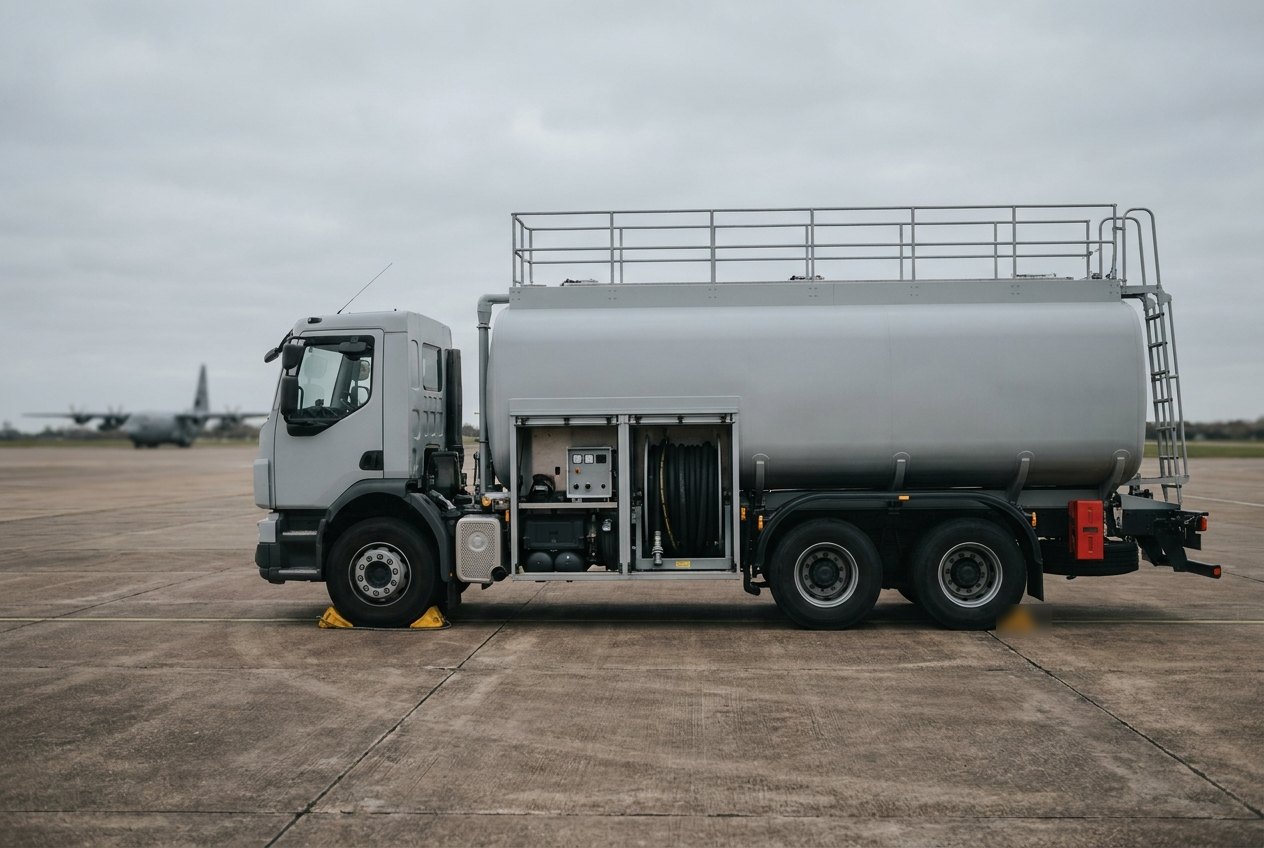

Aircraft Refuellers and Fuel Bowsers: Clean, Counted and Safe
An aircraft refueller is not a tank on a truck. It is a fluid system on wheels, built around three demands: the fuel must arrive clean, it must be measured and it must be delivered safely. Refuelling looks like the simplest job on the apron and is one of the least forgiving. This guide explains how a refueller is designed around those demands, for airfield operators, ground-support engineers and procurement teams in the USA, the UK and Europe.
Key Takeaways
– Capacity ranges from about 4 kL on a bowser (1,057 US gal) to about 38 kL on a refueller (10,039 US gal).
– Clean: a filter water separator with a differential-pressure gauge, plus a tank sloped to sumps that are drained and checked before delivery.
– Counted: a flow meter (positive-displacement or turbine) with a register and preset, with electronic fuel management and telemetry where reconciliation is needed.
– Safe: bonding and earthing, a deadman control, pressure control and drive-away interlocks.
– Neometrix designs and body-builds vehicles onto the chassis and overhauls in-service ones. Engineered to order.
Three Demands Behind Every Feature
1. The quantity must be right, because the aircraft is loaded and trimmed on it.
2. The fuel must be clean, because water and particulate carried into a fuel system are a flight-safety matter, not housekeeping.
3. The operation must be safe, because a flammable liquid is being moved at rate alongside an aircraft, where static discharge is what you design against.
Clean: Why Filtration Is the Heart
The defining component is the filter water separator (or filter monitor). Fuel passes through coalescer and separator stages that pull out free water and hold back particulate. Its differential-pressure gauge is watched, because rising pressure drop is how the elements announce they are loaded. The tank is sloped to sumps that are drained and checked before delivery, and the whole system is built to keep water from getting a foothold.
Counted: Every Litre Measured
A flow meter with a register and preset gives the uplift and lets the operator set a quantity so that delivery stops there. Increasingly, the requirement extends to electronic fuel management, vehicle and user identification and telemetry, so that fuel issued is reconciled automatically instead of on a clipboard.
Safe: Built That Way
– Bonding and earthing to the aircraft before any fuel moves, because static is the hazard.
– A deadman control: delivery stops the moment the operator lets go.
– Pressure control protects the aircraft from over-pressure on a single-point connection.
– Drive-away interlocks stop the vehicle being driven off while still connected.
– Emergency stops, extinguishers and a proper platform, ladder and lighting fit-out.
Refueller or Bowser?
| Variant | Typical size | Use |
|---|---|---|
| Aircraft refueller | About 16-38 kL (4,200-10,000 US gal) on a heavy truck chassis | Full filtration, metering and underwing delivery for fast turnrounds |
| ATF fuel bowser | About 4-6 kL (1,057-1,585 US gal), including pressurized types | Smaller aprons, dispersed operations, field replenishment |
| Dispensing tank and trailer units | About 1 kL (264 US gal) | Detachments, small aircraft, remote fuel points |
| Overhaul and fuel-management upgrade | Existing vehicles | Strip, inspect, re-pipe, recalibrate; retrofit metering and telemetry |
Applications
Airfield aircraft refuelling; forward and field fuel replenishment; underwing single-point pressure refuelling; overwing nozzle refuelling; fuel-farm to aircraft distribution; and refueller overhaul, refurbishment and upgrade.
Related Ground Support
The refueller belongs to the same ground-support family as the Neometrix liquid-oxygen tanker (the same body-build competence with a very different fluid), the aircraft tyre nitrogen charging rig and the ground air-conditioning cart.
Standards and Procurement Context for US, UK and European Buyers
Aviation fuelling is governed by fuel quality, equipment and safety frameworks. Those commonly referenced include:
– United States: NFPA 407 (Standard for Aircraft Fuel Servicing), ASTM D1655 for Jet A / Jet A-1 fuel specification and API / Energy Institute 1581 for aviation jet fuel filter/separators.
– United Kingdom: DEF STAN 91-091 (turbine fuel, Jet A-1), the Energy Institute EI 1540 guidance on aviation fuelling facilities and the Dangerous Substances and Explosive Atmospheres Regulations (DSEAR).
– European Union: ADR for road tankers carrying dangerous goods, the ATEX Directive 2014/34/EU for equipment in explosive atmospheres and the Machinery Directive 2006/42/EC (replaced by Regulation (EU) 2023/1230 from January 2027).
– Industry: Joint Inspection Group (JIG) standards for aviation fuel handling at airports.
– Quality: ISO 9001 and ISO 14001 (listed on the Neometrix page).
Neometrix does not claim certification to these on the product page. Send the capacity and the chassis and Neometrix replies with a clause-by-clause compliance matrix within two working days.
Buyer’s Checklist: 8 Questions for a Refueller Supplier
1. What capacity and compartment layout do we need, and on what chassis?
2. What filter water separator is fitted, and how is the differential-pressure gauge read and recorded?
3. How are sumps drained and checked before every delivery?
4. What metering and preset system is fitted, and does it include electronic fuel management or telemetry?
5. How are bonding, earthing, the deadman control and drive-away interlocks implemented?
6. Is delivery underwing (single-point pressure), overwing or both?
7. What overhaul or retrofit options exist for our in-service fleet?
8. What is built in-house and what is bought in, and what spares and support are included?
Frequently Asked Questions
What is the difference between a refueller and a bowser?
A refueller is the large vehicle (roughly 16 to 38 kL) for fast turnrounds; a bowser is the compact 4 to 6 kL unit for smaller aprons and field replenishment.
Why is filtration the heart of a refueller?
Because water and particulate in jet fuel are a flight-safety hazard, and the filter water separator is what removes them.
How is the refuelling operation kept safe?
Bonding and earthing against static, a deadman control, pressure control against over-pressure, drive-away interlocks, emergency stops and extinguishers.
Can an existing refueller be overhauled or upgraded?
Yes. In-service vehicles can be stripped, inspected, re-piped and recalibrated, with metering and telemetry retrofitted where reconciliation is wanted.
Get in Touch
Send the capacity and the chassis for a clause-by-clause compliance matrix and a budgetary quotation within two working days:
– Product page: Aircraft Refueller & Fuel Bowser
– Tenders and quotations: [email protected]
– Phone: +91-7777-876-876 (India; dial +91 from the USA, UK and Europe)