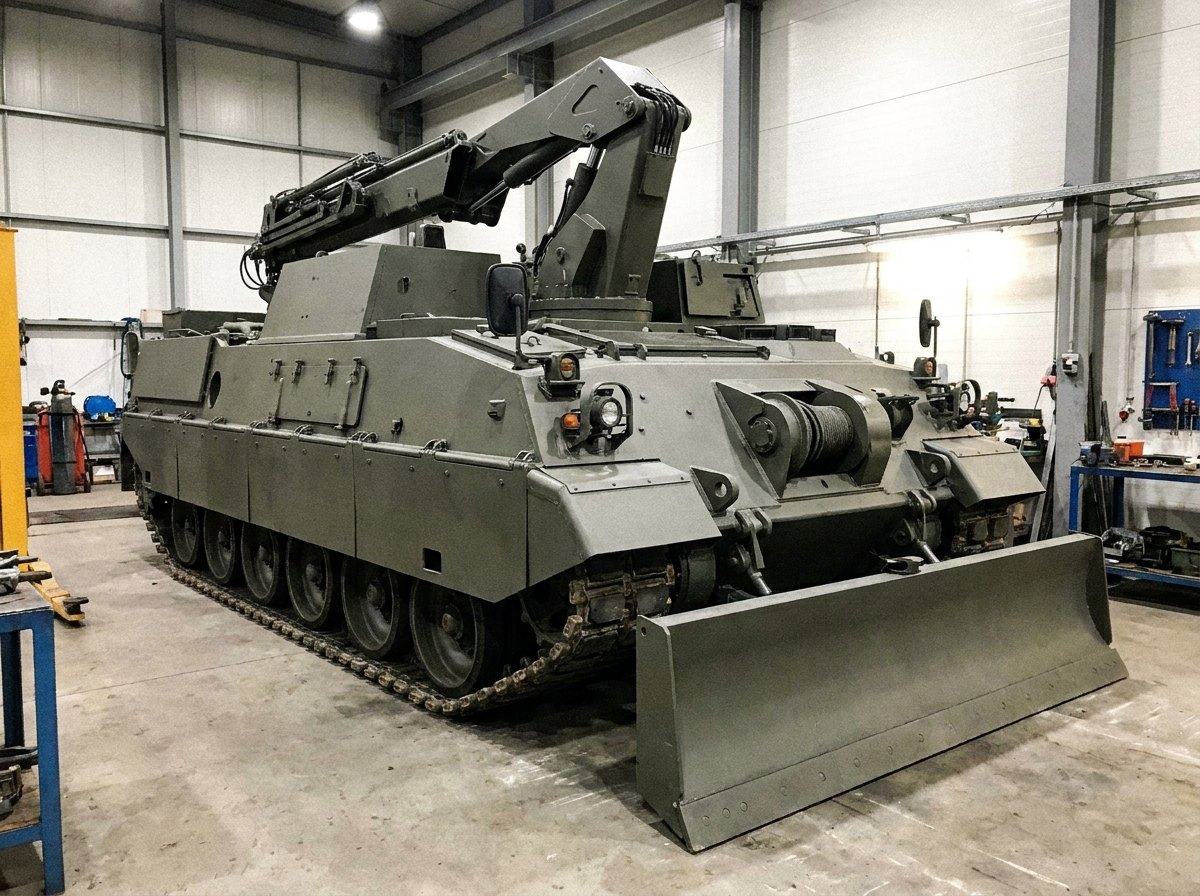

Armoured Recovery Vehicle Equipment: Anchor, Drag, Lift, Tow
A 40 to 60 tonne armoured vehicle that has thrown a track or sunk into soft ground cannot be moved by willpower. Something has to dig in, pull, lift and tow it, usually on bad ground and often in a hurry. On an armoured recovery vehicle (ARV) every one of those jobs is done by hydraulics. This guide explains how that equipment works, what sizes it, and where it goes wrong, for defense logistics, fleet-support and procurement teams in the USA, the UK and Europe.
Key Takeaways
– Recovery is a hydraulics problem: a spade anchors, winches drag, a crane lifts, and a hydraulic power aggregate drives all of it.
– Reference capability on the Neometrix page: a main winch of about 50 tonnes line pull (roughly 110,000 lbf), an auxiliary winch up to about 5 tonnes, recovery of casualties up to about 60 tonnes.
– The sequence is always anchor, rig, recover, lift and tow.
– Neometrix builds, integrates and refurbishes the hydraulic aggregates and recovery equipment. The hull, engine and vision systems are bought in or government-furnished.
– It is a machine-and-hydraulics system: no turret, no gun. Engineered to order; no specific delivered vehicle is claimed.
The Recovery Sequence
The page describes four steps that happen in a fixed order:
1. Anchor. Before the main winch can drag a heavy casualty, the recovery vehicle must hold station. A dozer / earth-anchor spade is lowered and dug in, reacting the line load so that the recovery vehicle is not dragged instead.
2. Rig. The lighter, faster auxiliary winch reeves and positions the heavy main rope.
3. Recover. The main winch, with a line pull in the region of 50 tonnes, drags the casualty clear.
4. Lift and tow. A hydraulic crane / jib lifts what has to be lifted, most demandingly a powerpack or engine change in the field, and the casualty is towed home.
The result is a mobile field-repair platform, not just a tug: a casualty can be repaired forward instead of only being towed.
The Four Sub-Systems
| Sub-system | What it does | Notes from the product page |
|---|---|---|
| Main and auxiliary winch | Drags the casualty; the auxiliary reeves and positions the main rope | Main winch about 50 t line pull, wire rope and fairlead; auxiliary up to about 5 t |
| Hydraulic crane / jib | Lifts powerpacks and engines, handles obstacles | Knuckle or telescopic boom with its own hydraulic circuit |
| Dozer / earth-anchor spade | Anchors against the winch load; doubles as a dozer for clearance | Front blade with hydraulic rams |
| Hydraulic power aggregates and controls | Pump, valve blocks and controls that drive every function | Sized to the winch and crane loads and built for field duty |
Where Recovery Equipment Goes Wrong
The Neometrix page is blunt: failures are in the loads and the hydraulics, not the idea.
– A winch undersized for the heaviest casualty stalls when it matters.
– A spade that cannot react the winch load drags the recovery vehicle instead of the casualty.
– A crane rated for the boom but not the powerpack weight cannot do the field repair.
– Hydraulics not built for shock, contamination and duty cycle fail in the field.
The remedy is sizing to the weight class and the worst-case pull, matching the spade and anchor to the winch, and building the aggregates for field duty. Recovery equipment is only worth the casualty it can actually move.
Four Configurations
Tenders call this recovery equipment, hydraulic aggregates for a recovery vehicle, a recovery winch or a refurbishment of the hydraulic portion. The principle is common; Neometrix supplies the sub-system or the whole kit:
– Main recovery winch system: drum, wire rope, fairlead and hydraulic drive
– Hydraulic crane / jib: knuckle or telescopic, for powerpack / engine change and obstacle handling
– Dozer / earth-anchor spade: the reaction member and clearance blade
– Power pack and refurbishment: the aggregate, plus refurbishment of the hydraulic / utility portion of an in-service vehicle
Applications
Heavy tracked-vehicle recovery up to about 60-tonne casualties; wheeled-vehicle recovery with faster turnaround; powerpack and engine lift and change for forward field repair; casualty towing and winching; obstacle clearance and earth anchoring; and field-workshop recovery support.
The Honest Split
Neometrix describes its scope plainly: it builds the hydraulic power aggregates and the recovery equipment (winches, crane, spade), integrates them and refurbishes them. The armoured hull, engine and vision systems are bought in or government-furnished. The company also points to existing armoured-vehicle hydraulics work (an actuating-cylinder indigenization for a legacy tank platform) and marine deck hydraulics as the same discipline on different platforms. No delivered vehicle is claimed.
Standards and Procurement Context for US, UK and European Buyers
Recovery equipment is usually specified against the user’s own vehicle requirement and defense standards rather than a single product standard. The frameworks buyers commonly reference are:
– United States: MIL-STD environmental and equipment requirements, and wire-rope and lifting-equipment practice under ASME and OSHA rules for any commercial lifting use.
– United Kingdom: DEF STAN requirements, plus the Lifting Operations and Lifting Equipment Regulations (LOLER) and the Supply of Machinery (Safety) Regulations for lifting equipment placed on the Great Britain market.
– European Union and NATO: the Machinery Directive 2006/42/EC (replaced by Regulation (EU) 2023/1230 from January 2027), the Pressure Equipment Directive 2014/68/EU for hydraulic accumulators where relevant, and STANAG interoperability requirements.
– Quality: ISO 9001 and ISO 14001 (Neometrix lists both on this page).
Neometrix does not claim certification to the defense or lifting frameworks on this page. The company replies to a tender with a clause-by-clause compliance matrix within two working days.
Buyer’s Checklist: 8 Questions for an ARV Equipment Supplier
1. What is the heaviest casualty weight class, and is the winch sized to the worst-case pull, including soft-ground resistance?
2. Is the spade matched to the winch load so the recovery vehicle stays put?
3. What lift capacity does the crane have at working radius, and does it cover a powerpack or engine?
4. How is the hydraulic power aggregate protected against shock, contamination and duty cycle?
5. Can the system be refurbished in service, and what spares are held?
6. What is built in-house and what is bought in or government-furnished?
7. What safety interlocks, overload protection and manual fallback are fitted?
8. What documentation, training and support come with the kit?
Frequently Asked Questions
What does ARV recovery equipment actually do?
It anchors the recovery vehicle, drags a disabled or bogged vehicle clear with winches, lifts heavy components with a crane and tows the casualty back into service.
How are the winch and crane sized?
To the weight class of the vehicles to be recovered and the worst-case task, including the powerpack weight for the crane. Line pull, lift and hydraulic power all follow from that.
Is this a weapon system?
No. It is a machine and hydraulics system on a recovery vehicle: no turret and no gun.
Do you build the whole vehicle?
No. Neometrix builds the hydraulic aggregates and the recovery equipment. The hull, engine and vision systems are bought in or government-furnished.
Get in Touch
Send the vehicle weight class and the recovery task for a clause-by-clause compliance matrix and a budgetary quotation within two working days:
– Product page: Armoured Recovery Vehicle Equipment
– Tenders and quotations: [email protected]
– Phone: +91-7777-876-876 (India; dial +91 from the USA, UK and Europe)