
Dynamic Turret Test Rig: Tuning Gun Stabilisation Before the Vehicle Ever Moves
A modern armoured fighting vehicle’s gun-control system lives or dies on one capability: keeping the sight and the muzzle on target while the hull pitches, rolls and bounces across rough ground at speed. That stabilisation loop cannot be tuned on a static stand, and it cannot be tuned efficiently by driving the actual vehicle over test ground for every iteration of every gain adjustment. What’s needed is the turret held still in a workshop while the ground moves underneath it, repeatably, on command. That’s the specific engineering problem a dynamic turret test rig solves.
A Six-Axis Platform Standing in for the Battlefield
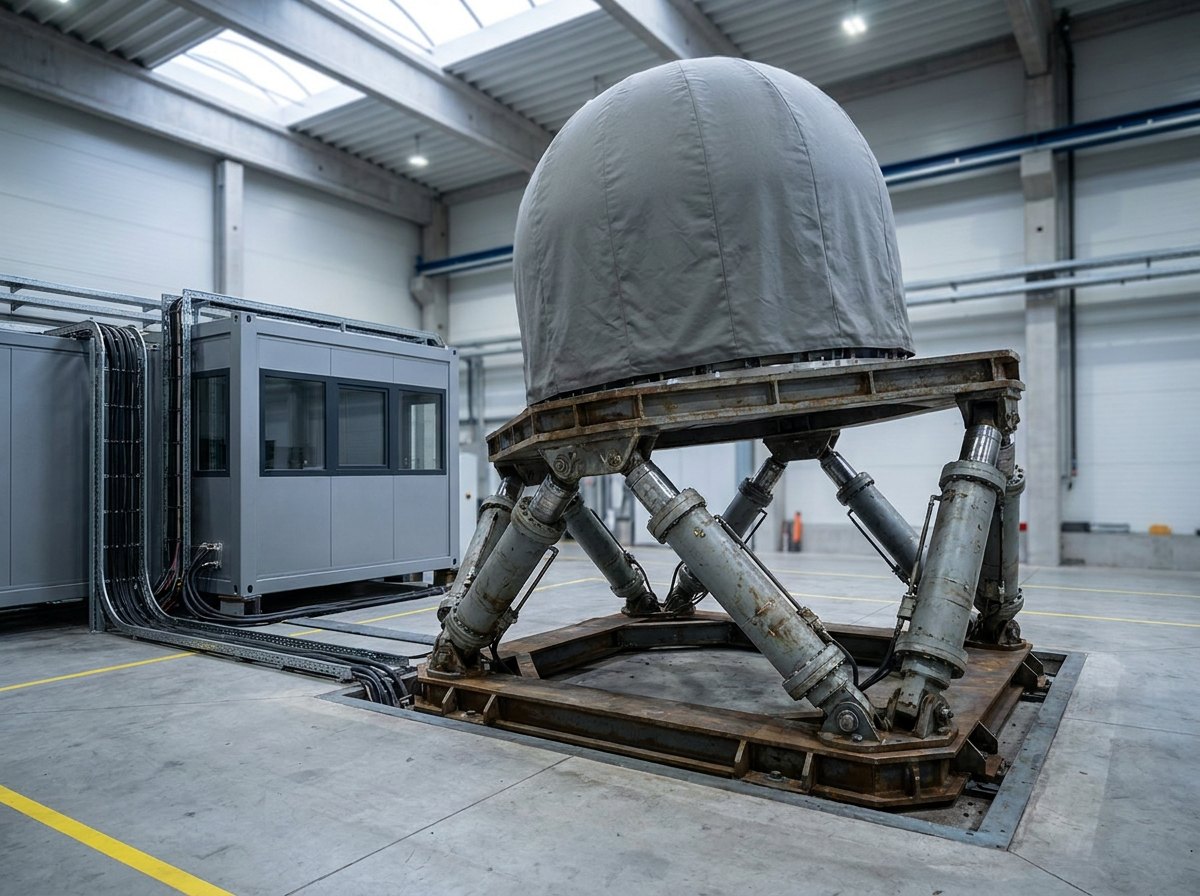
At the core of the rig is a six-axis (hexapod) motion platform. The customer’s own turret and gun-control system bolt directly to a moving frame, and six electromechanical linear actuators — each built from a motor, gearhead and roller screw — tilt that frame through roll and pitch and drive a vertical bounce. The frame sits above a concrete-anchored base stiff enough to react the loads a heavy turret throws at it under dynamic motion.
Roller-screw actuators are chosen specifically for their load capacity and speed. Each one carries its own position sensor and a manual override for safe recovery in the event of a power loss, with posture locking so the platform holds a commanded position reliably. An optional set of pneumatic load-sharing equalisers helps share peak loads under high acceleration — a detail that matters when a heavy turret is being driven through aggressive disturbance profiles repeatedly over a long test campaign.
A real-time controller does the actual work of translating a commanded roll-and-pitch posture into the individual stroke length each of the six actuators must take — solving the platform’s kinematics on the fly. It replays programmable disturbance profiles that stand in for a vehicle running over real terrain, with adjustable motion speed and acceleration, inclinometer feedback, limit switches and alarms keeping every posture inside its safe envelope.
Measuring the Turret While It Turns
The whole point of the exercise is capturing how well the gun-control system holds its aim under disturbance — which means instrumenting a turret that has to keep traversing while it’s being measured. That’s handled through a rotary base junction: a slip-ring path at the turret base carrying power and signal rings alongside discrete, CAN, Ethernet and video channels, so the turret can rotate continuously while its data keeps flowing.
The real-time data-acquisition system logs turret azimuth and gun-elevation speed, acceleration and position, along with the stabilisation-mode errors the gun-control system itself reports — the actual number an engineer tunes the control loop against. Data lands on a rugged acquisition unit and an analysis workstation with redundant local and external logging, so a test run becomes a dataset rather than just an observation.
The Turret Stays the Customer’s; Everything Around It Is Engineered to Order
The turret and its gun-control system are customer-furnished equipment — Neometrix engineers everything around it: the motion platform, the actuation, the controller, the instrumentation, and the guarded safe cell. Interfaces between the customer’s turret and the rig are frozen jointly at design review, and no turret data leaves the programme.
Because a heavy turret on a tilting frame is a structural problem before it’s a control problem, static, modal and dynamic finite-element analysis of every frame and the concrete foundation is carried out and vetted at design review — so the platform is proven rigid and safe under worst-case dynamic loads before any steel is cut.
The Safe Cell Around a Heavy, Fast-Moving Turret
A turret at full traverse on a moving platform is not something operators stand next to. The full line sits inside a guarded, thermally conditioned safe cell: a toughened control cabin, continuous CCTV monitoring, safety rails around the rotating envelope, emergency stops both at the operator point and outside the guarded zone, and warning alarms with indicating lamps. Everything is handled from behind the guarding.
The rig also carries a separate, regulated DC power supply for the turret and gun-control system under test — kept independent of the rig’s own drive power for clean maintenance and to avoid any interaction between test-article power quality and platform motion control.
Engineered to Order, Not Off the Shelf
This is deliberately a reference architecture rather than a fixed product: tilt range, load class, actuator stroke, disturbance profiles and instrumentation are all sized to the specific turret and test programme in front of the engineering team. The capability has been quoted against requirements from an Indian defence research establishment, with turret class scaling the platform kinematics and structure from light turrets and remote weapon stations up through heavy main-turret systems — the architecture itself doesn’t change, only its sizing.
Quality and documentation follow ISO 9001 and ISO 14001 management systems, with IS 919 / IS 2102 (limits and fits), IS 8000 (tolerances) and IS 11669 (engineering-drawing practice) governing the mechanical documentation. Scope typically includes civil works with concealed cable routing, installation and commissioning of the rig and the safe cabin, on-site acceptance testing, operator and software training, and ongoing service support.
Neometrix Dynamic Turret Test Rig
A six-axis hexapod motion platform, engineered around the customer’s turret, that reproduces vehicle roll, pitch and bounce disturbances on demand while a real-time DAQ system captures gun-elevation and azimuth stabilisation performance through a rotary base junction. Designed, manufactured, and commissioned as a complete facility — platform, controller, instrumentation, power and safe cell — at the Neometrix Noida facility.
→ View Full Specifications
→ Request a Quote
FAQ
Q: Why does turret stabilisation testing need a six-axis motion platform rather than a simpler tilt table?
A: A vehicle moving across terrain doesn’t just tilt on one axis — it rolls, pitches and bounces vertically, often simultaneously and unpredictably. A gun-control system’s stabilisation loop has to reject all of that disturbance at once to keep the sight and muzzle on target. A six-axis hexapod platform is the only architecture that can reproduce roll, pitch and vertical bounce together, on command, and repeat the same disturbance profile run after run — which is what makes bench-based tuning of the control loop possible in the first place, instead of relying on iterative field trials.
Q: How is the turret instrumented if it has to keep rotating during the test?
A: Through a rotary base junction — effectively a slip-ring assembly at the turret’s rotation axis — carrying power and signal rings plus discrete, CAN, Ethernet and video channels across the rotating interface. This lets the turret traverse continuously in azimuth exactly as it would operationally, while azimuth and elevation speed, acceleration, position and the gun-control system’s own stabilisation-error signals are logged in real time without any wired connection having to twist or break.
—
Neometrix Defence Ltd. designs, manufactures and commissions dynamic turret test rigs and vehicle-dynamics test systems for defence research and manufacturing establishments. [email protected] | +91-7777-876-876