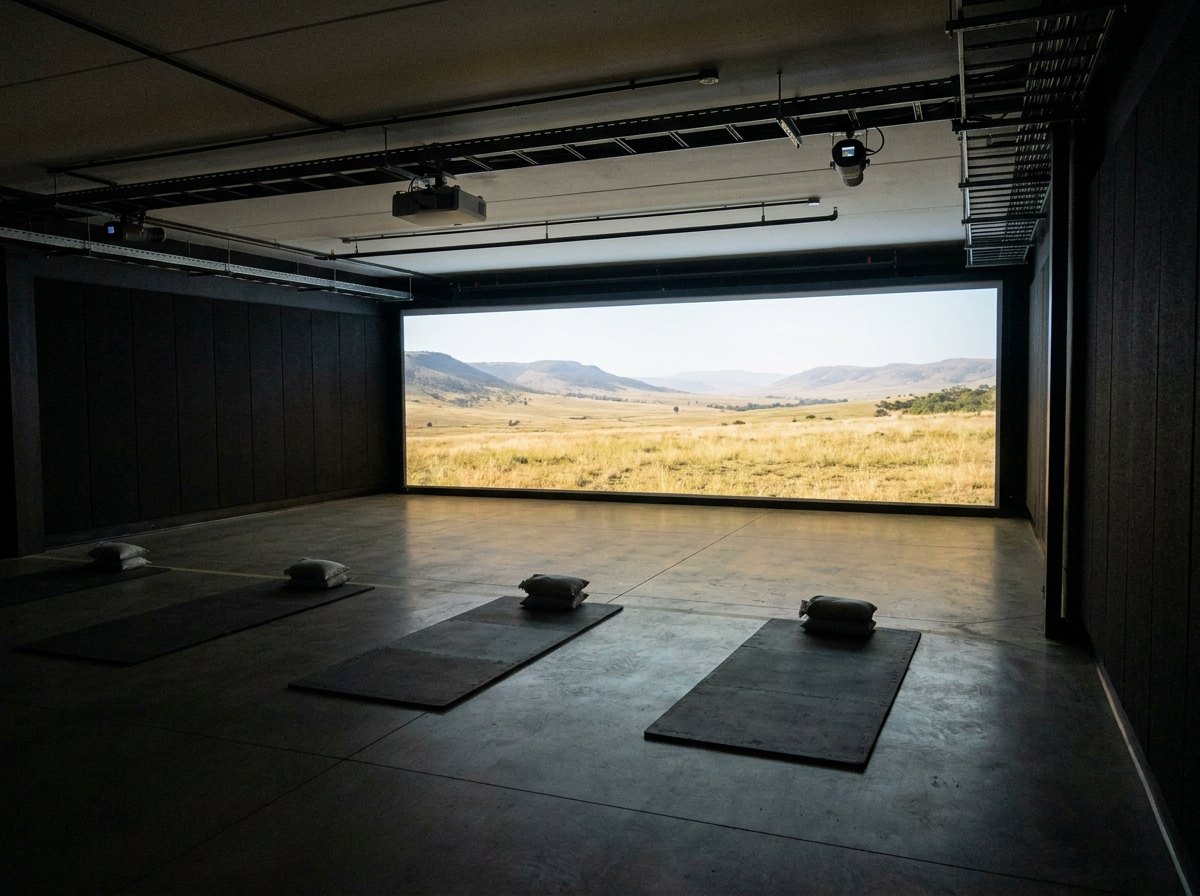

Firing Training & Tactical Engagement Simulators: Making Every Trigger Press a Record
A live round tells you where it went. It doesn’t tell you why. Ammunition is the most expensive teacher in the armoury and the least articulate one — a hole in a target reports the result and none of the causes. Neometrix’s firing training and tactical engagement simulators keep the weapon, the stance and the stress a trainee actually feels, and add the data a live range can’t produce.
Two Ranges, One Instrumentation Discipline
Indoors, the range becomes software: a projector fills a screen up to the 35 ft class with terrain and targets from 5 to 2,000 m, and a built-in infrared sensing device follows the laser dot of every weapon on the firing point, timestamps the trigger press, and hands the coordinates to an instructor console running twelve training modules. Ballistics — range, velocity, trajectory, wind deflection — are simulated per weapon class, and recoil comes wirelessly from compressed-gas magazines, so the hall never holds a live round.
In the field, the referee becomes instrumentation. An eye-safe laser transmitter (72-110 µW, under 500 g) goes on each service weapon and a sensor harness (under 3 kg, body and helmet) on each trainee, registering hits through 360 degrees as kill, injury or near-miss. A man-portable control station under 20 kg tracks every participant across up to 4 x 4 km and replays the whole engagement at any speed, fire tracks included.
Most Demand Isn’t for New Halls
Three of the five recent programmes behind this system are upgradations — new projectors and sensing, new software generations, recoil conversions and consoles fitted into simulator halls that already exist rather than built from scratch. The hall and the habit survive; the electronics move a decade forward.
Instrumentation Pedigree, Not a Standing Start
Neometrix has delivered a 512-channel universal automatic test system and a 256-channel avionics tester to the Indian Air Force, and PXI-based drive-and-control instrumentation to a helicopter MRO establishment — multi-channel, event-accurate systems built on the same discipline that scores a firing lane. Simulation engines and laser engagement modules come through an OEM partnership under MoU; Neometrix engineers the system around them.
Frequently Asked Questions
Are the lasers safe for the people taking part in the exercise?
Yes — the tactical engagement transmitters operate at 72-110 microwatts, classified as eye-safe, which is what makes it possible to run force-on-force exercises with real trainees at close engagement ranges rather than restricting laser tag-style training to symbolic distances. The same eye-safe principle applies to the indoor lane’s infrared sensing, which tracks the laser dot from each weapon without posing a hazard to anyone downrange or at the firing point.
Can an existing simulator hall be upgraded instead of replaced outright?
Yes, and it’s the more common request — three of the five recent programmes behind this system are upgradations rather than new builds. New projection hardware, infrared sensing, a current software generation, recoil conversion and updated consoles get fitted into a hall that already has its physical range, screen and firing points in place, which is significantly less disruptive and less expensive than demolishing a working facility to build a new one around newer electronics.
Get In Touch
For full specifications, RFQs, or a technical discussion about firing training and tactical engagement simulators:
– Product page: Firing Training & Tactical Engagement Simulators
– Email: [email protected]
– Phone: +91-7777-876-876