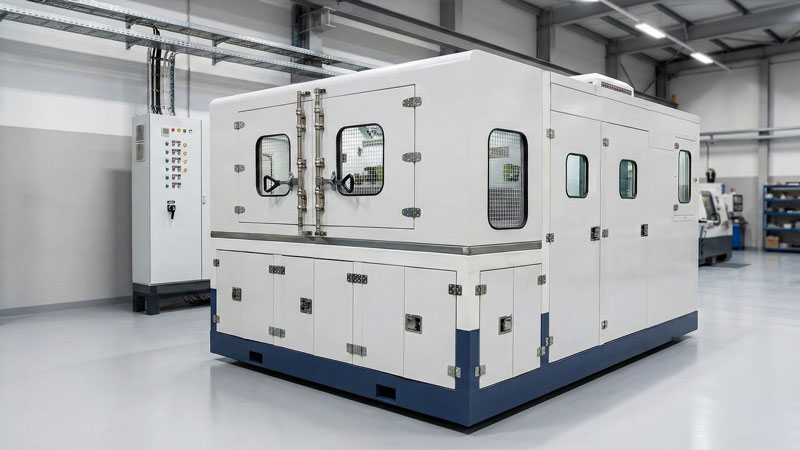

Hydraulic Control Valve Test Bench: Why a 350 kW Stand Exists and What It Measures
In mobile and industrial hydraulics, a valve is not just a component. It is the control authority of the whole machine. Flow metering accuracy decides whether an excavator feels smooth or jerky. Leakage decides whether a system holds a load safely. Response time decides whether a closed-loop controller behaves or hunts. A test stand that merely “makes pressure and shows a gauge” proves none of that. This guide explains what a serious valve test bench has to do, using the Neometrix 350 kW stand as the reference, for hydraulic OEM, MRO and quality teams in the USA, the UK and Europe.
Key Takeaways
– The Neometrix stand is a universal, automated rig for mobile sectional valves and industrial electrohydraulic / proportional valves.
– Envelope: up to about 400 L/min (about 106 US gpm) and 420 bar (about 6,090 psi), on a 350 kW installed power system with a 1,200 L (about 317 US gal) reservoir.
– Nine test modes run as programmed sequences, each producing a time-stamped multi-channel record.
– PLC + SCADA control with a 12-inch HMI, and automated PDF reports with pass / fail, operator and batch.
– It is a hydraulic stand: reference values are typical, and final specifications are confirmed at design review.
Why Valve Testing Is Harder Than It Looks
A valve has to be verified under real conditions, with repeatable automation, using the right signals, and with records that engineering and quality teams can trust months later. That means reproducing flow and pressure, controlling oil temperature (so viscosity does not masquerade as a defect), driving electrohydraulic valves with the correct current, PWM or CAN signals, and keeping every test comparable across batches.
The Nine Test Modes
| # | Test | What it reveals |
|---|---|---|
| 1 | Pressure drop and flow characterisation | Energy lost to heat; spool / sleeve variants and batch drift |
| 2 | Hysteresis (command up and down) | Sticky spool, biased neutral, friction-driven nonlinearity |
| 3 | Max flow verification | Wrong spool / sleeve combinations or tuning problems |
| 4 | Internal and external leakage | Load-holding safety, wear and seal degradation |
| 5 | Response time and dynamic behavior | Sluggishness, overshoot, oscillation (sampled at 10 kHz) |
| 6 | Impulse and cycling | Seal degradation and fatigue drift (impulses up to 400 bar) |
| 7 | Pull-in current and drop-out voltage | Hydraulic versus electrical fault in coils and drivers |
| 8 | Flow sharing and anti-saturation | Function “stealing” when several sections are commanded |
| 9 | Pressure compensation | Stable metered flow as inlet or load pressure changes |
Tests combine into sequences: warm-up, bleed, pressure-drop mapping, hysteresis sweep, leakage, dynamic response, endurance, then post-endurance comparison.
Architecture: How 350 kW Is Used
The stand uses a multi-motor, multi-pump architecture. Small stages handle conditioning and low-flow work; larger stages scale up for high-flow or high-load events, so the system is never forced to an extreme operating point for every test. The reference drive set on the Steel-Plant Configuration 2 general arrangement lists a 200 kW main drive, a 130 kW secondary main drive, a 55 kW boost drive, a 3.7 kW auxiliary pump and a 0.75 kW return-line motor.
Supporting subsystems include fluid conditioning with bleed and flush sequences, flexible fixtures for cartridge, subplate and manifold mounts, pressure / return / drain filtration, and a plate-type cooler holding a 20-75 °C (68-167 °F) operating window on the reservoir.
Automation and Data
PLC-based sequencing removes operator variability. Flow, pressure, temperature, command signals and voltage feedback are logged to a single time history that can be exported as CSV or PDF (MATLAB-ready TDMS is optional) and archived for traceability. The page also lists MES / ERP integration and Industry 4.0 / IoT readiness.
Valve Families Covered
Preloaded protocols ship for six families: Thor twin-spool sectional systems (CMA), CLS180 sectional valve banks, screw-in cartridge valves (SiCV), two-stage proportional pilot valves, two-stage main valves and Size 3 and Size 5 electrohydraulic directional valves. With suitable fixtures the bench can be adapted to directional, pressure-control and flow-control architectures, including relief, reducing, sequence, counterbalance and priority flow control valves.
Specifications at a Glance
| Parameter | Reference value |
|---|---|
| System type | 350 kW automated valve test stand |
| Test envelope | Up to about 400 L/min, up to about 420 bar |
| Operating fluid | Hydraulic mineral oil, VG 32 |
| Reservoir | About 1,200 L |
| Operating temperature | About 20-75 °C |
| Pump architecture | Variable plus fixed displacement, multi-stage |
| Main electrical supply | 3-phase, 440 VAC |
| Control | PLC + SCADA, 12-inch HMI, multi-channel DAQ |
| Maximum power consumption | About 430 kW (reference) |
These are reference values for a typical configuration. Final specifications, valve routing and MES / ERP integration are confirmed during design review.
Applications
End-of-line production testing of mobile valves; sectional valve bank validation for excavators and mobile machinery; flow, pressure-drop and hysteresis characterisation of electrohydraulic valves; leakage testing; dynamic and step response for closed-loop control; flow sharing and compensation evaluation; coil and driver electrical testing; endurance and pressure cycling; R&D calibration; batch-to-batch QA comparison; and failure analysis of field-returned valves. The page lists industries from mobile machinery and hydraulic OEMs to aerospace, defense, oil and gas, railways and green energy.
Standards and Procurement Context for US, UK and European Buyers
– Fluid power: ISO 4406 for fluid cleanliness coding, ISO 10770 for electrically modulated hydraulic control valves, and ISO 6403 and ISO 4411 for valve test procedures (buyers typically map their own procedures to these).
– United States: NFPA T2 fluid power standards and MIL-STD practice for defense work.
– United Kingdom: Supply of Machinery (Safety) Regulations and UKCA marking for machinery placed on the Great Britain market.
– European Union: the Machinery Directive 2006/42/EC (replaced by Regulation (EU) 2023/1230 from January 2027), the Pressure Equipment Directive 2014/68/EU and the Low Voltage and EMC Directives.
– Quality: ISO 9001 quality systems and ISO/IEC 17025 for traceable calibration.
The Neometrix page states CE marked and lists DGAQA and DRDO accreditation as Indian defense references. UKCA marking and the fluid-power standards above are not claimed on the page; buyers should ask for a compliance matrix against their own specification.
Buyer’s Checklist: 8 Questions for a Valve Test Bench Supplier
1. Does the flow and pressure envelope cover our largest valve, with margin?
2. Which of our valve families have preloaded protocols, and how long does a new fixture take?
3. How is oil temperature controlled, and how are viscosity effects separated from valve behavior?
4. What sampling rate and which channels does the DAQ record?
5. Can acceptance criteria be configured, and can reports follow our format?
6. How are flow meters and pressure transducers calibrated and traceable?
7. How does it integrate with our MES / ERP and quality system?
8. What are the commissioning, training, warranty and AMC terms?
Frequently Asked Questions
What is the maximum flow and pressure?
Up to about 400 L/min and about 420 bar on the reference configuration.
Which valves can it test?
Mobile sectional valves (CMA, CLS180), screw-in cartridge valves, two-stage proportional valves and Size 3 and Size 5 electrohydraulic valves, with fixtures adaptable to many other architectures.
Is it PLC and SCADA controlled?
Yes, PLC sequencing with SCADA data acquisition and a 12-inch HMI touchscreen.
Can it run endurance tests?
Yes. Impulse and cycling tests run repeatably across thousands of cycles, with post-endurance comparison of leakage and response.
Get in Touch
Share the valve family, production volume, pressure and flow envelope and target throughput for a technical proposal:
– Product page: Hydraulic Test Stand 350 kW
– Email: [email protected]
– Phone: +91-7777-876-876 (India; dial +91 from the USA, UK and Europe)