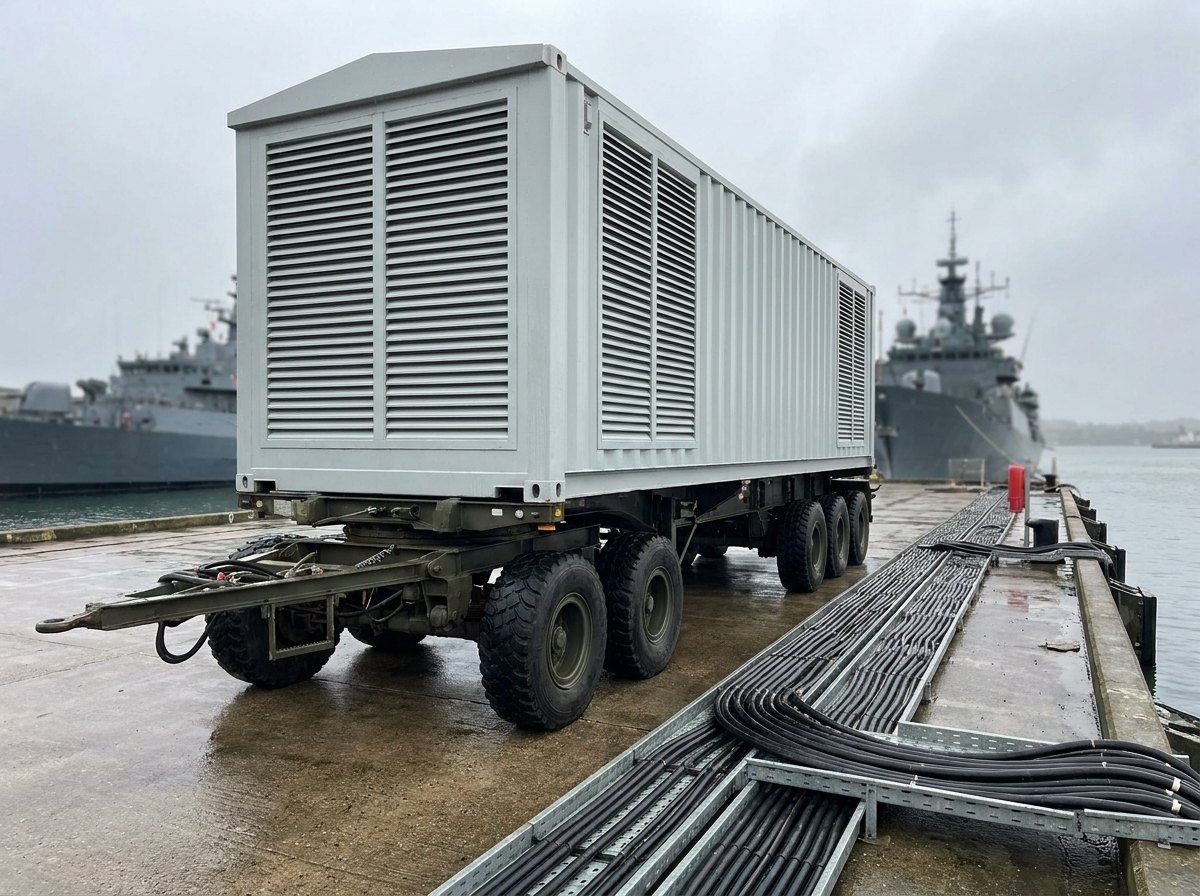

An aircraft on the ground without its engines running is an aircraft without power — unless it’s connected to external ground support. For maintenance, systems testing, pre-flight preparation, and post-flight defect rectification, external power is essential. The two standard electrical supply requirements for military and most commercial aircraft are 28V DC (for battery charging and DC-powered systems) and 115V/200V 400Hz AC (for AC avionics, radar, and systems). A mobile rectifier and battery charger unit that provides both these supplies from a single deployable platform covers most ground power needs for a wide range of fixed-wing and rotary aircraft.
Why Aircraft Use 400Hz Rather Than 50/60Hz Mains Frequency
The weight penalty for electrical equipment scales inversely with frequency — transformers, motors, and generators at 400Hz can be made much smaller and lighter than equivalent equipment at 50 or 60Hz because the iron core can be smaller at higher frequency. For aircraft where every kilogram matters, 400Hz became the standard aviation electrical frequency in the 1940s and has remained so across military and commercial aviation worldwide. Ground power supplied to aircraft must match this 400Hz standard — mains frequency 50Hz or 60Hz power cannot be connected directly to aircraft 400Hz equipment.
DC 28V: Why Aircraft Batteries and Many Systems Use This Voltage
28V DC (nominal) is the standard voltage for aircraft DC electrical systems in military and most general aviation aircraft — derived from 24V lead-acid or NiCd battery systems charged to approximately 28V. It powers engine starting (in aircraft with DC start systems), lighting, instruments, control actuators, and numerous avionics. Aircraft batteries that have discharged during storage, or have been depleted by extended ground operations, need external DC charging to restore charge before flight. A regulated DC rectifier supplying 28V at high current provides this charging function.
Military Deployment Requirements
The US military’s primary standard for aircraft electrical power quality is MIL-STD-704 (Aircraft Electric Power Characteristics), which specifies the voltage, frequency, waveform, and transient limits for power supplied to aircraft through the external power connector. Ground power equipment must supply power within MIL-STD-704 limits to avoid damaging sensitive avionics.
NATO’s STANAG 3101 defines the electrical connector standards for ground power connections to NATO aircraft, ensuring interoperability — a NATO member nation’s ground power equipment can connect to any other NATO nation’s aircraft using the standard connector interface.
For forward operating bases (FOBs) and contingency airfields, the ground power requirement is identical to that at main operating bases, but the infrastructure is more limited. Mobile, self-contained rectifier and charger units that require only a generator or shore power input — and provide clean regulated 28V DC and 400Hz AC output without external transformers or switchgear — are the practical solution for these environments.
Key Specifications and Design Features
Output regulation: The 28V DC output must regulate within ±1V across the full load range to prevent battery damage or avionics voltage-sensitivity issues. The 400Hz AC output must maintain voltage and frequency within MIL-STD-704 limits under varying load.
Current limiting: Battery charging at excessive current can damage the battery and create a fire hazard. The DC charger must implement appropriate current-limiting profiles for the battery types being charged.
Soft-start and disconnect protection: Aircraft power systems are sensitive to power interruptions and power-on transients. The unit should soft-start its output and provide protection against the output glitches that occur when load changes rapidly.
Portability: Military mobile units must be transportable by standard vehicles, position by hand at the aircraft, and operate without installation — plug-in-and-use rather than permanently wired.
Environmental rating: Operation across the temperature range from arctic winter to Gulf summer (typically -20°C to +55°C ambient), with appropriate ingress protection for the dusty, sandy, and potentially wet environments of military airfield operations.
Applications
US military aviation: USAF, US Army, and US Navy and Marine Corps aircraft at main operating bases, forward operating bases, and deployed expeditionary airfields all require 28V DC and 400Hz AC ground power capability. DoD logistics contracts procure this capability through DLA and service programme offices.
UK RAF and Royal Navy Fleet Air Arm: Ground power units for Typhoon, F-35B, Chinook, Merlin, Wildcat, and other types at UK and overseas airfields. British military GSE procurement through DE&S includes mobile power units.
NATO and European air forces: French Armée de l’Air et de l’Espace, German Luftwaffe, Italian Aeronautica Militare, and other NATO members require STANAG 3101-compatible ground power equipment for their mixed fleets.
Gulf armed forces: UAE Air Force, Royal Saudi Air Force, Qatar Emiri Air Force — all operating modern Western aircraft types that require MIL-STD-704-compliant ground power.
Neometrix Mobile Rectifier & Battery Charger Unit
A portable, self-contained dual-output ground power unit providing 28V DC regulated battery charging and 400Hz AC aircraft power supply. Designed to MIL-STD-704 and STANAG 3101 requirements for military aircraft ground power applications. Operable across the full military environment temperature and conditions range.
→ View Full Specifications
→ Request a Quote
FAQ
Q: Why do aircraft use 400Hz power rather than standard mains frequency?
A: At higher frequency, the iron cores in transformers, motors, and generators can be smaller and lighter for the same power capacity — because the core material saturates less quickly at higher frequency, allowing more flux per cycle. For aircraft where weight is a primary design constraint, 400Hz electrical systems allow significantly lighter power generation and distribution equipment compared to equivalent 50Hz or 60Hz systems. The weight saving across all the electrical equipment on a large aircraft is substantial. 400Hz became the aviation standard in the 1940s and has remained so because changing now would require replacing all aircraft electrical equipment — the legacy investment is too large to discard.
Q: What is MIL-STD-704 and why does ground power equipment need to comply with it?
A: MIL-STD-704 (Aircraft Electric Power Characteristics) defines the voltage, frequency, waveform quality, and transient limits for electrical power supplied to US military aircraft. Avionics and other aircraft equipment are designed and qualified to operate within these limits — power outside MIL-STD-704 tolerance can damage sensitive equipment or cause it to malfunction. Ground power units supplying military aircraft must therefore meet MIL-STD-704 output quality specifications. The standard covers both 28V DC and 115/200V 400Hz AC supplies with their respective tolerance bands, waveform requirements, and limits on transients and interruptions.
Neometrix Defence Ltd. designs and manufactures mobile rectifier and battery charger units for military and civil aircraft ground power applications. [email protected] | +91-7777-876-876