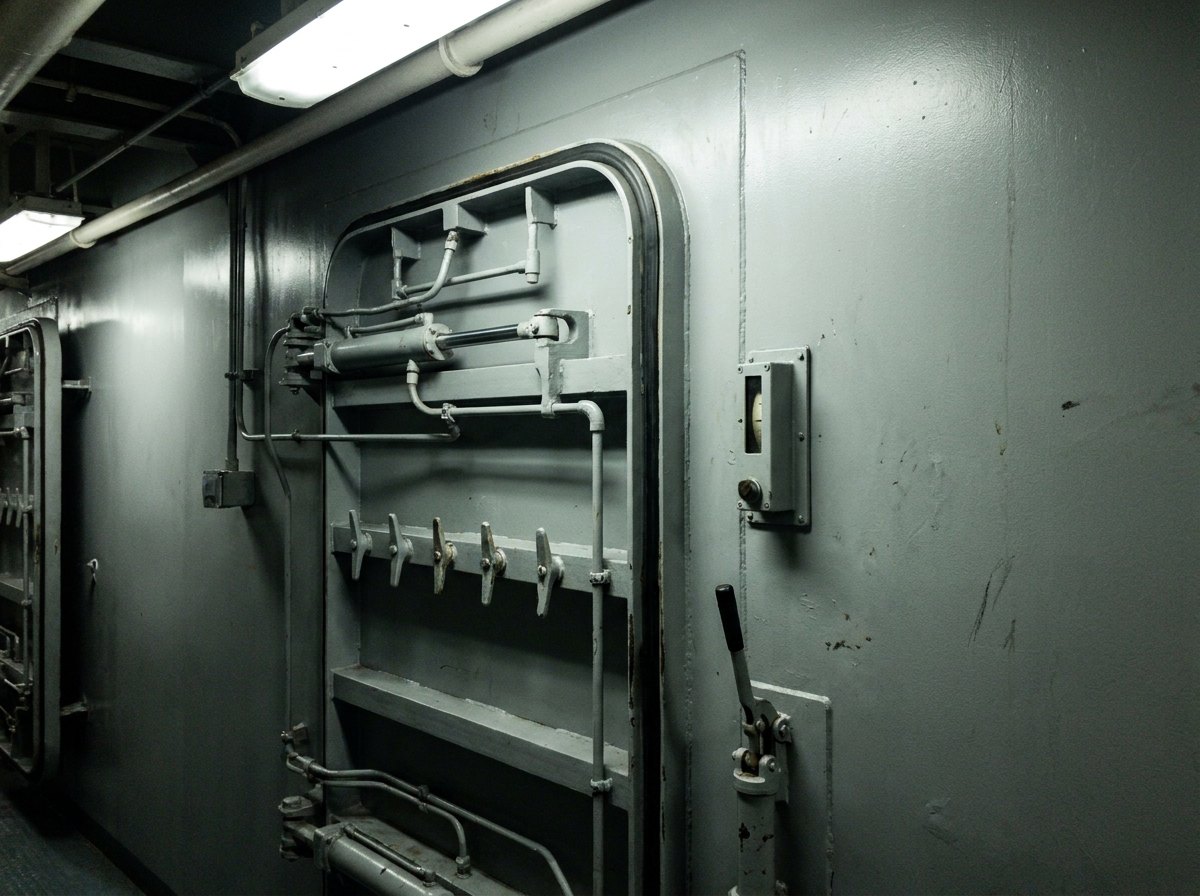

Move the Heavy Steel. Keep the Sea Out.
A ship’s watertight door is a contradiction that has to work every single day for decades: it has to be as strong and as sealed as the structural bulkhead it sits in, holding back a real pressure head of seawater — and it still has to open and shut reliably on command, whether that’s a routine watch change or an emergency closure during flooding. Neometrix builds the hydraulics that resolve that contradiction: hydraulically operated watertight and gastight doors, hatch covers, ramps and shell doors, together with the capstans, winches and windlasses that handle the loads holding a vessel to a quay or an anchor. All of it runs on 210 bar marine hydraulics, built and classed to IRS, DNV or LRS, with sea trials before handover.
The Hydraulics Franchise, Gone to Sea
Underneath the paint and the class stamp, a watertight door, a mooring capstan and an anchor windlass are the same thing Neometrix already builds ashore for industrial customers: a hydraulic power pack, cylinders, actuators and controls. What changes at sea is everything around that core — the materials, the seals, the redundancy and the survey. This page is that existing hydraulics competence, marinised for the deck.
The power side is a single 210 bar marine power pack — reservoir, pumps and accumulator — feeding a control system of directional valves with both local and remote operation, plus manual override. One hydraulic heart drives every closure and every piece of deck machinery on the vessel, which keeps the installation coherent instead of a scatter of unrelated hydraulic islands.
Watertight Closures: Strong, Sealed, and Still Fast
A closure that fails shut can trap a crew member. One that fails open in a flooding scenario can lose a compartment. That’s why every watertight and weathertight closure — doors, hatch covers, ramps, shell doors — is built with seals rated to the actual pressure head it will face, dogging and position indication so the bridge knows a door’s real state, and redundant actuation with a manual override as standard, not an afterthought. Damage control doesn’t get to depend on hydraulic power still being available.
Deck Machinery: Sized to the Load, Not the Average
Capstans, mooring and warping winches, anchor windlasses, cargo and stores winches and davits are all sized by safe working load, brake holding load, line pull and speed — with fail-safe braking built in. A winch brake sized for the average pull is a winch brake that lets go on the worst one, which is exactly the failure mode marine engineering is meant to design out.
Salt Is the Enemy of Everything
Every part on this equipment lives wet, moving and corrosive — conditions that would seize shop-grade equipment in a fraction of the service life expected at sea. Marine steels, bronze fittings, protective coatings and sealed hydraulics are what let deck equipment survive where equipment built to an industrial spec would not. Hydraulics that were fine in a workshop corrode and stick in a wet, moving deckhouse if they weren’t specified for it from the start.
Turnkey, Naval and Commercial
The scope is quoted as one package across naval and marine deck-equipment requirements: structural and hydraulic design, the power and control system, closure/winch/capstan fabrication, corrosion engineering, controls, class approval, installation, harbour and sea trials, documentation and training. Size, load, seal and layout all follow from the opening, the vessel and the classification rules that apply — no specific delivered vessel installation is claimed on this page; this describes reference marine deck equipment engineered to order.
Proven to Class, Not Just to a Datasheet
Marine equipment lives or dies by classification. Materials, welding, hydraulics and safety are designed and surveyed to IRS, DNV or LRS, then demonstrated in harbour and sea acceptance trials — the record that actually certifies a closure will hold and a winch will hold on, rather than simply matching a catalogue number.
Frequently Asked Questions
Why do watertight doors need a manual override if they’re hydraulically powered?
Because a door that only works with hydraulic power is a door that becomes a trap the moment that power is lost — exactly the scenario damage control has to plan for. Manual override isn’t a convenience feature; it’s a safety-critical redundancy requirement for any closure that could otherwise leave a compartment sealed or flooding uncontrolled.
What’s the difference between marine-grade hydraulics and industrial hydraulics?
The core hydraulic principles are the same, but marine equipment has to survive continuous exposure to salt spray, humidity and vibration on a moving deck for decades without the maintenance access an onshore installation gets. That drives the choice of marine steels, bronze, protective coatings and sealed hydraulic components — specified for the marine environment from the design stage, not adapted afterward.
Get In Touch
For full specifications, RFQs, or a technical discussion about marine and naval hydraulic deck equipment:
– Product page: Marine & Naval Hydraulic Deck Equipment
– Email: [email protected]
– Phone: +91-7777-876-876