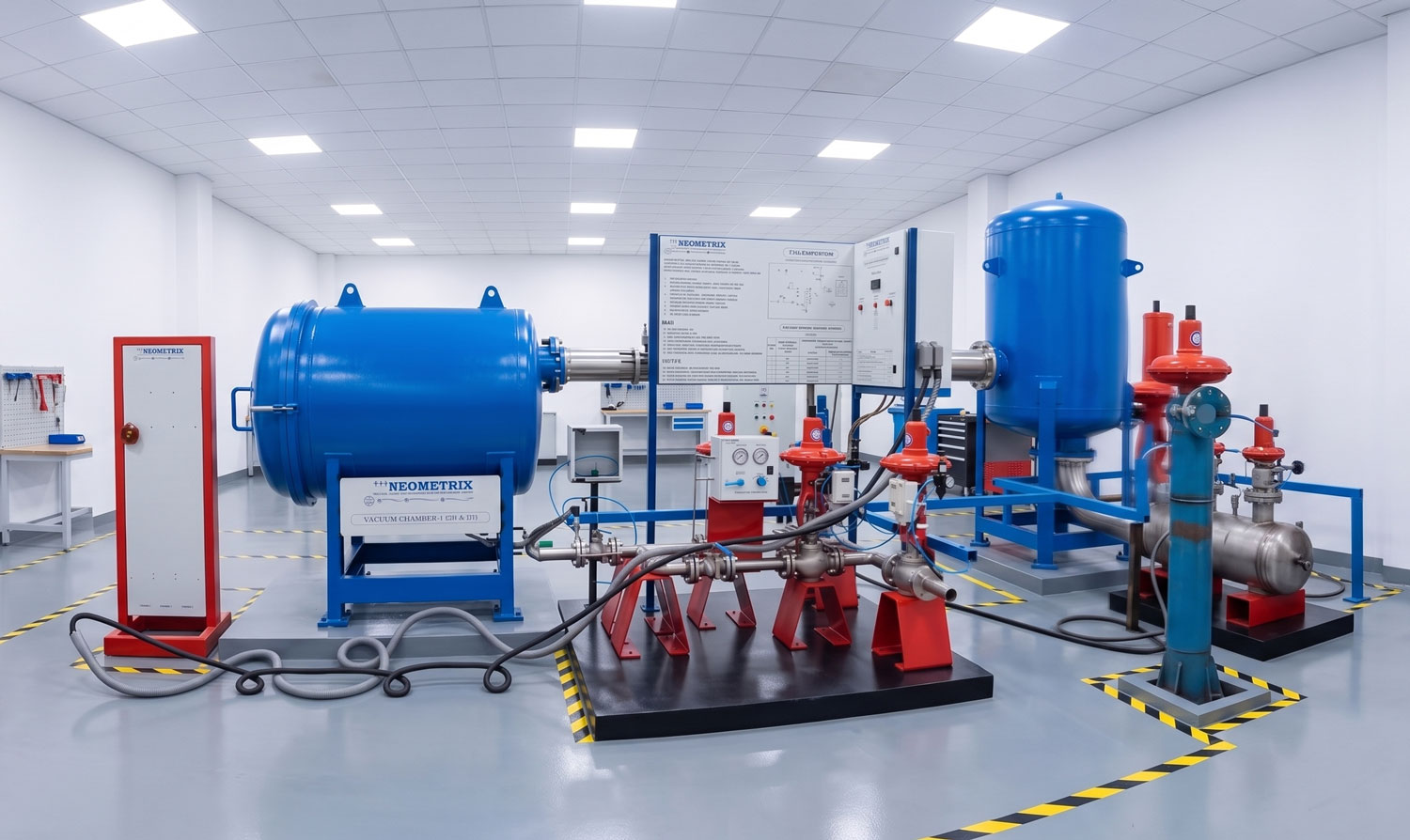

At 60,000 feet, atmospheric pressure is approximately 7% of sea level — about 72 mbar absolute. For aerospace components that must function across this entire pressure range — valves, sensors, regulators, actuators, avionics enclosures — testing at sea level conditions tells you almost nothing about how they will perform at altitude.
A pneumatic vacuum test rig simulates high-altitude low-pressure conditions in a controlled test chamber, allowing aerospace engineers to verify component performance, leak integrity, and functional reliability across the full operational altitude envelope.
Why Altitude Simulation Testing Matters
Pressure differential: Many aircraft components rely on pressure differentials to operate — pneumatic actuators, pressure regulators, differential pressure sensors. At altitude, the absolute pressure they work against is completely different from sea level conditions. A valve calibrated at sea level may operate at a different point or fail to operate at all at altitude.
Leak behaviour: Leak rates are proportional to pressure differential. A component that appears leak-tight at sea level may show significant leakage at altitude where the internal-to-external pressure differential is much larger.
Material behaviour: Elastomeric seals change properties at low pressure and low temperature (altitude conditions). A seal that functions at sea level may extrude or fail at altitude.
Vapour pressure effects: Fluids and lubricants can outgas or partially vaporise at low pressure — affecting lubrication, sealing, and electrical insulation.
Electronics and avionics: Reduced air density at altitude reduces convective cooling and increases corona discharge risk in high-voltage circuits. Avionics must be tested at altitude per DO-160 Section 4.
How a Vacuum Test Rig Works
The test rig uses a vacuum pump to reduce pressure in a sealed test chamber to the level corresponding to the altitude being simulated. Stainless steel chambers allow visual observation through viewports.
Altitude to pressure conversion:
- Sea level: 1013 mbar
- 10,000 ft: 697 mbar
- 20,000 ft: 466 mbar
- 30,000 ft: 301 mbar
- 40,000 ft: 188 mbar
- 50,000 ft: 116 mbar
- 60,000 ft: 72 mbar
The rig must control chamber pressure precisely at each test altitude and maintain it during functional testing of the component inside.
International Standards
| Standard | Region | Application |
|---|---|---|
| DO-160 Section 4 | USA/International | Altitude testing of avionics and airborne equipment |
| MIL-STD-810 Method 500.6 | USA/NATO | Low pressure (altitude) testing of military equipment |
| DEF STAN 00-35 Part 3 | UK | Environmental testing — altitude |
| RTCA DO-160G | USA/International | Latest revision of avionics environmental testing |
| EN 60068-2-13 | Europe | Environmental testing — reduced atmospheric pressure |
| IEC 60068-2-13 | International | Low air pressure testing |
| AS8003 | USA/International | Aerospace — altitude testing of sensors |
Applications
Aerospace valve testing: Pressure regulators, check valves, relief valves, and selector valves used in aircraft pneumatic, fuel, and oxygen systems must be function-tested at operational altitude conditions.
Avionics qualification: Electronic boxes, connectors, and displays must pass DO-160 altitude testing to demonstrate cooling adequacy and freedom from corona discharge.
Oxygen system components: Aircraft oxygen regulators must deliver the correct flow and pressure at all altitudes from sea level to service ceiling — altitude simulation is integral to qualification testing.
Pressure sensors and transducers: Calibration at altitude conditions verifies accuracy across the operational range.
Military electronics: MIL-STD-810 Method 500.6 requires altitude testing for all military equipment that operates at altitude.
Neometrix Pneumatic Test Rig (Vacuum)
The Neometrix Vacuum Test Rig simulates up to 60,000 ft altitude with dual stainless steel chambers, real-time DAQ, and optional SCADA integration — suitable for aerospace valve, sensor, and avionics component testing.
→ View Full Specifications
→ Request a Quote
FAQ
Q: What altitude can a pneumatic vacuum test rig simulate?
A: The Neometrix Vacuum Test Rig simulates up to 60,000 ft, corresponding to approximately 72 mbar absolute pressure. This covers the operational ceiling of virtually all military and commercial fixed-wing aircraft and high-altitude UAVs. Most DO-160 and MIL-STD-810 altitude test profiles require simulation to 70,000 ft equivalent (about 54 mbar) for qualification; 60,000 ft covers the majority of aerospace component test requirements.
Q: What is DO-160 Section 4 altitude testing?
A: RTCA DO-160 Section 4 specifies altitude testing requirements for airborne electronic equipment. It defines test altitudes corresponding to equipment category (A through F), ranging from 15,000 ft (4,570m) for Category A (unpressurised cargo) to 70,000 ft (21,300m) for Category F (high-altitude special-purpose aircraft). Testing verifies: functionality at altitude, no corona discharge, adequate cooling without dense sea-level air, and structural integrity under reduced external pressure.
Q: What is MIL-STD-810 Method 500.6?
A: MIL-STD-810 Method 500.6 is the Low Pressure (Altitude) test procedure for military equipment. It covers storage at altitude (up to 100,000 ft), operation at altitude (up to 70,000 ft), and rapid decompression (for pressurised compartments). Equipment is exposed to altitude conditions and evaluated for functionality, leakage, material degradation, and outgassing. NATO nations using MIL-STD-810 include USA, UK, Canada, Australia, and others.
Q: Why use dual chambers in a vacuum test rig?
A: Dual chambers allow two test configurations simultaneously — typically one chamber for functional testing of components while the second is being prepared with a new test article. This doubles throughput in qualification test campaigns where many samples must be tested. Alternatively, the dual chamber allows testing at two different simulated altitudes simultaneously — useful for comparative testing.
Neometrix Defence Ltd. manufactures vacuum pneumatic test rigs for aerospace altitude simulation testing. [email protected] | +91-7777-876-876