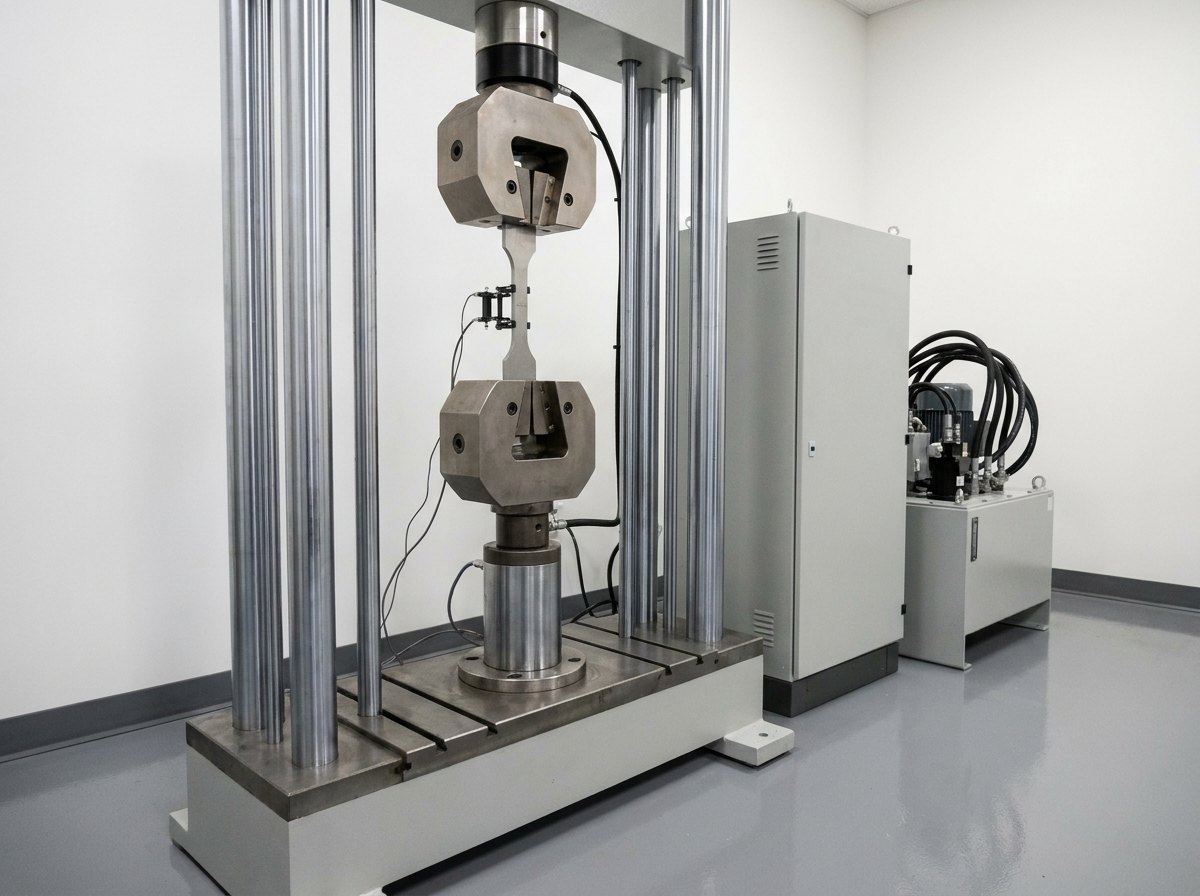

Servo-Hydraulic Fatigue & Structural Test System: Finding the Life a Static Test Can’t
Most structures don’t fail because someone overloaded them once. They fail because a crack grew, cycle by cycle, under loads far below the static strength, until one day it let go. Trusting a part with a service life means finding that fatigue life first — applying millions of controlled load cycles and watching for the crack. Neometrix’s Servo-Hydraulic Fatigue & Structural Test System is a turnkey dynamic universal testing machine built to do exactly that, to roughly 1000 kN, closed-loop to ASTM E466 and ISO methods.
Closing the Loop Is the Whole Engineering Problem
A command waveform — a target force, displacement or strain — drives a servo-valve and servo-hydraulic actuator; a load cell and extensometer feed back, and the controller holds that waveform faithfully over millions of cycles. Poor control and the specimen never sees the load history the test was designed to apply in the first place. Stiffness and alignment matter just as much: a compliant frame or misaligned grips inject bending into what’s meant to be a purely axial test, producing a fatigue life that’s both wrong and unrepeatable.
More Built In-House Than an Integration
Neometrix already manufactures servo-hydraulic actuators and hydraulic power packs, so this test machine is built around Neometrix’s own actuator and pump, with a bought-in servo-valve and controller — more of the machine is made in-house than a typical integration-only build. The load frame, grips and fixtures are engineered by Neometrix around that actuator, while the servo-valve, controller, load cell and extensometer come from specialist suppliers.
One Machine, the Whole Range
The same servo-hydraulic principle covers static tension and compression, S-N fatigue across low- and high-cycle regimes, crack-growth fatigue for fracture mechanics work, and full structural proof and ultimate tests — scaling from a single actuator on a materials coupon to multiple coordinated actuators loading a complete component or airframe section to reproduce real service loads.
Frequently Asked Questions
Why does fatigue testing matter if a part already passed a static strength test?
Because a static strength test only answers how strong a part is right now, under a single applied load — it says nothing about how that same part behaves after being loaded and unloaded thousands or millions of times at stresses well below its static failure point, which is exactly the loading pattern most real structures actually experience in service. Fatigue failure happens when a crack initiates at a stress concentration and grows incrementally with each load cycle until the remaining cross-section can no longer carry the load, and that process can take a part from apparently fine to catastrophically failed with no static-strength warning sign along the way. A servo-hydraulic fatigue and structural test system exists specifically to apply that realistic cyclic loading and find the fatigue life — the number of cycles to failure — because that’s the number a life-limited part actually lives or dies by, not its one-time static strength.
How much does frame stiffness and grip alignment actually matter, or is force capacity the more important spec?
Alignment and stiffness matter enormously, arguably more than raw force capacity for getting a trustworthy result. If the load frame is even slightly compliant or the grips pull a specimen even slightly off-axis, the test introduces a bending stress the specimen was never meant to see on top of the intended axial load — and the resulting fatigue life comes out both lower and more scattered than the material or component actually exhibits under pure axial loading, because you’re now measuring a combined bending-and-axial failure mode instead of the axial fatigue behaviour the test was supposed to characterize. A machine can have generous force capacity and still produce unusable, unrepeatable fatigue data if its frame flexes under load or its grips aren’t precisely concentric, which is why a properly engineered system prioritizes a stiff, precisely aligned load frame as core mechanical engineering, not a secondary detail.
Get In Touch
For full specifications, RFQs, or a technical discussion about the Servo-Hydraulic Fatigue & Structural Test System:
– Product page: Servo-Hydraulic Fatigue & Structural Test System
– Email: [email protected]
– Phone: +91-7777-876-876