
The Stack Makes the Gas. The Plant Makes It Hydrogen.
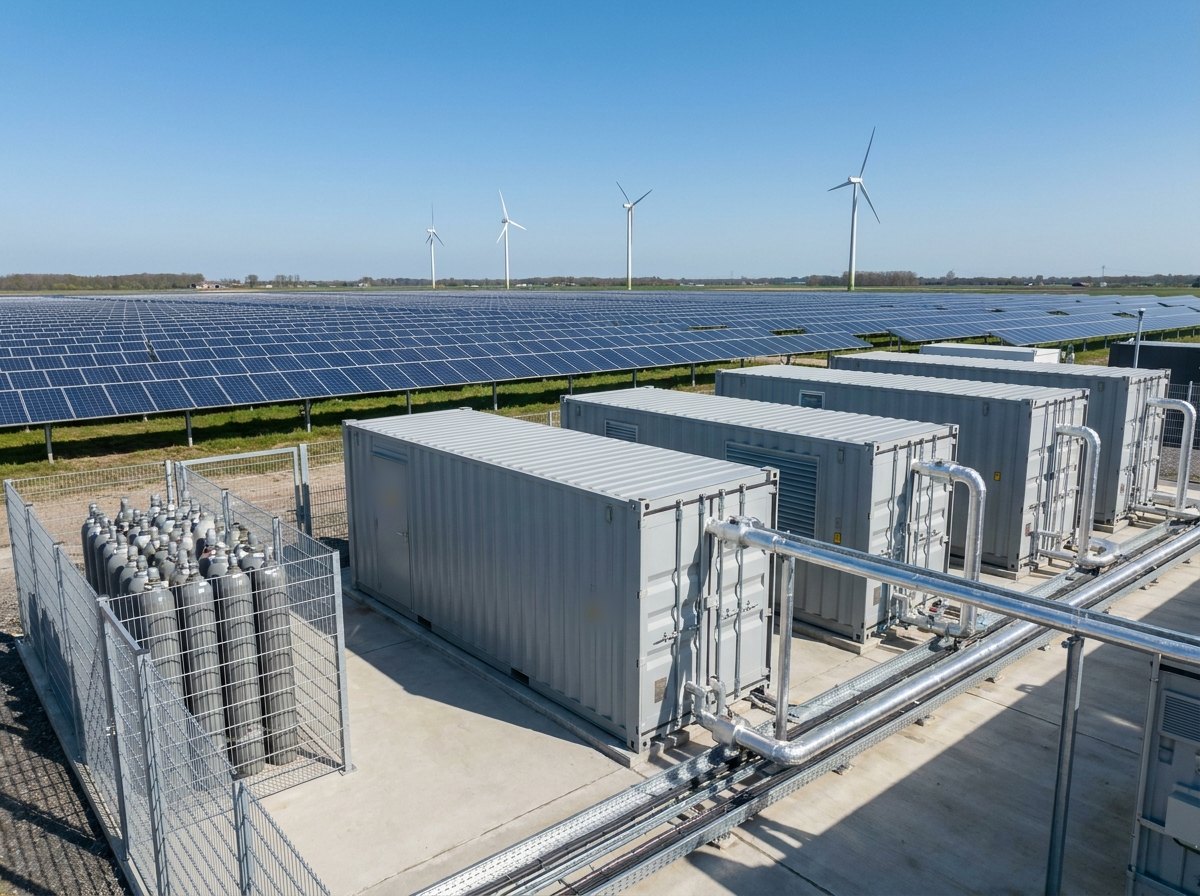
Buy an electrolyser stack and what you actually have is wet, low-pressure, impure gas. Turning that into hydrogen a refinery, a fuel-cell fleet or an industrial customer will actually accept — 99.999% pure, dry, compressed, safely stored, and made from a renewable supply that comes and goes with the sun or the wind — is a different job entirely. That job, the balance of plant, is roughly eighty per cent of the engineering work in a hydrogen plant, and it’s exactly what Neometrix builds: a turnkey green hydrogen generation plant wrapped around a bought-in MW-scale electrolyser, engineered to ISO 22734.
The Gas Is the Easy Part
An electrolyser stack splits water into hydrogen and oxygen — that’s the chemistry, and it’s well understood. What’s hard is everything downstream and upstream of that stack: converting renewable power into DC the stack can use, treating the feed water, purifying and drying the output gas, compressing it, storing it safely, and running the whole thing through hazardous-area safety systems that treat hydrogen with the respect its physical properties demand. Neometrix delivers that balance of plant and the EPC — rectifier and load-following, water treatment, gas purification and drying, compression, storage, hydrogen safety and controls — and integrates a bought-in electrolyser stack. The company engineers plants; it does not manufacture electrolyser stacks, and says so plainly.
Green Power Is Intermittent — the Plant Has to Follow It
A solar or wind-coupled electrolyser doesn’t see steady, predictable power — it sees a ramping, variable input that changes with cloud cover and wind speed. The transformer-rectifier, controls and buffering all have to load-follow that variability without harming the stack or losing gas purity. That single requirement — following renewable power honestly instead of assuming grid-steady input — is the difference between a real green hydrogen plant and a grid-fed grey one wearing a green label.
Purity Starts With Water and Ends With Drying
Feed water is deionised before it reaches the stack, because impurities in the water poison the electrolyser — roughly 9 litres of DI water go in per kilogram of hydrogen produced. On the output side, gas separation, de-oxygenation and drying bring the hydrogen to 99.999% purity (five nines) at a low dew point. Water treatment and drying bracket the stack on either side, and both matter as much as the electrolyser itself for the plant to deliver gas anyone can actually use.
Hydrogen Is the Hardest Gas to Contain
It’s the smallest molecule that exists, it has the widest flammability range of any common gas, and its flame is nearly invisible in daylight. That combination is why leak detection, ATEX hazardous-area design, nitrogen purging and a full safety case aren’t optional line items — they’re foundational to the plant design from the first drawing, engineered to ISO 22734, NFPA 2 and PESO/IS practice.
Our Franchise, Pointed at Hydrogen
Compression, storage, purification, high-pressure gas handling, hazardous-area safety and controls are already Neometrix product lines in their own right, built for other industrial applications. A green hydrogen plant is essentially those existing competences assembled around an electrolyser stack — which is exactly why the plant, not the stack, is the part Neometrix owns and engineers.
EPC — and BOO With a Partner
Where a tender calls for build-own-operate, ownership and long-term operation are handled together with a developer or O&M partner. Neometrix’s own role stays as the engineering, supply and commissioning company — an EPC and equipment specialist, not a hydrogen independent power producer — and the company scopes projects accordingly rather than overreaching into operating models it doesn’t run.
Frequently Asked Questions
Why can’t you just connect an electrolyser directly to solar panels and get usable hydrogen?
Because raw electrolyser output is wet, low-pressure and impure — nowhere near what a fuel-cell vehicle, an industrial customer or a refinery will accept as hydrogen fuel. It needs purification and drying to a specified purity level (typically 99.999%), compression to a usable storage or delivery pressure, and safe storage — plus a rectifier and control system that can handle solar or wind power’s natural variability without damaging the stack. That downstream and upstream engineering, not the electrolysis reaction itself, is the majority of what makes a working hydrogen plant.
What does “load-following” mean for a renewable-coupled hydrogen plant, and why does it matter?
It means the plant’s rectifier and controls track a solar or wind input that ramps up and down with weather rather than assuming a constant, grid-steady supply. A plant designed only for steady grid power will struggle when solar output ramps quickly — the rectifier can’t follow the swing, which either damages the stack over time or forces the plant offline. Genuine renewable-coupled hydrogen production requires the rectifier, buffering and controls to be engineered for that variability from the outset.
Get In Touch
For full specifications, RFQs, or a technical discussion about the green hydrogen generation plant:
– Product page: Green Hydrogen Generation Plant
– Email: [email protected]
– Phone: +91-7777-876-876