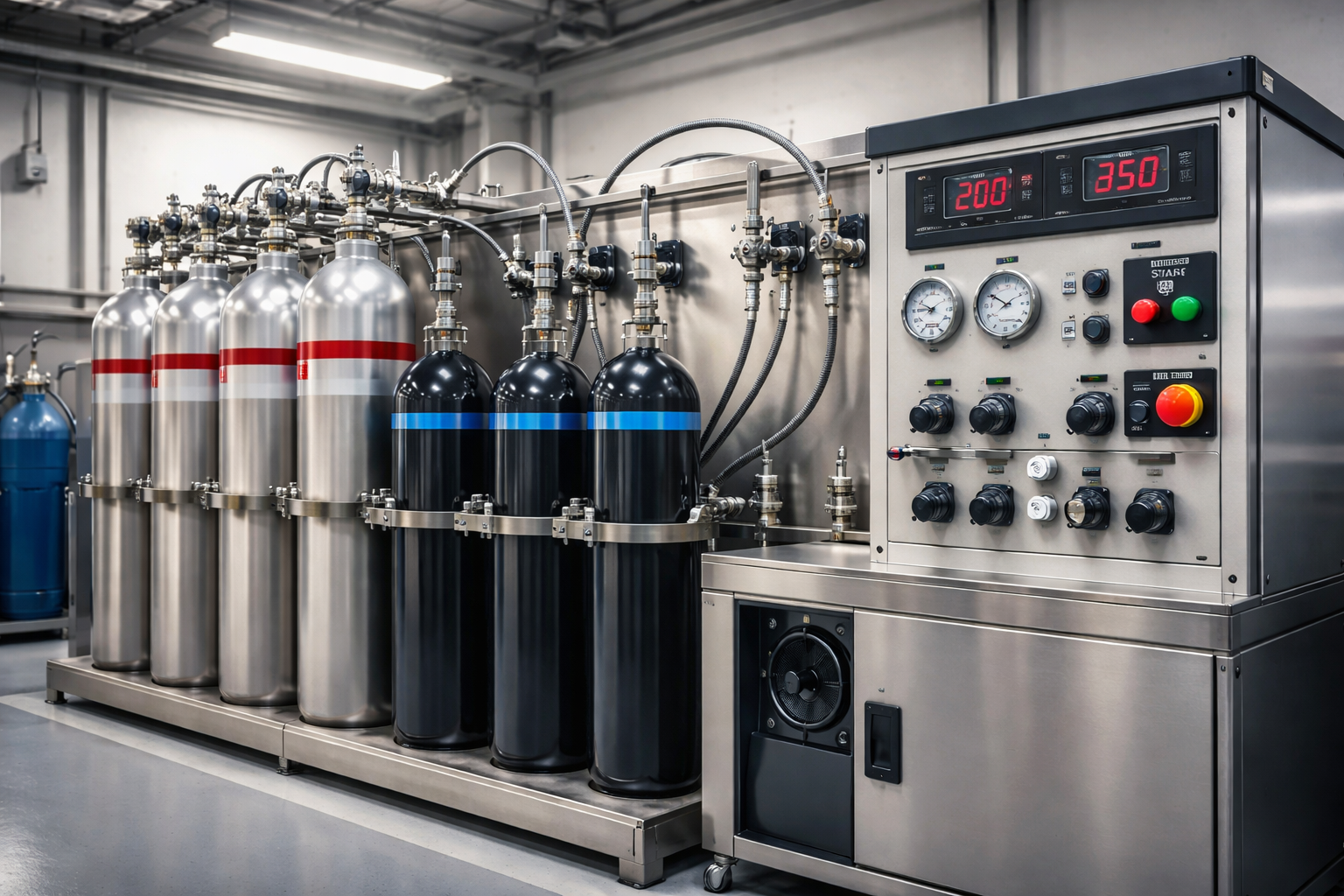
Gas filling systems are often treated as secondary equipment, yet in many engineering applications the accuracy and repeatability of gas charging directly affect system performance, safety, and long-term reliability. This is particularly true when working with carbon dioxide (CO₂) and nitrogen (N₂) in aerospace, defense, and industrial environments.
A CO₂–N₂ Filling System is designed to control, monitor, and manage the gas charging process under defined conditions, reducing variability and dependence on manual operation.
Importance of Controlled Gas Filling
Manual or semi-controlled gas filling relies heavily on operator judgement. Variations in filling rate, pressure stabilization, temperature during charging, and gas selection can introduce inconsistencies that may not be immediately visible but can impact performance later in service.
In systems where gas pressure or composition plays a functional role, such variations can lead to:
-
Inconsistent system behavior
-
Qualification or acceptance failures
-
Reduced operational life
-
Increased safety risk
Controlled gas filling minimizes these uncertainties.
What Is a CO₂–N₂ Filling System?
A CO₂–N₂ filling system is a dedicated setup used to safely charge components or cylinders with controlled quantities of CO₂ and nitrogen. The system ensures that the correct gas, pressure, and filling sequence are achieved consistently.
Typical system functions include:
-
Controlled pressurization
-
Accurate pressure monitoring
-
Safety interlocks and relief mechanisms
-
Clear operator indication during filling
This allows gas charging to be treated as a repeatable engineering process rather than a manual task.
Limitations of Manual Gas Filling
Basic gauge-based filling confirms that gas has been introduced, but it does not ensure that the process was carried out correctly or consistently. Factors such as pressure overshoot, insufficient stabilization time, or temperature effects during filling can result in significant variation between units.
A dedicated filling system helps eliminate these sources of error.
Applications of CO₂–N₂ Filling Systems
Aerospace and Defense
Gas-charged components are often part of safety-critical systems where predictable behavior and repeatability are essential.
Industrial Systems
CO₂ and nitrogen are widely used in industrial mechanisms where consistent charging improves reliability and reduces rework.
Production and Maintenance Facilities
Dedicated filling systems support standardized procedures, reduce operator error, and improve process traceability.
Modern CO₂–N₂ Filling Solutions
Modern filling systems typically integrate:
-
Pressure sensors and controlled valves
-
Defined filling sequences
-
Safety relief and interlocks
-
Clear human–machine interfaces
Solutions developed by Neometrix Group focus on aligning the filling process with real operational requirements, emphasizing safety, repeatability, and consistency.
🔗 Related system:
https://neometrixgroup.com/products/co2-n2-filling-system
Conclusion
A CO₂–N₂ filling system plays a key role in ensuring that gas-charged components perform as intended throughout their service life. By controlling the filling process and reducing variability, such systems help improve reliability, safety, and confidence in downstream performance.
Gas Cylinder Testing Equipment for USA, UK, Europe & the Middle East: Neometrix AVET systems are deployed at certified testing stations in the United States (DOT CFR-49), United Kingdom (HSE), European Union (EN 1968, PED), and Middle East (ESMA/SASO). We supply to testing facilities across UAE, Saudi Arabia, Germany, France, and the USA. Global commissioning and after-sales support is available.