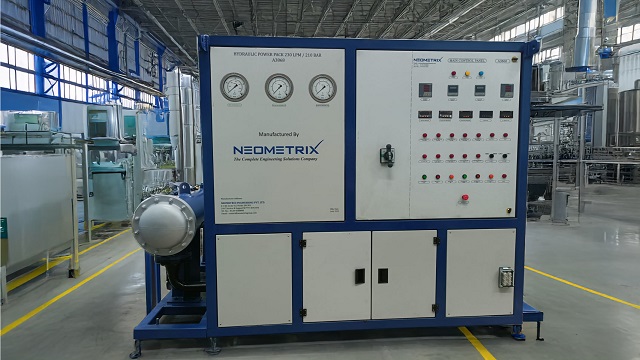

Servo-hydraulic actuators — the workhorses of structural fatigue testing, aerospace structural certification, and defence system simulation — require a continuous, stable supply of high-pressure hydraulic fluid at the flow rates needed to drive rapid, precise actuator movements. A hydraulic power pack (HPP) that is undersized, poorly filtered, or thermally unstable will compromise test results, damage precision servo valves, and create unsafe test conditions.
This guide covers the engineering requirements for hydraulic power packs serving servo-hydraulic test systems — including the 230 LPM/210 BAR specification required for high-force structural testing rigs.
What a Hydraulic Power Pack Does
A hydraulic power pack is the centralised power source for a hydraulic test system. It converts electrical power (motor) into hydraulic power (flow × pressure) and delivers clean, thermally stable, filtered fluid to servo valves and actuators.
Core components:
- Electric motor — typically 75–250 kW for structural testing applications
- Fixed or variable displacement pump — piston pump for high pressure applications
- Accumulator bank — stores energy for peak demand peaks without motor overload
- Cooling system — heat exchanger (water or air cooled) to maintain fluid temperature
- Filtration — typically 3-micron absolute for servo valve protection
- Reservoir — fluid storage, typically 500–2000 litres for large systems
- Control system — pressure regulation, temperature monitoring, fault protection
Why 230 LPM/210 BAR for Structural Testing?
Structural testing of aerospace components — wing sections, fuselage frames, landing gear, rotor heads — requires actuators that apply large forces at controlled rates. The force capacity of a hydraulic actuator is: F = P × A (pressure × bore area). At 210 BAR with a 200mm bore cylinder, this gives approximately 660 kN — typical for primary structure fatigue testing.
Flow rate determines actuator speed. At 230 LPM with a 200mm bore cylinder, peak actuator velocity is approximately 75 mm/sec — sufficient for full-spectrum fatigue loading up to 10 Hz.
For 24×7 continuous operation (standard in fatigue testing which runs millions of cycles), the HPP must be designed for continuous duty — not intermittent rating.
Key Specifications for Structural Test HPPs
| Parameter | Requirement | Why It Matters |
|---|---|---|
| Flow rate | 230 LPM continuous | Determines actuator speed capability |
| Pressure | 210 BAR | Determines actuator force capability |
| Duty cycle | 24×7 continuous | Fatigue tests run for weeks continuously |
| Fluid cleanliness | NAS 1638 Class 6 / ISO 4406 | Servo valves fail rapidly with contamination |
| Temperature stability | ±2°C at operating temp | Temperature affects fluid viscosity and servo valve calibration |
| Noise level | <75 dB(A) at 1m | Laboratory working environment requirements |
| Filtration | 3μm absolute | Beta ratio ≥200 at 3μm for servo valve protection |
International Standards
| Standard | Region | Application |
|---|---|---|
| ISO 4413 | International | Hydraulic fluid power safety rules |
| NAS 1638 | USA/International | Hydraulic fluid cleanliness for aerospace |
| ISO 4406 | International | Fluid cleanliness coding |
| ISO 10771-1 | International | Fatigue pressure testing of hydraulic components |
| ASTM D6158 | USA | Hydraulic oil specifications |
| EN 13849-1 | Europe | Safety of machinery control systems |
Applications
Aerospace structural certification: All major airframe OEMs (Airbus, Boeing, Embraer) run full-scale fatigue tests on new aircraft designs to 120,000+ simulated flight cycles. These tests run continuously for years, requiring HPPs designed for extreme reliability.
Defence vehicle testing: Armoured vehicle hull fatigue testing, weapon system recoil simulation, and vehicle suspension fatigue testing use high-force servo-hydraulic actuators requiring large HPPs.
Component fatigue testing: Landing gear, rotor heads, engine mounts, and composite structures are fatigue-tested on servo-hydraulic rigs at aerospace test laboratories worldwide.
Civil engineering: Bridge section fatigue testing, wind turbine blade testing, and seismic simulation tables use large servo-hydraulic HPPs.
Neometrix Hydraulic Power Pack 230-LPM/210-BAR
The Neometrix HPP 230/210 provides 24×7 continuous hydraulic power for servo-hydraulic structural test actuators with NAS 1638 Class 6 fluid cleanliness, integrated cooling, and ISO 4413 compliant safety systems.
FAQ
Q: What is the difference between fixed and variable displacement pumps in hydraulic power packs?
A: Fixed displacement pumps deliver constant flow regardless of pressure — excess flow goes over a relief valve (wasteful, generates heat). Variable displacement pumps reduce displacement when system demand drops, saving energy and reducing heat generation. For 24×7 structural testing, variable displacement piston pumps are preferred — they save significant energy during low-demand test phases and run cooler.
Q: Why is NAS 1638 Class 6 cleanliness required for servo valve protection?
A: Servo valves used in structural test actuators have internal clearances of 5–15 micrometres. Particles larger than these clearances cause wear, scoring, and sticking — degrading servo valve performance and ultimately causing failure. NAS 1638 Class 6 (equivalent to ISO 4406 14/12/9) limits particles to 640 particles >5μm per 100mL. 3-micron absolute filtration with Beta≥200 maintains this cleanliness continuously.
Q: What thermal management is required for 24×7 HPP operation?
A: Continuous operation at full load generates significant heat in the hydraulic fluid. Fluid operating temperature should be maintained between 40–60°C for optimal viscosity. This requires a water or air-cooled heat exchanger sized for the full thermal load (typically 20–40% of input power). Temperature sensors with automatic shutdown protect against overheating.
Neometrix Defence Ltd. manufactures hydraulic power packs for structural testing and defence applications. [email protected] | +91-7777-876-876