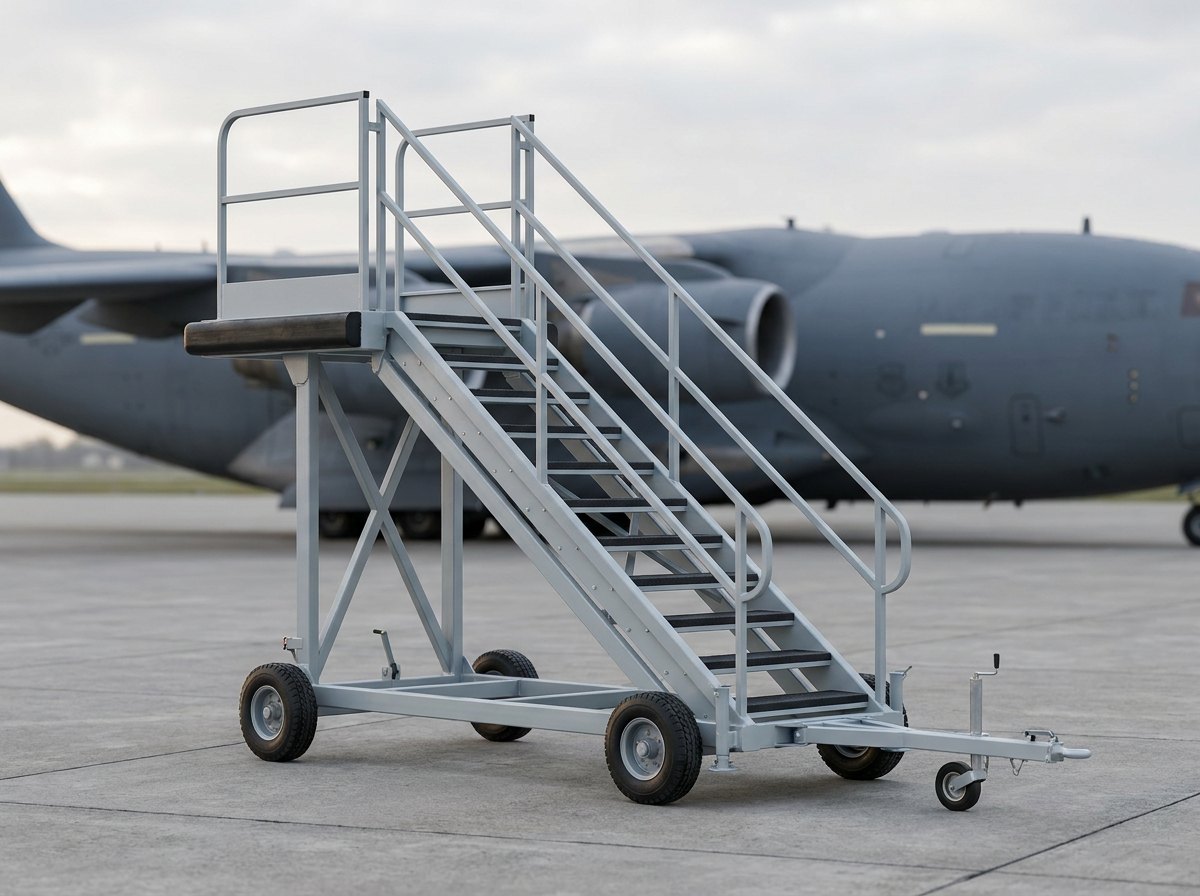

Every aircraft that lands — whether at a major hub like Heathrow, Dubai International, or Chicago O’Hare, or at a forward military airfield without a jet bridge in sight — needs a way for crew and passengers to board and disembark. When a jet bridge isn’t available or isn’t appropriate, aircraft access ladders and passenger steps fill this role. Getting the design, sizing, and safety features right isn’t just a matter of convenience — it has direct implications for ramp safety, aircraft skin protection, and regulatory compliance.
Two Distinct Types With Different Requirements
Passenger steps are designed for boarding and disembarking passengers. They need to accommodate the full range of passengers including those with limited mobility, match the door sill height of specific aircraft types, provide a stable, non-slip walking surface in all weather, and allow rapid connection and disconnection from the aircraft door frame without contact with the fuselage skin. Most large airport passenger steps are towable units — towed by a tug to the aircraft — though self-propelled versions exist for busy high-frequency operations.
Maintenance access ladders are used by engineering and maintenance crews to reach specific work areas: engine nacelles, avionics bays, fuselage skin panels at height, tail structures, and cockpit areas. These need precise height adjustability, stable platform surfaces wide enough to work from, and the structural strength to support personnel with tools and equipment.
Why Height Adjustability Is Non-Negotiable
Aircraft types vary enormously in door sill height. A regional turboprop like the ATR 72 has a main door sill at approximately 1.7m above ground; a Boeing 747-8 main deck door is at approximately 5.5m; an Airbus A380 upper deck door is at approximately 8.5m. Passenger steps that fix at one height serve only one aircraft type. Adjustable-height steps serve the full range.
For military airfields operating a mixed fleet — C-130J Hercules alongside C-17 Globemaster III, or Chinook CH-47 alongside AW101 Merlin — the range of heights is even wider, and the operational requirement for the steps to serve all aircraft types without dedicated sets for each type drives the need for broad adjustment range.
Key Safety Requirements
Anti-slip surfaces: Ramp surfaces and step treads must provide adequate slip resistance in wet conditions. Aluminium chequerplate, open-mesh grating, and GRP (glass-reinforced polyester) grating all provide better wet-condition grip than smooth painted steel. EN ISO 14122 in Europe specifies requirements for fixed means of access to machinery — the same anti-slip principles apply to aircraft access equipment.
Handrails at correct height: Passenger steps must have continuous handrails at a height that provides support for the full range of users, including children and elderly passengers. ICAO Airport Services Manual Part 4 (Ground Support Equipment) and IATA Ground Operations Manual (IGOM) both specify handrail requirements and dimensional guidance.
Wheel brakes and chocking: Towable steps must be chocked and braked before passengers board. A step unit that can move while passengers are on it is an unacceptable safety risk. Wheel lock mechanisms, parking brakes, and procedural chocking requirements are all part of the safety system.
Aircraft skin protection: The canopy or header frame at the top of passenger steps must approach the aircraft door frame without contacting and damaging the fuselage skin. Protective bumpers, controlled approach procedures, and careful dimensional design of the head frame prevent paint damage and skin denting that would require costly cosmetic or structural rectification.
Structural load rating: Steps must be rated for the maximum number of occupants (passengers plus crew) who could simultaneously be on the unit, with an appropriate safety factor. IATA IGOM provides guidance on the load assessment.
Military Airfield Applications
Passenger steps at military airfields have additional requirements. Quick deployment capability — the steps need to be positioned and ready faster than at a commercial airport where operations are more predictable. Operation by military personnel rather than specialist GSE operators means the steps need to be simple to operate correctly under time pressure. Robustness for a wider range of environments than the controlled ramp of an international airport. And in some cases, the ability to be airlifted or transported to deployed operating locations.
The Gulf region — with UAE Air Force, Royal Saudi Air Force, and Qatar Emiri Air Force all operating modern fixed-wing and rotary fleets — requires aircraft access equipment that meets both military operational requirements and the commercial aviation standards relevant to their international airport operations.
Neometrix Aircraft Access Ladders & Passenger Steps
Purpose-built access and boarding equipment for narrow-body, wide-body, and military aircraft types. Height-adjustable with anti-slip treads and platforms, aircraft skin protective header frames, wheel brakes, and structural ratings for airport and military airfield deployment.
→ View Full Specifications
→ Request a Quote
FAQ
Q: What height range do passenger boarding steps need to cover for common aircraft types?
A: For common narrow-body aircraft (Airbus A320 family, Boeing 737 series), the main cabin door sill is typically 3.0–3.8m above ground level. Wide-body aircraft (A330, A350, B777, B787) range from approximately 4.5–5.5m. For military transport aircraft, the range varies widely — a C-130J cargo ramp is at approximately 1.1m while a C-17 paratroop door is at approximately 2.7m. Adjustable steps with a broad height range serve multiple aircraft types from a single unit, which is the operationally practical solution for most airports and military airfields operating mixed fleets.
Q: What standards apply to airport passenger boarding step design?
A: The primary references are IATA Ground Operations Manual (IGOM) which covers GSE design requirements including passenger steps, ICAO Airport Services Manual Part 4 which addresses airport GSE broadly, and EN 1915 series (Ground Support Equipment — General Requirements) published by CEN (European Committee for Standardisation) which provides specific technical requirements for airport GSE including access equipment. In the UK, CAA CAP 642 (Airside Safety Management) addresses GSE safety management. Military airfield equipment may additionally reference STANAG or national military standards depending on the operating nation.
Neometrix Defence Ltd. designs and manufactures aircraft access ladders and passenger steps for airports, airlines, and military airfields. [email protected] | +91-7777-876-876