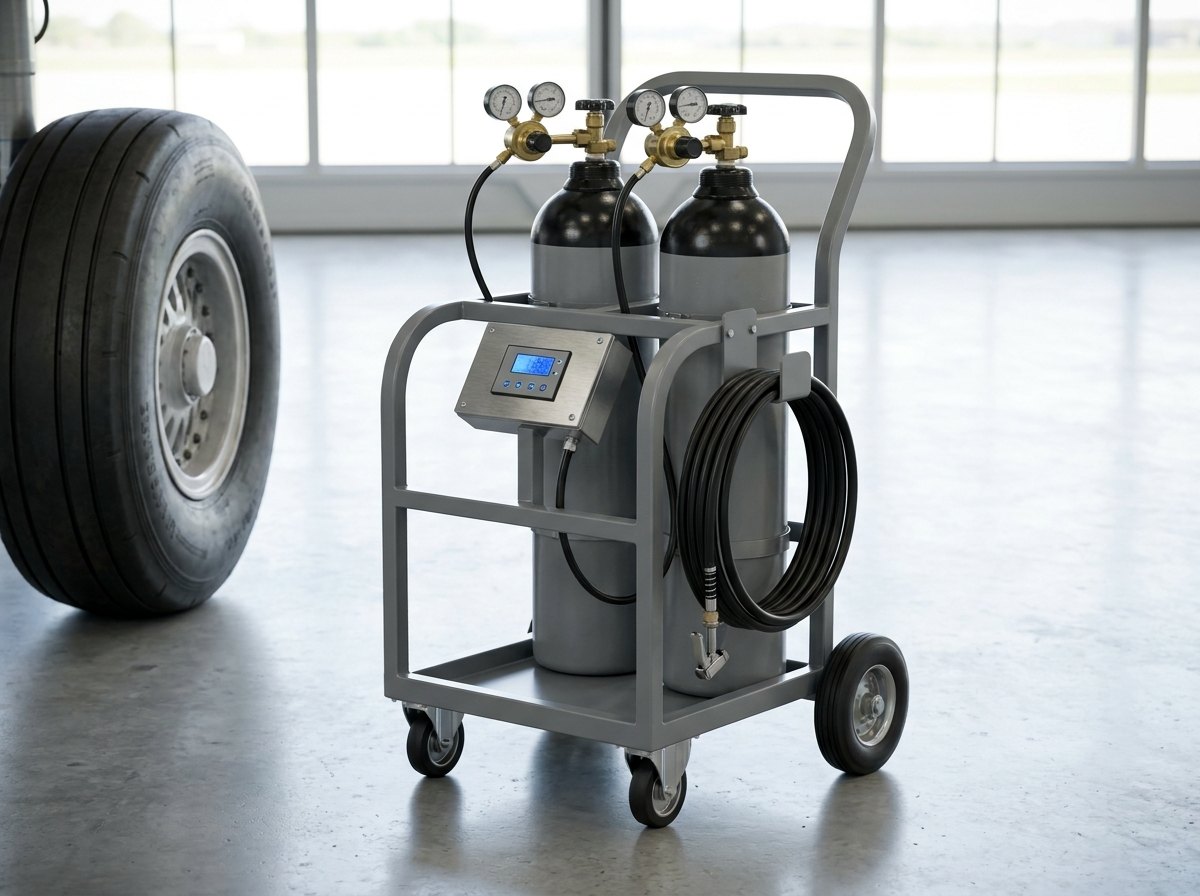

It’s a question that comes up in every aviation training programme: why do aircraft tyres use nitrogen rather than air? The answer is more nuanced than “because nitrogen is inert” — although that’s part of it. Understanding the engineering reasons helps explain why a dedicated nitrogen charging rig (rather than a workshop compressor with a tyre inflator) is the correct equipment for this task.
Why Nitrogen, Not Compressed Air
No moisture. Atmospheric air contains water vapour. When you compress air into a tyre at 200 psi (approximately 14 bar), the moisture content concentrated into a much smaller volume. In cold conditions at altitude — which aircraft tyres experience in the wheel wells during cruise — this moisture can freeze, potentially icing over the tyre valve or forming condensation inside the wheel assembly that contributes to corrosion of the wheel rim. Nitrogen, when supplied from proper sources to MIL-PRF-27401 specification, has a dew point of -40°C or lower — the water content is negligible.
Consistent pressure variation. Because dry nitrogen has virtually no water vapour content, its pressure variation with temperature is governed almost entirely by the ideal gas law. Air containing significant moisture has an additional pressure contribution from the water vapour, whose contribution changes with temperature. Nitrogen-inflated tyres show more predictable pressure changes with temperature — a useful property when calculating tyre pressure corrections for significant temperature changes between cold parking and hot runway conditions.
No oxygen. Aircraft tyre failures at high speed are energetic events. Main gear tyres on heavy aircraft braking from high speed can reach 200°C and above. The presence of oxygen inside a tyre at these temperatures creates a combustion risk if the tyre fails and the inner surface is exposed to the hot gas. Nitrogen, being inert, eliminates this risk. This argument is particularly significant for military aircraft operating with tyres that may be stressed beyond normal commercial operating margins.
No contamination. Workshop compressed air may contain oil carryover from the compressor, despite filters. Oil inside an aircraft tyre wheel assembly contributes to rubber degradation over time and creates contamination of wheel bearing and brake areas during tyre removal. Nitrogen from MIL-PRF-27401 supply has specified maximum oil content.
What a Nitrogen Charging Rig Does
The task of charging a tyre to the correct pressure sounds simple — connect to the valve, open the gas supply, inflate to the specified pressure, disconnect. In practice, correct aircraft tyre charging involves several steps that benefit from dedicated equipment:
Pressure specification: The Aircraft Maintenance Manual specifies tyre inflation pressure as a function of temperature, aircraft load configuration, and sometimes tyre age. The applicable pressure is not simply “the number on the tyre” — it must be calculated or looked up from the AMM for the specific conditions. The charging rig must be capable of accurately controlling and measuring the final pressure.
Pressure measurement accuracy: Aircraft tyre pressures are specified precisely — main gear tyres on commercial aircraft to ±5 psi (±0.35 bar) or better. The rig’s pressure gauges must be calibrated to provide this accuracy. Uncalibrated workshop gauges may have errors of 5–10% or more, which translates to significant over- or under-inflation.
Nitrogen purity verification: For military applications, the nitrogen source should be verified against MIL-PRF-27401 requirements. Commercial aviation accepts nitrogen from BOC/Air Liquide supply cylinders with appropriate purity certification.
Portable deployment: Tyre charging is performed at the aircraft’s parking position, not in a workshop. Military forward operations may require nitrogen charging at airbases with limited infrastructure. A portable nitrogen charging rig with integral cylinder supply, calibrated gauges, and the connections for the aircraft’s tyre valves is the operationally practical solution.
Correct Inflation Matters More Than Many Realise
Under-inflation is the most common and consequential tyre inflation error in aviation:
- An under-inflated tyre runs hotter because the sidewall flex generates more heat per revolution
- The contact patch is larger and more irregular, increasing wear and creating heat concentrations
- The tyre may “bottom out” — the sidewall contacts the wheel rim under heavy braking loads — causing sudden and potentially catastrophic structural failure
- Ground handling characteristics change: aircraft may veer on takeoff or landing roll
Over-inflation has its own consequences — harder ride, increased susceptibility to cut damage on runway debris, and a smaller contact patch that concentrates the static load.
Aviation safety regulators and aircraft manufacturers treat tyre inflation as a safety-critical maintenance task. FAA Advisory Circular AC 43.13-1B includes specific guidance on tyre inflation procedures. EASA and UK CAA equivalent guidance is embedded in aircraft-specific AMM requirements.
Neometrix Aircraft Tyre Nitrogen Charging Rig
A portable, deployable nitrogen charging unit with calibrated precision pressure gauges, nitrogen supply integration, aircraft-compatible tyre valve connections, and the pressure range needed for military and commercial aircraft tyre inflation across nose and main gear applications.
→ View Full Specifications
→ Request a Quote
FAQ
Q: What pressure should aircraft tyres be inflated to?
A: Aircraft tyre inflation pressure is aircraft-specific and is found in Chapter 12 (Servicing) or Chapter 32 (Landing Gear) of the Aircraft Maintenance Manual. The correct pressure depends on the aircraft type, the specific tyre position (nose versus main gear), the ambient temperature at time of inflation, and in some cases the aircraft’s configuration (fuel load affects the required gear tyre pressure in some aircraft). Never inflate to a pressure from memory or from the tyre markings alone — always refer to the current AMM for the specific aircraft registration.
Q: What is MIL-PRF-27401 for aircraft nitrogen?
A: MIL-PRF-27401 is the US military performance specification for Nitrogen, Technical (also called Technical Grade Nitrogen) for use in aircraft systems. It specifies minimum purity (99.5%), maximum dew point (≤-40°C), maximum oxygen content (≤0.5%), and maximum oil content. Compliance with MIL-PRF-27401 ensures the nitrogen used in aircraft tyre and pneumatic system servicing meets the purity and moisture standards required for aircraft use — preventing moisture ingress, oxygen enrichment, and oil contamination in tyres and struts. NATO nations reference an equivalent national standard; UK usage follows the MoD technical specifications derived from the same requirements.
Neometrix Defence Ltd. manufactures aircraft tyre nitrogen charging rigs for military and commercial aviation ground support. [email protected] | +91-7777-876-876