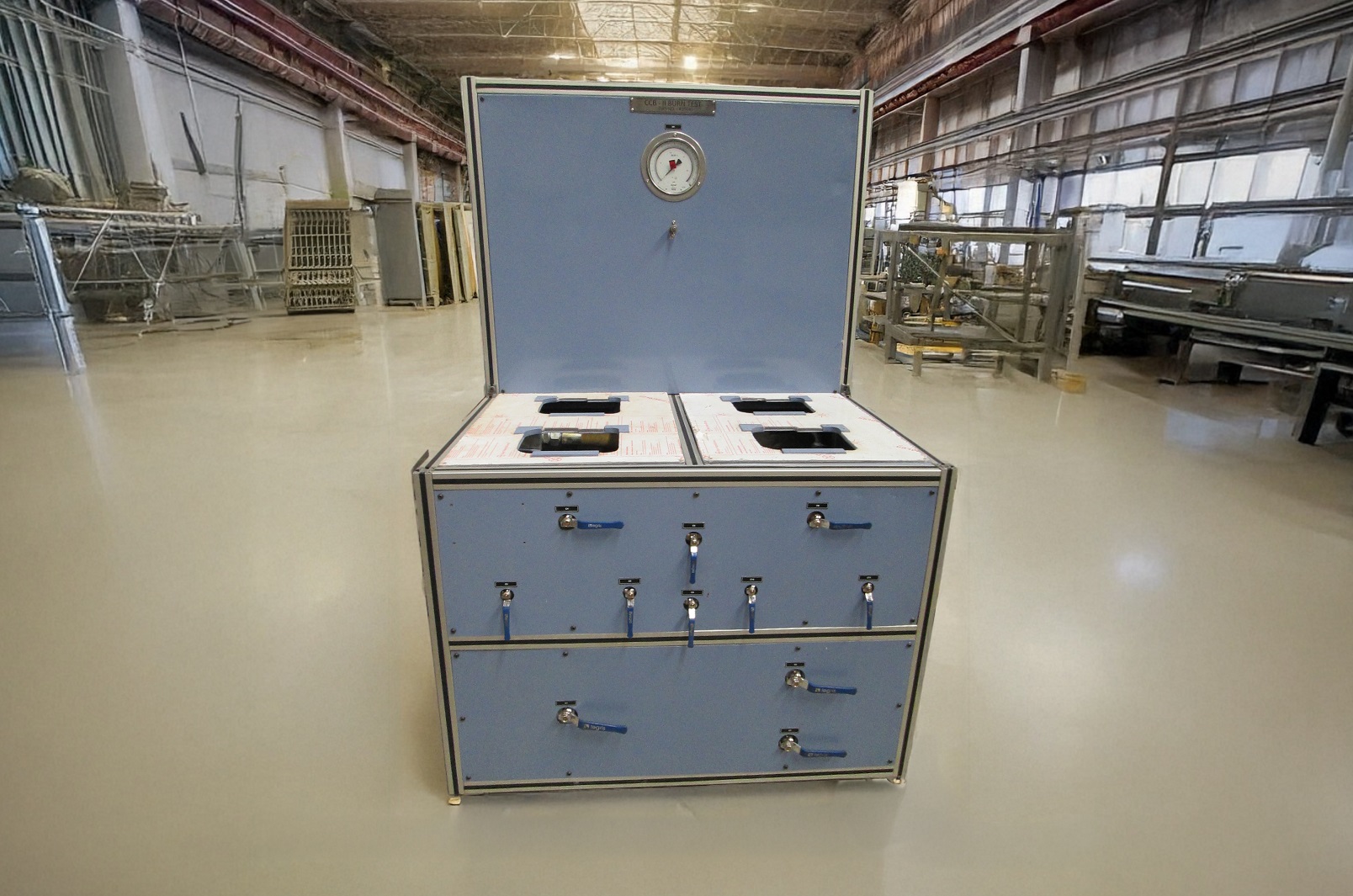

One of the most important safety requirements for modern military munitions is insensitivity to unintended thermal stimuli — specifically, the requirement that a munition that catches fire in a storage area or burning vehicle does not detonate or produce hazardous fragmentation at the level that a fully functioning round would. This requirement, known as Insensitive Munitions (IM) compliance, is tested through a series of standardised thermal tests including cook-off tests (slow and fast heating until reaction occurs) and confined burning tests (burning the munition directly in its storage configuration).
A CCB (Cook-off/Confined Burning) Burn Test Rig provides the controlled heating environment needed to perform these thermal vulnerability assessments under controlled, repeatable, instrumented conditions — generating the data needed to characterise a munition’s thermal response and demonstrate IM compliance per international standards.
Why Insensitive Munitions Testing Matters
Military history contains numerous accidents where munitions stored in burning vehicles, ships, or magazines initiated sympathetically — with catastrophic consequences disproportionate to the original fire. The USS Forrestal fire (1967), the HMS Sheffield sinking (1982), and multiple ammunition depot accidents have all involved munitions that detonated rather than burning when exposed to fire. Insensitive Munitions requirements were developed specifically to prevent this class of accident.
Modern defence procurement in NATO countries and many others requires new munitions to pass IM tests demonstrating that when subjected to fire, they react in the least violent manner possible — ideally burning rather than detonating, and not producing hazardous fragmentation beyond a defined radius.
CCB Test Types
Slow cook-off test: The munition is heated at a slow, controlled rate (typically 3.3°C/hour per MIL-STD-2105) until thermal initiation occurs. This simulates exposure to a slow-developing fire such as a burning building or warehouse. The test determines the temperature at which the munition initiates and characterises the violence of the reaction.
Fast cook-off test: The munition is placed in a jet fuel or pool fire, simulating a rapid, intense fire such as a post-impact fuel fire on an aircraft carrier deck or vehicle. The test determines how quickly the munition reacts in an intense fire environment and characterises the reaction violence.
Confined burning test (CCB): The munition is enclosed in its shipping/storage container or a defined confinement, then subjected to burning. This tests whether the combined effect of fire and confinement affects the reaction character — some munitions that react acceptably in open burn may react more violently when confined.
What the Test Rig Measures
Reaction time: Time from initiation of heating to munition reaction — important for characterising the warning time available before a stored munition initiates in a fire scenario.
Reaction violence classification: The reaction is classified on a standard scale (burn, deflagration, explosion, detonation) based on overpressure measurements, fragment recovery, and damage assessment at defined distances. MIL-STD-2105 and STANAG 4240 define the classification criteria.
Temperature profile: Continuous temperature measurement throughout the test via multiple thermocouples tracks the thermal history of the munition and its components.
Fragment projection: Fragment capture screens around the test site determine the number, size distribution, and projection distance of any fragments — key data for hazard radius determination.
International Standards
| Standard | Scope |
|---|---|
| MIL-STD-2105 | USA — Hazard assessment tests for non-nuclear ordnance |
| STANAG 4240 | NATO — Liquid fuel/external fire (fast cook-off) test |
| STANAG 4396 | NATO — Slow cook-off test |
| AOP-39 | NATO — Guidance on assessment of munitions for IM |
| DEF STAN 07-85 | UK MoD — IM requirements |
Applications
New munition qualification: New warheads, missiles, bombs, and artillery shells must pass IM tests as part of the qualification process for NATO countries and many other defence forces.
Modified munition re-qualification: Any significant design change — new explosive fill, new casing material, changed fuze — may require partial or full IM re-testing to confirm the change has not degraded IM performance.
Research and development: CCB test rigs are used in R&D to screen new explosive formulations and munition designs for IM characteristics before committing to full qualification test programmes.
Supplier qualification: Defence procurement agencies require manufacturer demonstration of IM test capability and results before approving munition suppliers.
Neometrix CCB Burn Test Rig
A controlled thermal testing platform for slow cook-off, fast cook-off, and confined burning (CCB) tests on munitions and explosive components per MIL-STD-2105, STANAG 4240, and STANAG 4396. Instrumented with multiple thermocouples, overpressure gauges, and fragment capture systems. Designed and operated with full safety exclusion zone compliance.
→ View Full Specifications
→ Request a Quote
FAQ
Q: What is a cook-off test and what does it tell you about a munition?
A: A cook-off test heats a munition at a controlled rate until it thermally initiates, revealing the temperature at which the explosive fill reacts, how quickly it reacts once initiation begins, and the violence of the reaction (burn, deflagration, or detonation). This information determines the munition’s thermal hazard in fire scenarios and its classification against IM criteria — whether it behaves as required for Insensitive Munitions compliance or poses unacceptable hazard.
Q: What is the difference between slow cook-off and fast cook-off?
A: Slow cook-off heats the munition gradually (typically 3.3°C/hour) simulating a slow-developing fire exposure — for example, a munition left in a building that catches fire and burns for hours before the munition initiates. Fast cook-off immerses the munition directly in an intense fire (jet fuel pool fire) simulating rapid fire exposure — for example, a fuel fire on a carrier deck or in a burning vehicle. The two tests characterise different threat scenarios and typically produce different reaction characteristics because the explosive fill and casing have different time and temperature profiles.
Q: What is the reaction violence scale used in IM testing?
A: International IM standards use a standard reaction violence classification scale from Type I (detonation — most violent, produces full blast and fragmentation) through Type V (burn — least violent, no significant blast or fragmentation beyond the immediate burning area). Type II is partial detonation, Type III is explosion, Type IV is deflagration. IM requirements typically specify that a munition must achieve no worse than Type IV (deflagration) or Type V (burn) reaction in the applicable IM tests — meaning it should not produce the full blast overpressure and fragment hazard of a functioning detonation when exposed to fire.
Neometrix Defence Ltd. designs and manufactures CCB burn test rigs for insensitive munitions thermal vulnerability assessment. [email protected] | +91-7777-876-876